
NEET Score Required for MBBS in Russia: Eligibility Guide
September 15, 2026
If you scored low on NEET and think MBBS abroad is off the table, that’s not quite true for Russia. Every year, thousands of Indian students ask the same question before they even open an application form: how much NEET score is required for MBBS in Russia? The honest answer surprises most families, because Russian medical universities don’t set a minimum NEET cutoff the way Indian colleges do under NEET counseling.
What actually matters is that you qualify NEET, meaning you clear the minimum qualifying marks set by the NMC (currently around 50th percentile for general category), not that you hit a specific score threshold. Universities in Russia care more about your 12th-grade PCB percentage and passport eligibility than your NEET rank, which is why students who didn’t get a seat in India through counseling still get admitted abroad.
In this guide, we’ll break down the real eligibility criteria for MBBS education in Russia, including NEET qualifying marks by category, academic requirements, age limits, and what NMC recognition actually depends on, so you can plan your application with facts instead of rumors.
Why your NEET score matters for MBBS in Russia
NEET works differently for MBBS abroad than it does for domestic counseling, and that difference is exactly why so many students get confused. Indian medical colleges use your NEET rank to allot seats through a competitive counseling process, so a lower score genuinely locks you out. Russian universities don’t run seat allotment based on NEET rank at all. They use NEET as a pass/fail eligibility filter required by India’s National Medical Commission (NMC), not as a ranking tool for admission.
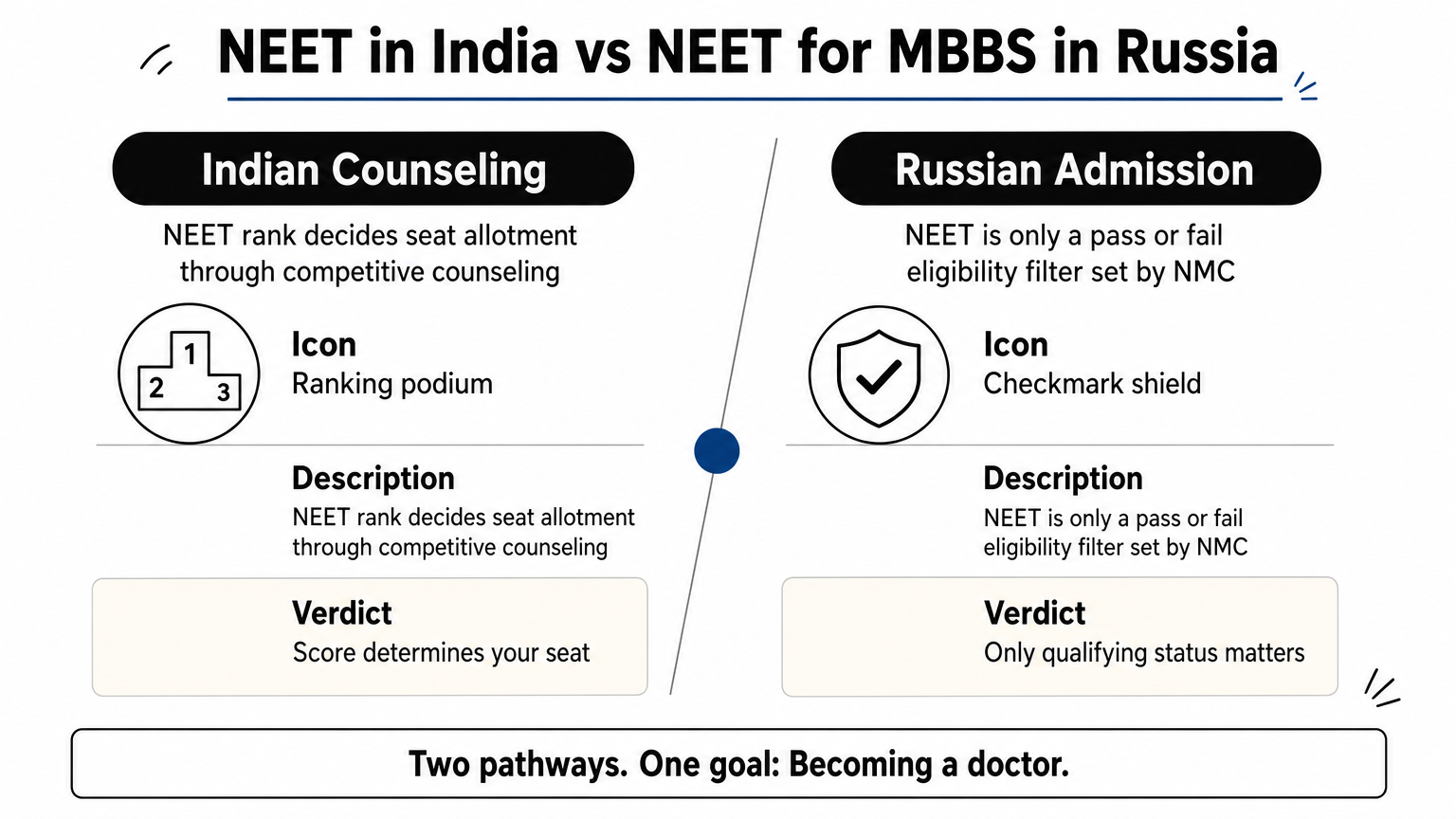
Your NEET score decides whether you’re eligible to study medicine abroad, not how good a doctor you’ll become or which Russian university will accept you.
Here’s the part most coaching centers don’t explain clearly: the NMC requires every Indian student pursuing an MBBS abroad to have qualified NEET in the same academic year they seek admission, or in a prior attempt, before their foreign medical degree can even be considered for licensing back home. "Qualifying" means crossing a minimum percentile, not achieving a specific score. That percentile changes slightly by category:
| Category | Minimum Qualifying Percentile |
|---|---|
| General | 50th percentile |
| General-EWS | 45th percentile |
| OBC / SC / ST | 40th percentile |
| PwD (General) | 45th percentile |
| PwD (OBC/SC/ST) | 40th percentile |
Source guidance aligns with NMC’s published eligibility norms for foreign medical study.
It’s a licensing requirement, not an admission requirement
Russian universities themselves don’t check your NEET percentile during the admission process, since it’s an Indian regulatory requirement, not a Russian one. Institutions in Moscow, Kazan, or Ufa, one of the cheapest cities to study medicine in Russia, evaluate your 10+2 marksheet, your PCB percentage, and your passport, then issue an offer letter. What NEET actually protects is your ability to sit for the Foreign Medical Graduate Examination (FMGE) or the newer National Exit Test (NExT) once you return to India with your degree. Skip qualifying NEET, and no amount of academic excellence in Russia will let you register as a doctor in India.
So when families ask about the required score, the real question isn’t
How to check if your NEET score meets Russia’s requirements
Checking your eligibility takes five minutes if you know where to look, and it saves you weeks of anxiety later. Start with your NEET scorecard, which lists your percentile, not just your raw marks out of 720. Coaching centers often quote a "minimum NEET score for MBBS abroad" as if it were a fixed number like 350 or 400, but that’s misleading. The NMC only cares about the percentile band tied to your category, so a 320 for a General category student who lands above the 50th percentile clears the bar just as well as a 550 would.
Don’t chase a target score. Chase the qualifying percentile that matches your category, and everything else falls into place.
Steps to confirm you’re eligible
Run through this checklist before you start shortlisting Russian universities:
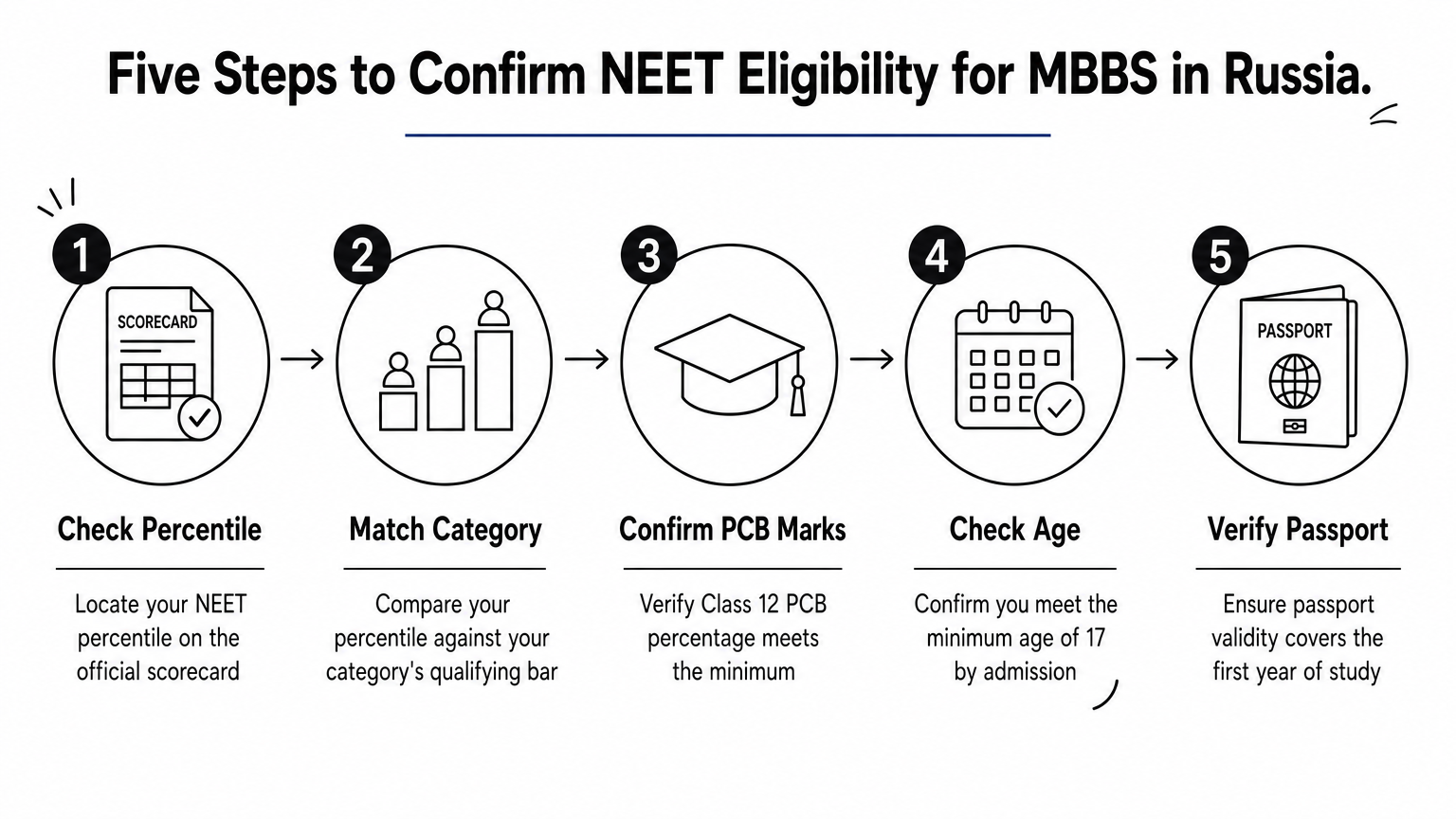
- Locate your NEET percentile on the official scorecard from the National Testing Agency, not just the marks.
- Match it against your category using the qualifying percentile table (50th for General, 40th for SC/ST/OBC, and so on).
- Confirm your PCB percentage in Class 12 meets the standard 50% minimum (40% for reserved categories) that Russian universities and the NMC both expect.
- Check your age on the date of admission. Most Russian medical programs require you to be at least 17.
- Verify passport validity for at least the first year of your course, since universities need this for the invitation letter.
Once you’ve ticked all five, you’re not "borderline eligible," you’re simply eligible, full stop.
Where students go wrong here
Some families call agents asking for the "NEET cutoff for MBBS in Russia" as if there’s a secret number the university withholds. There isn’t one. What actually varies is how strict individual universities are about your PCB percentage and English-taught medical programmes, which we cover next. If your percentile clears NMC’s threshold, that part of your eligibility is settled, and RUSBASE’s free consultation can confirm the rest against a specific university’s requirements within a day.
NEET score expectations across different Russian universities
Here’s something that surprises most applicants: no Russian medical university publishes its own NEET score requirement, because none of them look at your percentile in the first place. Whether you’re applying to Kazan Federal University’s MBBS programme, Bashkir State Medical University in Ufa, or a Moscow-based institution, the admission committee reviews your 12th-grade transcript and passport, not your NEET scorecard. That document only becomes relevant later, when the NMC checks it for licensing eligibility.
The NEET score you need for MBBS in Russia is the same at every university, because it’s a national eligibility filter, not a campus-specific cutoff.
What actually differs across universities is the academic and language bar they set independently. Some accept a straight 50% in PCB, others ask for slightly higher marks if the program is oversubscribed. A few campuses, such as the seaside medical campus in Sevastopol or those in Novosibirsk, run a short interview or basic science quiz for borderline applicants, though this is rare and never tied to NEET.
A quick comparison
| University | City | Typical PCB Requirement | English Test Required |
|---|---|---|---|
| Kazan Federal University | Kazan | 50% | No |
| Bashkir State Medical University | Ufa | 50% | No |
| Novosibirsk State Medical University | Novosibirsk | 50% | No |
| Sevastopol State University | Sevastopol | 55% | No |
Notice that the NEET qualifying score for MBBS admission never appears in this table, because it’s not something universities individually enforce. RUSBASE tracks these institution-level differences directly across the best medical universities in Russia for international students, since published tuition and admission norms change slightly year to year, and matching your profile against the right campus matters far more than obsessing over a NEET number that’s already settled once you’ve qualified. If a university claims it needs a specific NEET score to admit you, that’s a red flag worth raising with your consultant before you sign anything or send a deposit.
Eligibility criteria beyond your NEET score
Qualifying NEET only opens the door. Russian universities also check a set of academic and personal criteria before they issue an offer letter, and skipping over these is where many applications stall. Age at the time of admission matters just as much as your marksheet, since most institutions require you to turn 17 by December 31 of your admission year, and a handful of programs set the bar at 18. Passport validity is another quiet requirement: your document needs to cover at least the first year of study, because the university’s invitation letter for a Russian student visa is tied to it.
Beyond age and passport, your academic transcript carries real weight. Universities want a Class 12 certificate showing Physics, Chemistry, and Biology as core subjects, with the standard 50% aggregate for general category applicants and 40% for reserved categories. This is separate from your NEET percentile and gets checked independently during document verification.
Your NEET percentile gets you past the licensing gate. Your transcript, age, and passport get you past the university’s own gate, and both have to line up.
What documents universities actually verify
Here’s the shortlist of documents needed to apply to a Russian university that RUSBASE walks students through before submitting any application:

- 10th and 12th mark sheets, attested and translated where required
- NEET scorecard, showing percentile rather than raw score
- Passport, valid well beyond the first year of the course
- Migration and transfer certificates, if applicable
- Medical fitness certificate, including HIV test results some universities request
Submitting these together, rather than piecemeal, cuts weeks off your admission timeline.
Registration nuances also come up for students who took a gap year or resat Class 12 exams. Universities generally accept both, but they’ll ask for a clear explanation and the relevant certificates, so keep your paperwork organized rather than scattered across old files. Verifying every one of these details before you apply, rather than after you’ve paid a deposit, is exactly the kind of check RUSBASE’s university shortlisting service runs for each student against a specific institution’s current requirements.
Common mistakes to avoid when applying with your NEET score
Applying without qualifying NEET at all is the single biggest error families make, and it’s the one that costs the most later. Some students assume that as long as they’ve appeared for the exam, they can start their MBBS abroad journey and sort out the licensing paperwork afterward. That’s backwards. If your percentile falls below the qualifying bar for your category, no Russian degree, however good, will let you sit for FMGE or NExT once you’re back home. Confirm your qualifying status before you spend a rupee on documentation or travel.
Agents who promise a guaranteed seat based on your raw NEET marks are another red flag worth spotting early. Since Russian universities don’t rank applicants by NEET score, anyone quoting a specific number as a cutoff is either misinformed or trying to upsell you on a "premium" package you don’t need.
The moment someone quotes you a NEET score for admission instead of a qualifying percentile, that’s your cue to ask harder questions.
Mistakes that can derail your application
Beyond the score itself, a handful of paperwork slip-ups show up again and again in stalled files:
- Mismatched name spellings across your passport, marksheets, and NEET admit card, which delays visa invitation processing
- Ignoring your PCB percentage while assuming NEET percentile alone covers eligibility
- Skipping WHO and NMC recognition checks for the specific university, not just "Russia" as a country
- Waiting until the last month to apply, since invitation letters and visa slots take real time to process
Underestimating document translation timelines is a quieter but common problem too. Universities need attested, translated transcripts before they’ll issue an offer, and rushing this step often means resubmitting paperwork weeks later. Working with a consultant who checks your NEET qualifying status and university-specific requirements together, rather than treating them as separate boxes to tick, is what keeps an application on schedule instead of stuck in review.
Making sense of your NEET score for Russia
Getting into MBBS in Russia was never about chasing a magic number. Once you clear the NEET qualifying percentile for your category, that box is ticked for good, and the rest of your application depends on your PCB percentage, age, passport validity, and the specific university’s own document checks. Families who understand this early save themselves months of anxious searching for a "cutoff" that simply doesn’t exist.
Treat your NEET scorecard as a pass/fail gate, not a competition, and put your energy into choosing a WHO-recognized university that fits your budget and city preference instead. That’s where real decisions get made, and where a wrong choice actually costs you time and money.
If you’ve qualified NEET and want a straight answer on which Russian university fits your marks, budget, and city preference, talk to a RUSBASE adviser based in Russia and get a realistic shortlist within a day, free of charge.
Questions About Your Own Case?
Requirements depend on your nationality and subject. Ask us directly — free.
Book a Free Consultation