
MBBS Fees in Russia: Complete Cost Guide for Indian Students
September 17, 2026
Every family we talk to asks the same question first: what will an MBBS in Russia actually cost, all in? If you have been searching russia fees for mbbs and getting vague answers or "contact us for pricing" pages, that confusion is exactly what pushes students to skip good options or overpay for average ones. You need real numbers before you commit two years of savings and six years of your child’s life to a decision.
Here is the direct answer: tuition for MBBS in Russia typically runs $3,400 to $11,000 a year, depending on the university and city, which works out to roughly ₹2.8 lakh to ₹9 lakh annually, far below the ₹40 lakh to ₹1 crore families spend in the UK, US, or Canada. Add living expenses in Russia of $150 to $300 a month for hostel, food, and transport, and you get a full six-year budget most Indian families can plan around with confidence.
In this guide, we break down the fee structure by university, city-wise cost differences across Moscow, Kazan, Ufa, and Novosibirsk, hidden costs to budget for, and how WHO/NMC-recognized programs compare on price and value.
Why MBBS fees in Russia are lower than other countries
Parents often assume low tuition means low quality, but that is not how the Russian system works. Russia mbbs fees stay low mainly because the government funds a large share of medical education through public universities, keeping the base cost of running a medical faculty far below what private colleges in India or universities in the West charge. On top of that, Russia has a surplus of seats compared to domestic demand in many cities, so universities compete for international students by keeping fees transparent and reasonable rather than negotiating case by case.
Public funding keeps tuition down
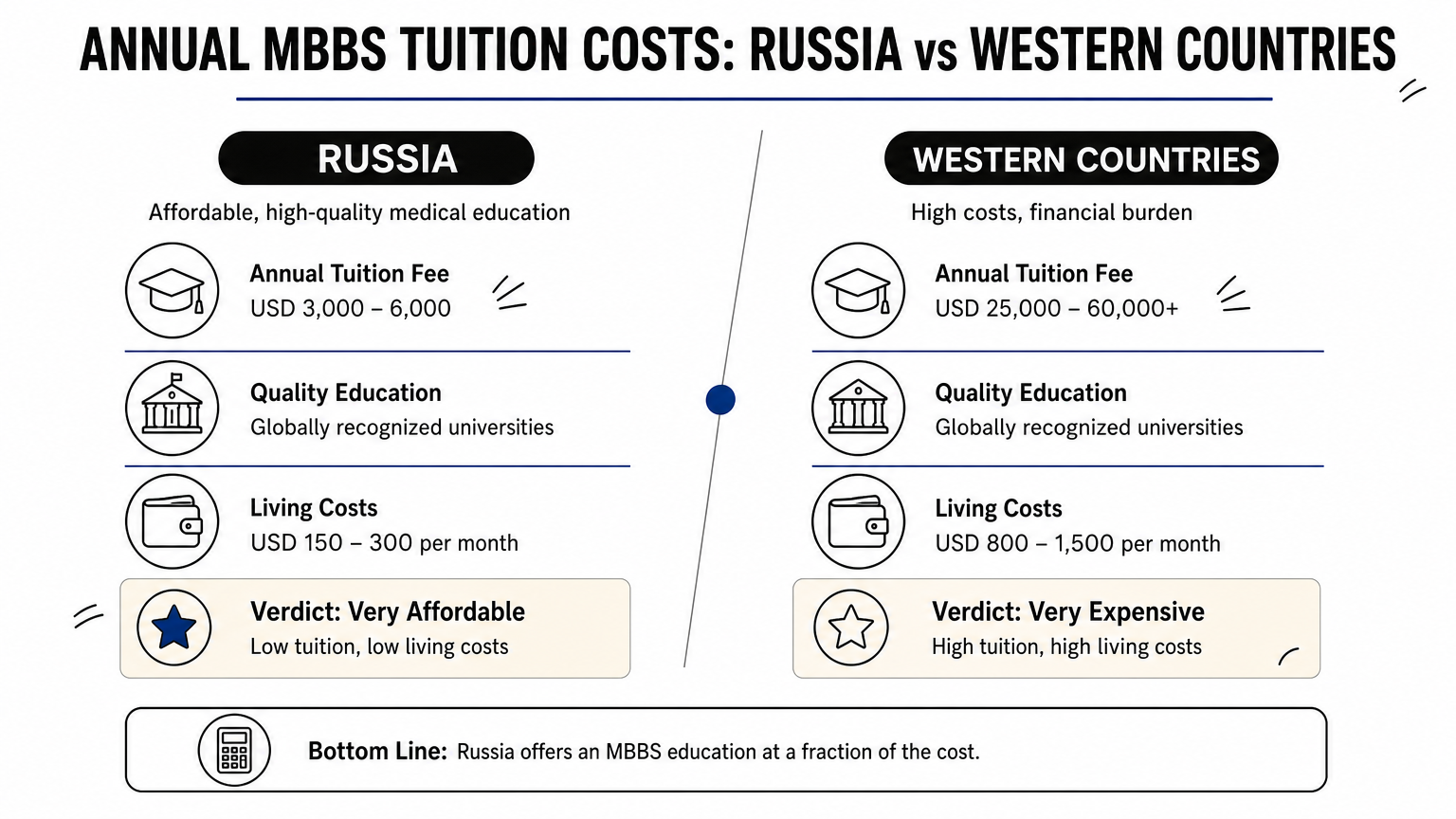
Unlike private medical colleges in India that charge ₹50 lakh to ₹1.5 crore for a full MBBS course, most Russian medical universities are state institutions. The government covers infrastructure, faculty salaries, and hospital tie-ups through public budgets, so the fee charged to students, domestic or international, only needs to cover a portion of the actual running cost. That is why mbbs fees russia programs rarely cross $11,000 a year even at well-ranked universities in Moscow or Saint Petersburg.
Russian medical universities charge less because the state, not the student, funds most of the infrastructure.
Lower cost of living translates into lower fees
Cities outside Moscow, places like Ufa, Kazan, and Novosibirsk, have a much lower cost of living than Western capitals, and university fee structures reflect that reality. Rent, utilities, lab equipment, and staff wages all cost less in these regions, so the university can charge less without cutting corners on teaching hours or clinical exposure. This is a big reason mbbs in russia low fees options cluster in these second-tier cities rather than in Moscow alone, where costs run somewhat higher due to rent and demand.
Currency conversion works in your favor
The Russian ruble has historically traded at a rate that makes dollar-denominated or ruble-denominated fees convert favorably into Indian rupees, especially compared to the British pound or US dollar tuition quoted by UK and American medical schools. When you calculate mbbs in russia fees in indian rupees, a $5,000 annual fee lands around ₹4.2 lakh at typical exchange rates, a fraction of what a single semester might cost in London or New York. Currency swings do happen, so it is worth checking the current INR-to-ruble or INR-to-dollar rate before you lock in a payment schedule, but the gap between Russia and Western options stays wide even after adjusting for fluctuations.
No entrance exam industry inflating costs
Unlike some countries where a parallel industry of test prep, donation seats, and management quotas drives up the real cost of a medical seat, Russian admission runs on transparent academic criteria and does not require IELTS or TOEFL for most partner programs. That removes an entire layer of hidden expense, coaching fees, donation payments, capitation charges, that Indian students often face when chasing a private medical seat at home. According to the World Health Organization’s World Directory of Medical Schools, Russian medical universities appear on the same recognized list as institutions in far more expensive countries, so you are not trading recognition for savings.
| Country | Typical Annual Tuition (USD) | Approx. INR Equivalent |
|---|---|---|
| Russia | $3,400 – $11,000 | ₹2.8 lakh – ₹9 lakh |
| UK | $20,000 – $35,000 | ₹16.6 lakh – ₹29 lakh |
| USA | $30,000 – $60,000 | ₹25 lakh – ₹50 lakh |
| India (private) | $6,000 – $18,000 | ₹5 lakh – ₹15 lakh, plus donation |
Zero in on this table when you compare options, because it shows why families researching russia me mbbs fees kitni hai consistently land on Russia once they see tuition side by side with the UK, US, and private Indian colleges.
How to calculate your total MBBS in Russia budget
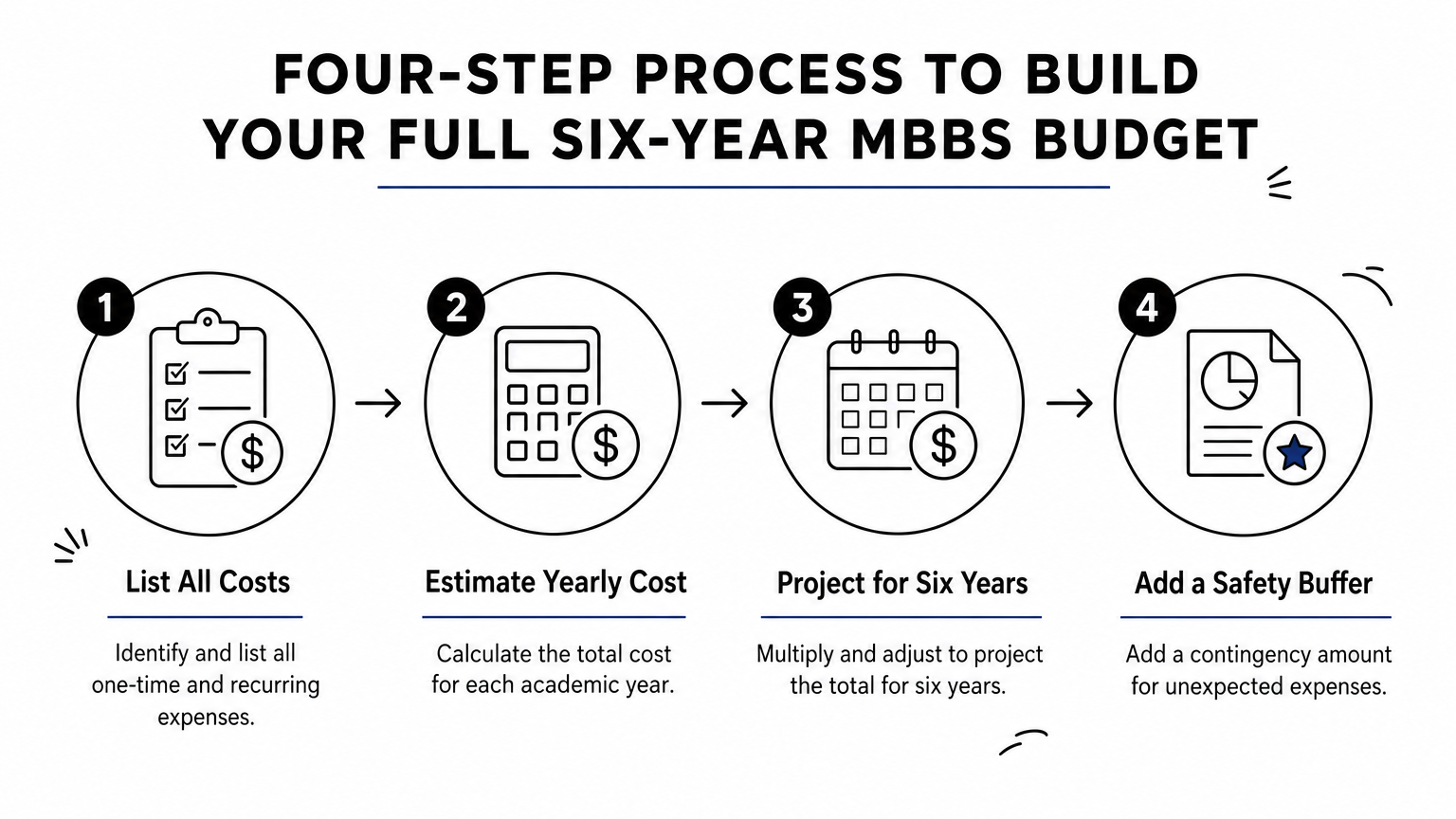
Budgeting for six years abroad takes more than multiplying one year’s tuition by six. You need a formula that adds tuition, living costs, one-time fees, and a currency buffer, because skipping any one of these leaves families short by lakhs before graduation. RUSBASE’s university selection service exists partly to solve this: it maps a student’s actual budget against real fee structures instead of letting a family guess.
The six-year cost formula
Start with the published tuition for your target university, since russia mbbs fees structure almost never hides charges once you have the official fee sheet in hand. Then add hostel and food, visa and travel, and a small contingency for currency shifts. A simple way to model it:
Total MBBS Budget = (Annual Tuition x 6)
 + (Monthly Living Cost x 12 x 6)
 + One-Time Costs (visa, flights, insurance, documents)
 + 10% Currency Buffer
Grouping the numbers this way turns a vague worry into a spreadsheet you can actually plan around, and it is the same method our advisers walk families through during a free consultation.
A real MBBS budget is tuition plus living costs plus one-time fees, not tuition alone.
One-time costs to add before you fly
Most families forget the costs that hit before the first semester even starts. These do not repeat every year, but skipping them from your plan means an unpleasant surprise right when you are packing bags:
- Visa processing and embassy fees, typically $50 to $150
- Flight tickets to Russia, usually $400 to $700 round trip depending on season
- Health insurance for the academic year, often $150 to $300
- Document translation and notarization, generally $50 to $150
- Initial hostel deposit, sometimes one month’s rent upfront
Once you total these, they usually add $700 to $1,300 to your first year, so build that into year one specifically rather than spreading it across all six years.
Why a currency buffer matters
Currency swings between the ruble, dollar, and rupee can shift your annual cost by 5 to 10 percent in either direction. Padding your calculation with a buffer protects you from a semester where a weak rupee suddenly makes tuition feel 8,000 to 15,000 rupees more expensive than you planned. Building this cushion in early, rather than scrambling for extra funds mid-year, is what separates a smooth six years from a stressful one.
MBBS fee structure at top Russian universities for 2026
Budget planning gets much easier once you see actual 2026 fee sheets side by side instead of vague ranges. The russia mbbs fees structure varies mainly by city and university ranking, not by the quality of the medical curriculum, since all state universities follow the same federal education standards. Below is a snapshot of what partner universities are charging for the 2026 intake, based on published tuition rather than estimates.
2026 tuition snapshot by university
Quoting real numbers matters more than averages when you are comparing russia mbbs fees for indian students across cities, because a $2,000 gap per year adds up to over ₹10 lakh across six years.
| University | City | Annual Tuition (USD) | Approx. INR/Year |
|---|---|---|---|
| Bashkir State Medical University | Ufa | $4,300 – $5,000 | ₹3.6 lakh – ₹4.2 lakh |
| Kazan Federal University | Kazan | $4,800 – $5,500 | ₹4 lakh – ₹4.6 lakh |
| Novosibirsk State Medical University | Novosibirsk | $5,000 – $6,200 | ₹4.2 lakh – ₹5.2 lakh |
| Sechenov University | Moscow | $8,000 – $11,000 | ₹6.7 lakh – ₹9 lakh |
| Saint Petersburg State University | Saint Petersburg | $7,500 – $9,500 | ₹6.3 lakh – ₹8 lakh |
| Sevastopol State University | Sevastopol | $3,400 – $4,500 | ₹2.8 lakh – ₹3.8 lakh |
Two universities can teach the same medical curriculum while charging a ₹5 lakh gap in yearly fees, so the city you pick matters as much as the university name.
Why fees rise every year of the course
Almost every Russian medical university builds in a small annual increase, usually 3 to 5 percent, to account for inflation and currency adjustments. Checking whether the fee sheet you receive already reflects six years of increases, or only shows year one, saves you from underestimating your total by ₹1 lakh or more by graduation. RUSBASE publishes the full six-year fee sheet upfront for every partner university, so you see the year-six number before you sign anything, not after.
Moscow and Saint Petersburg cost more, and here is why
Metro cities charge higher tuition mainly because rent, faculty salaries, and hospital partnerships cost more in Moscow and Saint Petersburg than in Ufa or Sevastopol. Studying there still gives you the same WHO- and NMC-recognized degree, but if your russia mbbs fees for indian students without neet-quota budget is tight, a second-tier city stretches your savings further without any drop in recognition or clinical training quality.
Living and other expenses to budget for in Russia
Tuition is only part of the picture when you plan russia fees for mbbs, because six years of hostel, food, transport, and everyday supplies add up to a real number that families need to see before departure. Most Indian students spend $150 to $300 a month on non-tuition costs, and that range shifts depending on the city, the university’s hostel setup, and how much you eat out versus cook. Getting this number right matters just as much as nailing down the tuition sheet, since living costs run every single month for six straight years.
Monthly living cost breakdown
Breaking the monthly budget into categories makes it easier to spot where you can save without cutting into food or safety.
| Category | Typical Monthly Cost (USD) | Approx. INR |
|---|---|---|
| Hostel/accommodation | $60 – $120 | ₹5,000 – ₹10,000 |
| Food and groceries | $60 – $100 | ₹5,000 – ₹8,300 |
| Local transport | $15 – $30 | ₹1,250 – ₹2,500 |
| Phone/internet | $10 – $15 | ₹830 – ₹1,250 |
| Miscellaneous | $15 – $35 | ₹1,250 – ₹2,900 |
Living costs in Russia rarely cross $300 a month, which is why families comparing MBBS destinations keep coming back to it.
City-wise cost differences
Moscow and Saint Petersburg run 20 to 30 percent higher on rent and food than Ufa, Kazan, or Sevastopol, mirroring the same pattern you see in tuition. Novosibirsk sits somewhere in the middle, giving decent city infrastructure without metro-level prices. Choosing a second-tier city stretches a fixed budget noticeably further across six years, especially once you factor in cheaper local transport passes and lower grocery prices in these regions.
Other one-time and recurring costs
Beyond rent and food, a handful of smaller expenses show up at predictable points in the course and deserve a line in your spreadsheet:
- Textbooks and lab manuals, roughly $100 to $200 a year
- Lab coat, stethoscope, and basic medical kit, a one-time $50 to $80
- Winter clothing for your first year, around $100 to $150
- Local SIM card and residence permit renewal fees, small annual charges
- Screening or licensing exam prep materials for when you return home
RUSBASE’s airport pickup and arrival support helps new students avoid the overspending that often happens in the first confusing week, when unfamiliar prices and no local guidance push families to pay far more than they need to.
Universities with the lowest MBBS fees in Russia
Families chasing the absolute lowest MBBS fees in Russia usually land on a small cluster of universities outside the two big metros, where tuition dips below $4,500 a year without sacrificing WHO or NMC recognition. Sevastopol State University, Bashkir State Medical University, and a handful of partner institutions in smaller cities consistently post the cheapest fee sheets among our 24 partner universities, and that gap holds steady year after year rather than being a one-time discount. Picking one of these does not mean a lighter curriculum; it means a university operating in a lower-cost city that passes those savings straight to students.
The cheapest options at a glance
Grouping the lowest-fee options together makes it easy to see how much a city choice alone can save you over six years.
| University | City | Annual Tuition (USD) | 6-Year Tuition (approx. INR) |
|---|---|---|---|
| Sevastopol State University | Sevastopol | $3,400 – $4,000 | ₹17 lakh – ₹20 lakh |
| Bashkir State Medical University | Ufa | $4,300 – $4,700 | ₹21.6 lakh – ₹23.6 lakh |
| Kazan Federal University | Kazan | $4,800 – $5,200 | ₹24 lakh – ₹26 lakh |
The cheapest six-year MBBS route in Russia can cost close to ₹20 lakh less than a mid-range Moscow program.
Why these universities charge less without cutting quality
Sevastopol and Ufa run lower administrative and rent costs than Moscow, and that difference shows up directly in the fee sheet rather than in smaller labs or fewer clinical rotations. Government subsidies cover the same share of infrastructure costs across all state universities, so a cheaper program in Ufa follows the identical federal medical curriculum as a pricier one in Moscow. Recognizing this pattern helps families stop assuming price signals quality, because in this system it mostly signals city cost of living.
Matching low fees to your NEET score and budget
Students searching for mbbs from russia fees on the lower end should still confirm two things before applying: current NEET eligibility rules and seat availability for the intake year, since low-fee universities fill up fast among budget-conscious applicants. Comparing two or three of these options side by side, rather than fixating on the single cheapest number, usually turns up a university that fits both your budget and your preferred city. RUSBASE’s university selection service does exactly this comparison for you, matching your budget against verified fee sheets instead of leaving you to guess.
NEET, scholarships, and other factors that affect your cost
Qualifying NEET matters more to your budget than most families realize, even though Russian universities themselves rarely ask for a NEET score at admission. Without a valid NEET qualifying score, the National Medical Commission will not recognize your degree when you return to India, which means the entire six-year investment in tuition and living costs delivers no license to practice back home. Students searching for russia mbbs fees for indian students without neet should treat that phrase carefully: you can enroll without submitting NEET marks to the university, but you still need to have cleared NEET to use the degree in India, so factor NEET prep into your overall plan even if it does not appear on any fee sheet.
A degree without a NEET-qualifying score is a sunk cost, no matter how low the tuition was.
Scholarships change your final number, but only for a small share of applicants, so budget as if you will pay full tuition and treat any award as a bonus. Government quota seats and programs like Open Doors do exist and can cut fees significantly, yet seats are limited and awarded on merit or entrance performance, not guaranteed to every applicant. Building your six-year plan around a scholarship you have not yet secured is the fastest way to run short of funds in year two.
Several other factors nudge your final cost up or down beyond tuition and living expenses:
- University ranking and city: metro universities charge more, as covered earlier
- Currency movement: a weaker rupee raises your effective ruble or dollar cost year over year
- Internship year: some programs bundle a clinical internship into year six at little extra cost, others charge separately
- Repeat semesters: failing an exam and retaking a semester adds tuition and living costs outside your original plan
- Insurance renewal: annual health insurance premiums can rise slightly each year
Rankings and city choice remain the two levers you control directly, since NEET status and currency swings sit outside your control once you have committed to a university. Working through these variables with an adviser before you sign an offer letter, rather than after, is what keeps a six-year budget accurate instead of optimistic.
Putting your MBBS budget together
You now have the real numbers behind russia fees for mbbs: tuition between $3,400 and $11,000 a year, living costs of $150 to $300 a month, and a handful of one-time charges that hit before your first semester starts. Layer NEET eligibility and currency movement on top, and you have a complete six-year picture instead of a single vague quote.
Quoting a fee sheet is easy; matching that fee sheet to your actual budget, city preference, and NEET status takes someone who works with these universities every day. That is the gap RUSBASE closes, with published tuition, no hidden charges, and an adviser who walks you through the exact university fit for your budget before you sign anything.
Book a free consultation with RUSBASE and get a real, university-specific fee sheet for your MBBS in Russia within days, not weeks of back-and-forth emails.
Questions About Your Own Case?
Requirements depend on your nationality and subject. Ask us directly — free.
Book a Free Consultation