
Pavlov Medical University: History, Faculties, and Rankings
September 28, 2026
If you’re comparing medical schools in Russia, Pavlov Medical University probably keeps showing up on every shortlist, and for good reason. Founded in 1897, it’s one of the oldest medical institutions in the country and still carries the name of Ivan Pavlov, the Nobel laureate whose work in physiology shaped modern medicine. For students from Algeria and elsewhere weighing tuition costs against degree recognition, that history matters as much as the price tag.
This article answers the practical questions you actually have: what faculties the university offers, how it ranks among other Saint Petersburg medical university options, and whether its degrees hold up internationally. Officially known as Pavlov First Saint Petersburg State Medical University, it trains thousands of students yearly in programs recognized by WHO’s World Directory, which matters if you plan to practice medicine back home.
We’ll walk through its academic structure, admission standards, and where it stands in the Saint Petersburg State Medical University ranking tables, so you can decide if it fits your goals before you apply through an agency like ours.
Why Pavlov Medical University attracts international students
Students don’t choose Pavlov Medical University by accident. Word travels fast in international student circles, and when thousands of graduates from India, Africa, and the Middle East report smooth licensing exams back home, that reputation becomes the strongest recruitment tool the university has. The school’s medical degrees are listed in WHO’s World Directory of Medical Schools, and that single detail often decides whether a family greenlights the move to Russia at all.
A legacy that still shapes the curriculum
Founded in 1897 as the Women’s Medical Institute, the school was one of the first in Europe to train female physicians formally, a detail that still shows up in its progressive approach to clinical training today. Renamed after Ivan Pavlov in 1936 to honor his contributions to physiology, the university built its academic identity around research-driven medicine rather than rote memorization. Walking through its older buildings in Saint Petersburg, you notice lecture halls that have trained generations of doctors, some of whom now practice in over 100 countries. That continuity gives the degree weight that newer institutions simply haven’t earned yet.
Tuition that doesn’t force a trade-off
Cost drives most decisions in study-abroad planning, and this is where Saint Petersburg medical university options like Pavlov pull ahead of Western alternatives. A six-year MBBS-equivalent program here runs a fraction of what comparable degrees cost in the UK or Canada, without cutting corners on lab access, cadaver work, or hospital rotations. Families comparing five-year budgets often find that total costs, tuition plus housing plus food, land lower than a single year of tuition alone at some North American schools.
Students don’t pick Pavlov because it’s cheap. They pick it because it’s affordable and internationally recognized, which is a rarer combination than most agencies admit.
No IELTS, no TOEFL, no wasted year
Another reason Pavlov First Saint Petersburg State Medical University keeps appearing on shortlists: most of its English-taught programs don’t require IELTS or TOEFL scores for admission. That single policy saves applicants months of test prep and retake fees, especially students who are strong academically but haven’t had access to expensive coaching centers. Instead, the university relies on academic transcripts and an internal assessment during the first year, which puts the focus back on subject knowledge rather than English test performance.
A city built for student life
Outside the classroom, Saint Petersburg itself becomes part of the appeal. It’s a cultural capital with museums, canals, and a large international student population, so newcomers rarely feel isolated the way they might in a smaller Russian city. Public transport is reliable, the cost of daily living stays reasonable compared to Moscow, and the presence of other Indian, African, and Middle Eastern students means halal food options and community support networks already exist near campus.
Clinical exposure from year one
Finally, hands-on training sets Pavlov apart from schools that delay clinical exposure until the final years. Students rotate through affiliated hospitals early, working alongside practicing physicians rather than watching from a lecture hall. This matters enormously for students planning to sit licensing exams like India’s NEXT or FMGE, since those exams test applied clinical reasoning, not just textbook facts. Graduates consistently mention that early exposure as the difference between passing licensing exams on the first attempt and needing a second try.
Taken together, these factors explain why Pavlov shows up repeatedly in Saint Petersburg State Medical University ranking comparisons among agencies and students alike. It’s not the flashiest campus in Russia, but it delivers a rare mix of affordability, recognition, and genuine clinical training that’s hard to match elsewhere.
How to apply to Pavlov Medical University
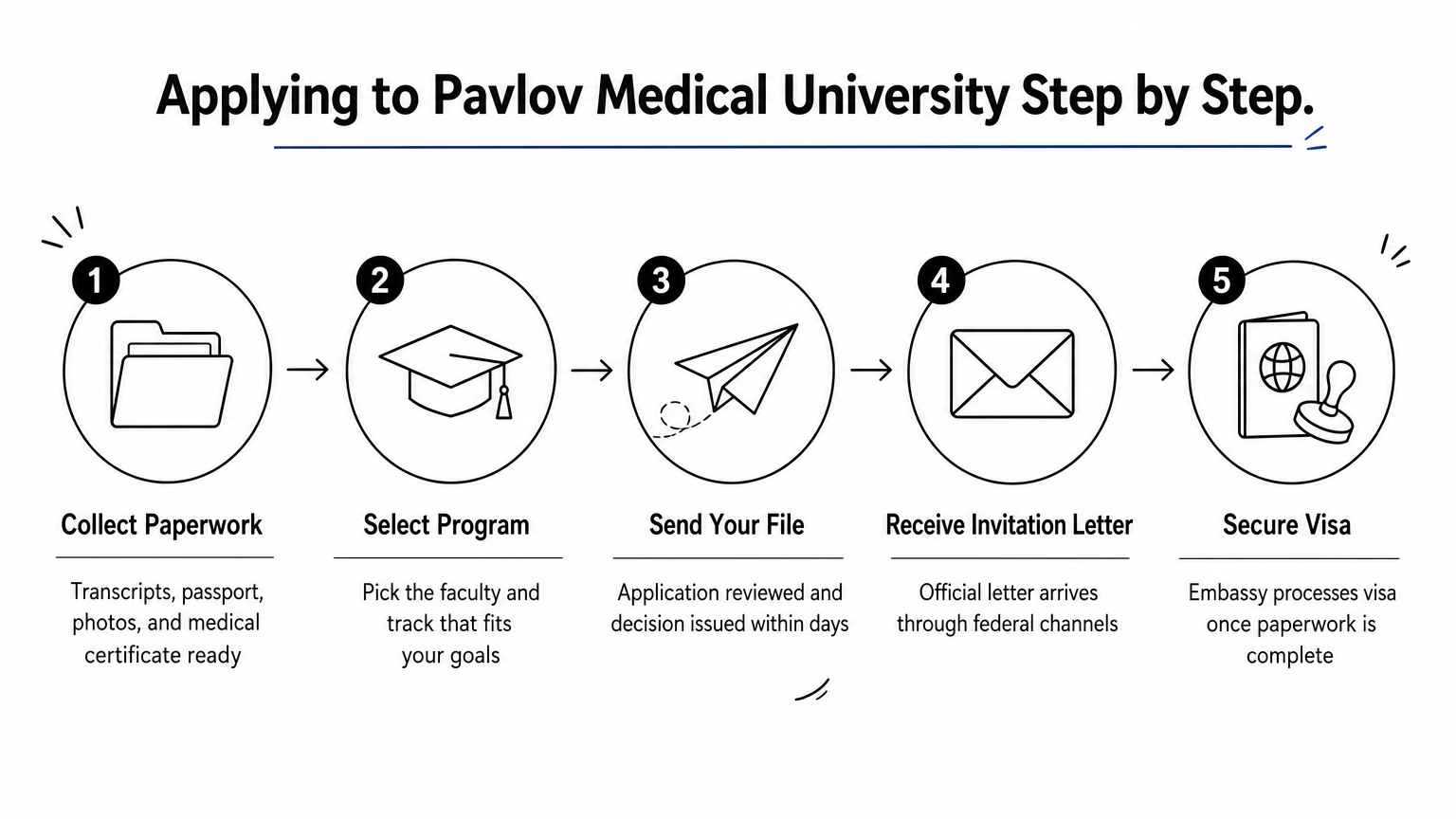
Applying to Pavlov Medical University looks intimidating from the outside, mostly because Russian university websites rarely explain the process in plain English. Strip away the confusion and it’s a straightforward sequence: document collection, university selection, submission, invitation letter, and visa. Most students who go it alone lose weeks chasing translation stamps or discover too late that a document format doesn’t match what the admissions office expects.
What you need before you start
Before anyone submits anything, gather the paperwork. Missing even one item stalls the whole file, and Russian consulates don’t accept partial submissions.
- High school or pre-med transcripts, translated and notarized
- Passport valid for at least 18 months from your intended entry date
- Passport-sized photographs meeting Russian visa specifications
- Medical fitness certificate confirming no HIV or major infectious disease
- Migration card and invitation letter, which the university or an agency arranges on your behalf
The realistic timeline
Once your documents are complete, admission itself moves fast. RUSBASE typically secures an admission decision within 7 working days of submitting a clean file. The official invitation letter from the Russian government takes longer, around 30 working days, since it passes through federal channels rather than the university alone. After that, visa processing at the embassy adds roughly another week, assuming your paperwork is in order.
The bottleneck is almost never the university. It’s the paperwork nobody prepared properly the first time.
Why most students don’t apply directly
Direct applications to Russian universities often stall because admissions staff communicate primarily in Russian and prioritize local processes over international inquiries. That’s where a placement agency earns its fee: translating documents correctly the first time, catching errors before submission, and following up with the university when things go quiet. RUSBASE publishes tuition fees upfront for its 24-plus partner universities, so applicants compare Pavlov First Saint Petersburg State Medical University against other options without waiting on a sales call for basic numbers.
Getting started without wasted steps
Getting a free consultation through WhatsApp or a scheduled call remains the fastest way to confirm whether your grades and documents meet Pavlov’s current intake requirements. Advisers on the ground in Russia flag issues in real time rather than after a rejected submission, which matters when intake windows close on fixed dates each year. That kind of direct feedback loop is what keeps RUSBASE’s acceptance rate at 100 percent among the applications it actually submits, since shortlisting happens honestly before paperwork ever reaches the university.
Faculties and degree programs at Pavlov University
Most applicants only ask about one program, the six-year General Medicine degree, but Pavlov Medical University actually runs a broader academic structure than most agencies mention upfront. Understanding the full faculty lineup helps you pick a track that matches your career goal, whether that’s clinical practice, dentistry, or public health administration back home.
The core medical faculties
General Medicine remains the flagship program, taught entirely in English for international students and structured around six years of coursework followed by a mandatory internship year. Dentistry runs on a similar five-year timeline, with hands-on clinical rotations starting earlier than at many Western dental schools. Pediatrics exists as a separate specialization track for students who know from day one that they want to treat children rather than general adult populations, a distinction some universities in Saint Petersburg don’t bother offering separately.
| Program | Duration | Language | Clinical Start |
|---|---|---|---|
| General Medicine | 6 years | English/Russian | Year 1 |
| Dentistry | 5 years | English/Russian | Year 2 |
| Pediatrics | 6 years | English/Russian | Year 1 |
| Pharmacy | 5 years | Russian | Year 3 |
Postgraduate and research tracks
Beyond undergraduate degrees, the university maintains postgraduate residency programs and PhD-level research positions, mostly conducted in Russian and aimed at students already holding a medical degree. These tracks matter less to first-time applicants but explain why Pavlov First Saint Petersburg State Medical University attracts serious researchers, not just undergraduates chasing an affordable MBBS-equivalent.
A university that trains both first-year students and PhD researchers under one roof isn’t padding its brochure. That range reflects genuine academic depth.
Why the English-taught track matters most
For international students, particularly from India and North Africa, the English-medium General Medicine program is what actually drives enrollment numbers. Russian-taught programs exist and cost less, but they require a full year of language preparation first, which extends your total timeline by twelve months most students don’t want to lose. Choosing English instruction from the start keeps your degree on the standard six-year schedule and avoids the awkward gap year that catches unprepared applicants off guard.
Matching the program to your license goal
Students planning to sit India’s NEXT exam or similar licensing tests elsewhere should confirm their specific program appears on WHO’s World Directory listing before enrolling, since not every postgraduate specialization carries the same international recognition as the core MBBS-equivalent track. Verifying this detail before you commit saves you from discovering licensing gaps years into your degree, when switching programs is no longer realistic.
Rankings, accreditation, and global recognition
Numbers matter when you’re choosing where to spend six years of your life, and Pavlov Medical University consistently lands among the top five medical schools in Russia according to independent national rankings like RAEX and Interfax. Those rankings weigh research output, faculty credentials, and graduate employment rates, not just campus size or marketing budgets. For students comparing multiple cities before committing, that consistency across different ranking methodologies signals something real rather than a one-off good year.
Where Pavlov stands nationally
Within Russia, Pavlov typically ranks behind Sechenov University in Moscow but ahead of most regional medical schools, a position that reflects its research funding and historical prestige rather than aggressive self-promotion. Any thorough Saint Petersburg State Medical University ranking comparison places Pavlov at or near the top of that specific city, which matters if you’ve already decided Saint Petersburg fits your budget and lifestyle better than Moscow.
International recognition that actually matters
Rankings look good on a brochure, but accreditation is what actually determines whether you can practice medicine after graduation. Pavlov’s General Medicine and Dentistry programs appear in the WHO World Directory of Medical Schools, and its degrees satisfy India’s National Medical Commission requirements for graduates planning to sit the FMGE or NEXT licensing exam. Skipping this verification step is the single most common mistake students make when comparing agencies, since a cheap program with no international listing is worthless for anyone planning to practice back home.
A ranking tells you the university is respected. Accreditation tells you your degree will actually let you work.
Accreditation bodies to know
Before signing anything, confirm your target program against the relevant accreditation body rather than trusting a university brochure alone.
| Body | What it confirms | Why it matters |
|---|---|---|
| WHO World Directory | Program is internationally listed | Required for most licensing exams worldwide |
| India’s NMC | Degree qualifies for FMGE/NEXT | Mandatory for Indian students returning home |
| Russian Ministry of Education | Domestic accreditation status | Confirms the degree is legally valid in Russia |
| ECFMG (for US-bound doctors) | Eligibility for USMLE pathway | Relevant if you plan to practice in the US |
Students often assume accreditation is automatic once a university appears reputable, but that’s not always true across every specialization. Verify your exact program, not just the university name, since some postgraduate tracks lag behind the flagship MBBS-equivalent in international listings. Doing this homework before enrollment, rather than after, protects the six years you’re about to invest.
Tuition fees and living costs for international students
Money questions decide more study-abroad plans than any ranking table ever does, and Pavlov Medical University holds up well once you actually compare total costs rather than headline tuition numbers. Yearly tuition for the English-taught General Medicine program runs noticeably lower than comparable degrees in the UK, US, or Canada, and that gap widens once you add housing, food, and transport into the equation. Families researching Pavlov First Saint Petersburg State Medical University often assume Russian tuition hides extra fees somewhere, but published pricing from partner agencies removes that guesswork before you commit.
What the numbers actually look like
Breaking down annual costs helps you budget realistically instead of guessing at a lump sum. These figures reflect typical ranges for international students on the English-medium track, not inflated worst-case estimates some agencies quote to justify their fees.
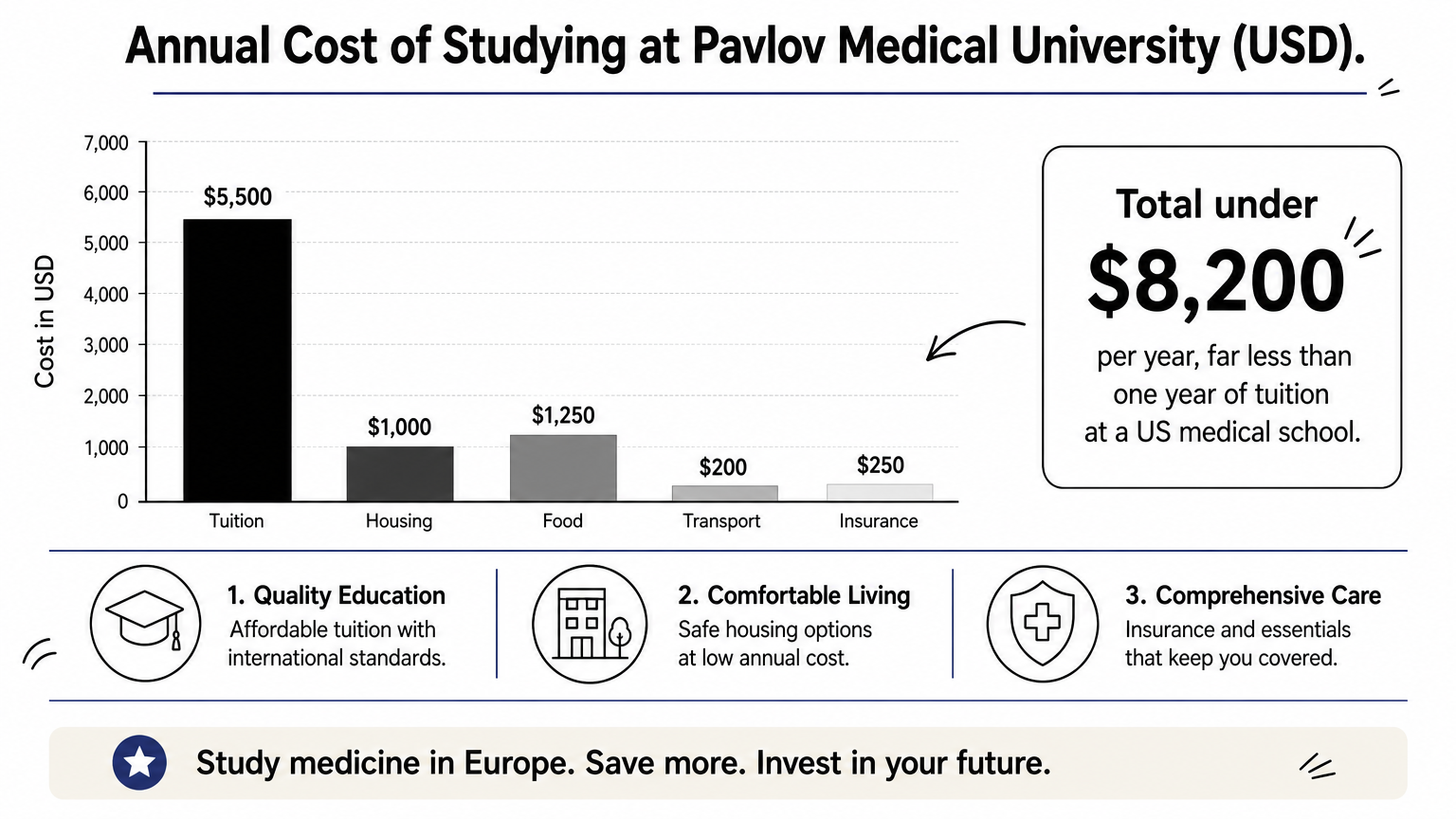
| Expense category | Typical annual cost (USD) |
|---|---|
| Tuition (General Medicine) | $4,500 – $6,500 |
| Hostel/dormitory housing | $800 – $1,200 |
| Food and groceries | $1,000 – $1,500 |
| Local transport | $150 – $250 |
| Health insurance (mandatory) | $200 – $300 |
Comparing that to Western alternatives
Set those numbers against a single year of medical school in North America, where tuition alone often exceeds $40,000, and the math explains why so many students choose Saint Petersburg medical university options over staying home or applying further west. Six years at Pavlov, tuition plus living expenses combined, frequently costs less than one year at a private US medical school. That comparison isn’t marketing spin, it’s arithmetic families can verify themselves once they see actual fee schedules instead of vague estimates.
Six years in Saint Petersburg can cost less than a single year in North America, and the degree still opens the same licensing doors.
Where the hidden costs usually hide
Unexpected expenses trip up students more than tuition ever does, mostly around visa renewal fees, winter clothing for a climate most applicants have never experienced, and occasional document re-translation if paperwork gets rejected the first time. Planning for these upfront, rather than discovering them mid-semester, keeps your budget realistic. RUSBASE publishes full tuition fee comparisons across its 24-plus partner universities precisely because students deserve real numbers before they book flights, not after.
Planning your next step toward Pavlov University
Everything you’ve read here points to the same conclusion: Pavlov Medical University delivers a rare combination of history, recognized accreditation, and tuition that won’t bankrupt your family. From its 1897 founding through its current WHO-listed programs, the school has earned its spot among Russia’s top medical schools without inflating the numbers to get there. Whether you’re comparing it against other Saint Petersburg medical university options or weighing Moscow against Saint Petersburg entirely, the fundamentals hold up under scrutiny.
Applying alone means navigating Russian-language admissions offices and hoping your paperwork translates correctly the first time. Skip that risk. RUSBASE handles document prep, university selection, and visa support with published pricing across 24-plus partner schools, so you know costs before you commit. Ready to see if your grades qualify? Book a free consultation with RUSBASE and get a straight answer within days, not months.
Questions About Your Own Case?
Requirements depend on your nationality and subject. Ask us directly, free of charge.
Book a Free Consultation