9 Best Medical Universities in Russia for International Students
September 28, 2026
If you’re comparing medical universities in Russia for international students, you already know the basics: tuition that costs a fraction of what you’d pay in the US or UK, no mandatory IELTS or TOEFL, and degrees that thousands of doctors from India, Africa, and the Middle East have used to build real careers back home. What you probably don’t know yet is which universities actually deliver on that promise and which ones just look good on a random ranking site.
This list answers exactly that. We’re covering 9 medical universities in Russia with WHO-recognized programs and NMC-compliant curricula, along with what each one actually charges, where it sits, and what kind of student it fits best. No inflated rankings, no vague marketing language.
We put this together after years of working directly with students applying to these exact schools, so every entry reflects real admission timelines, real tuition costs, and real outcomes, not brochure copy. By the end, you’ll know which university matches your budget, your city preference, and your plans for practicing medicine after graduation.
1. Sechenov University
Overview and global recognition
Sechenov University, officially known as I.M. Sechenov First Moscow State Medical University, is the oldest and most prestigious medical school in Russia, founded in 1758. It’s the benchmark other medical universities in Russia get compared against, and for good reason: it’s listed in the WHO World Directory of Medical Schools, its MBBS program is accepted by India’s National Medical Commission, and its graduates routinely pass ECFMG and USMLE screening abroad. Ranking bodies like QS regularly place it among the top medical schools in Eastern Europe.
A degree only matters if the body that licenses you back home recognizes it, and Sechenov clears that bar cleanly.
Tuition fees and program duration
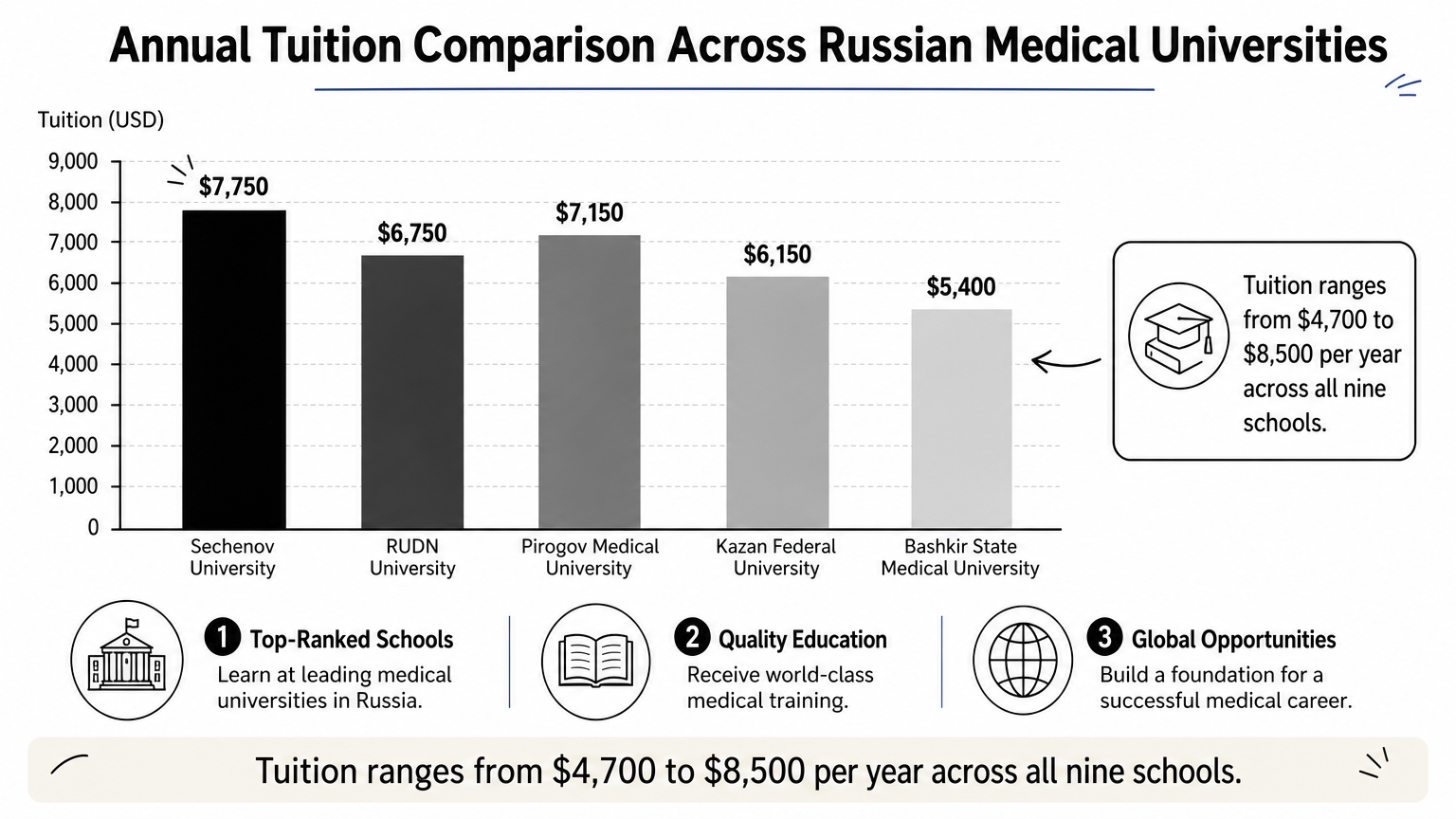
Costs here run higher than most Russian medical schools, which reflects the university’s reputation and Moscow’s cost of living, but they’re still a fraction of Western tuition.
| Program | Duration | Approx. Annual Tuition |
|---|---|---|
| General Medicine (MBBS) | 6 years | $7,000-$8,500 |
| Dentistry | 5 years | $8,000-$9,500 |
| Pharmacy | 5 years | $6,500-$7,500 |
Hostel accommodation adds roughly $1,000-$1,500 per year on top of tuition, and RUSBASE publishes these totals upfront rather than making you request a quote.
Admission requirements
Entry doesn’t require IELTS or TOEFL, but you do need a completed secondary school certificate with passing grades in biology and chemistry, since those subjects form the foundation of the first-year curriculum. Applicants must typically be at least 17 years old by the start of the academic year. Document requirements include:
- Notarized translation of your school certificate and transcripts
- Valid passport with at least 18 months remaining
- Medical fitness certificate, including HIV test results
- Passport-sized photographs for the application file
Once your documents clear the initial check, admission decisions typically come back within about a week, and the official invitation letter for your visa follows in roughly a month.
Campus life and location in Moscow
Geography plays a real role in day-to-day life here. Sechenov’s main campus sits close to central Moscow, giving students access to major teaching hospitals, research institutes, and a genuinely international student body from over 70 countries. Living costs in Moscow run higher than smaller cities like Ufa or Kazan, so factor that into your total budget beyond tuition alone, but the clinical exposure at affiliated hospitals is hard to match anywhere else in the country.
2. RUDN University
Overview and global recognition
RUDN University, or the Peoples’ Friendship University of Russia, built its reputation on decades of training international students, and medicine is its flagship faculty. Its MBBS program appears in the WHO World Directory of Medical Schools and clears NMC screening for Indian graduates, so licensing back home isn’t a gray area. Founded specifically to educate students from Asia, Africa, and Latin America, RUDN carries a diversity that few medical universities in Russia can match, with alumni from over 150 countries.
A university built for international students from day one tends to handle your paperwork, housing, and adjustment better than one that’s just added an English-taught program on the side.
Tuition fees and program duration
The general medicine program runs 6 years and costs between $6,000 and $7,500 annually, placing it below Sechenov but still within Moscow’s higher cost bracket. Add roughly $900-$1,200 per year for hostel accommodation. RUSBASE lists these figures without requiring a consultation call first, so you can compare totals before committing.
Admission requirements
Applicants need a secondary school certificate with strong grades in biology and chemistry, a valid passport, and a medical fitness certificate. No IELTS or TOEFL is required. Standard documents include notarized transcripts, passport copies, and photographs, and admission decisions typically arrive within a week of document submission.
Campus life and location in Moscow
RUDN’s campus sits in southern Moscow, with dedicated international dormitories, sports facilities, and a medical faculty building close to teaching hospitals. Housing costs run slightly lower than central Moscow, which helps offset the capital’s overall living expenses.
3. Pirogov Russian National Research Medical University
Overview and global recognition
Pirogov Russian National Research Medical University ranks among the most research-focused medical universities in Russia, with a strong reputation in surgery and clinical research built over decades. Its MBBS program sits in the WHO World Directory of Medical Schools, and NMC accepts its graduates for licensing exams back in India, so recognition isn’t a concern here. Named after the pioneering surgeon Nikolai Pirogov, the university leans heavily into hands-on clinical training from the early years, which sets it apart from schools that delay clinical exposure until year four or five.
Choosing a research-driven medical school matters most if you plan to pursue a specialty or residency that rewards early clinical hours, not just a passing grade.
Tuition fees and program duration
The 6-year general medicine program costs between $6,500 and $7,800 per year, with dentistry running slightly higher. Hostel fees add roughly $900-$1,100 annually, and RUSBASE publishes both figures together so you’re budgeting for the real total, not just the headline tuition number.
Admission requirements
Applicants submit a secondary school certificate with passing marks in biology and chemistry, a valid passport, and a medical fitness certificate including HIV screening. No IELTS or TOEFL applies. Processing typically takes about a week for admission confirmation, followed by the official invitation letter within a month.
Campus life and location in Moscow
Pirogov’s campus sits in western Moscow, close to several affiliated hospitals where students rotate for clinical practice. The surrounding district offers cheaper housing than central Moscow, which helps students manage costs while still commuting easily to teaching hospitals and lecture halls.
4. Kazan Federal University
Overview and global recognition
Kazan Federal University stands out among medical universities in Russia for its dual identity: it’s a comprehensive research university with a medical institute that carries full international accreditation. Its MBBS program appears in the WHO World Directory of Medical Schools, and graduates clear NMC screening for Indian licensing exams without issue. Founded in 1804, KFU ranks among Russia’s oldest universities and holds a spot in QS World University Rankings, giving it broader institutional credibility beyond just the medical faculty.
A university with strong rankings across multiple disciplines usually means better labs, libraries, and research funding flowing into the medical program too.
Tuition fees and program duration
The 6-year general medicine program costs between $5,500 and $6,800 annually, making it one of the more affordable options on this list without sacrificing WHO recognition. Hostel accommodation runs roughly $700-$900 per year, and RUSBASE lists both numbers together so you know the real annual cost before applying.
Admission requirements
Applicants need a secondary school certificate with passing grades in biology and chemistry, a valid passport, and a medical fitness certificate. No IELTS or TOEFL is required. Admission confirmation typically arrives within about a week of document submission, with the invitation letter following within a month.
Campus life and location in Kazan
Kazan itself offers a calmer, more affordable alternative to Moscow, with lower rent and a growing international student community. The medical institute’s facilities sit close to teaching hospitals, and the city’s bilingual Russian-Tatar culture gives students a genuinely different experience from the capital.
5. Kazan State Medical University
Overview and global recognition
Kazan State Medical University is a dedicated medical school, unlike Kazan Federal University’s broader institute model, and it’s been training doctors since 1814. It’s one of the oldest medical universities in Russia focused purely on health sciences, and its MBBS program sits in the WHO World Directory of Medical Schools with full NMC acceptance for Indian graduates. The university also runs specialized departments in pediatrics and preventive medicine that give students exposure beyond general clinical training.
Picking a dedicated medical university over a multi-faculty institute often means faculty and resources are concentrated entirely on training doctors, not split across departments.
Tuition fees and program duration
The 6-year general medicine program costs between $5,200 and $6,500 annually, keeping it among the more budget-friendly choices on this list. Hostel accommodation adds roughly $600-$850 per year, and RUSBASE publishes both figures upfront so you can plan the full four-to-six-year cost before applying, not just the first year.
Admission requirements
Applicants need a secondary school certificate with passing grades in biology and chemistry, plus a valid passport and medical fitness certificate. No IELTS or TOEFL applies. Admission confirmation usually arrives within a week, and the official invitation letter follows within about a month, letting you move quickly toward visa applications.
Campus life and location in Kazan
The main campus sits within walking distance of the city center, putting students close to affiliated hospitals, markets, and public transport. Kazan’s lower cost of living, combined with a sizable South Asian student population, makes settling in noticeably easier than in a bigger, pricier city.
6. Bashkir State Medical University
Overview and global recognition
Bashkir State Medical University sits in Ufa, a city that rarely comes up when people first research medical universities in Russia but deserves more attention once you compare the numbers. Established in 1932, it’s built a strong reputation for training doctors who go on to practice across South Asia and the Middle East. Its MBBS program appears in the WHO World Directory of Medical Schools, and NMC accepts its graduates for licensing screening back in India, so recognition holds up the same as it does at the bigger-name schools in Moscow.
Ufa proves you don’t need a Moscow address to get a WHO-recognized medical degree at a fraction of the cost.
Tuition fees and program duration
The 6-year general medicine program costs between $4,800 and $6,000 annually, making it one of the cheapest options on this list while still meeting NMC and WHO standards. Hostel fees add roughly $500-$750 per year, and RUSBASE lists both figures together upfront so families can plan the full six-year budget before applying.
Admission requirements
Applicants submit a secondary school certificate with passing grades in biology and chemistry, a valid passport, and a medical fitness certificate. No IELTS or TOEFL applies. Confirmation typically arrives within a week, with the official invitation letter following within about a month, keeping the visa timeline short.
Campus life and location in Ufa
Ufa offers noticeably lower rent than Moscow or Saint Petersburg, and the medical faculty sits close to affiliated clinical hospitals used for rotations. A growing South Asian student community makes the adjustment period shorter for newcomers arriving without prior contacts in the city.
7. Saint Petersburg State Pediatric Medical University
Overview and global recognition
Saint Petersburg State Pediatric Medical University holds a unique spot among medical universities in Russia: it’s the only school on this list built specifically around pediatric and child health training, alongside a standard general medicine track. Founded in 1925, it has decades of experience producing doctors who specialize in maternal and child care, a niche that pays off if you already know pediatrics is your target field. Its MBBS program appears in the WHO World Directory of Medical Schools, and NMC clears its graduates for licensing exams in India, so recognition matches the bigger Moscow schools despite the university’s smaller size.
A pediatric-focused curriculum from year one gives you a head start if you already know you want to specialize in child health later.
Tuition fees and program duration
The 6-year general medicine program costs between $5,000 and $6,200 annually, and the dedicated pediatrics track runs in a similar range. Hostel accommodation adds roughly $600-$800 per year, and RUSBASE publishes both numbers together so you can budget the full stay before applying.
Admission requirements
Applicants need a secondary school certificate with passing grades in biology and chemistry, a valid passport, and a medical fitness certificate. No IELTS or TOEFL applies. Admission confirmation typically arrives within about a week, with the invitation letter following within a month.
Campus life and location in Saint Petersburg
Saint Petersburg gives students a genuinely European city experience, with canals, museums, and a large international student population spread across several universities. Rent runs higher than Kazan or Ufa but stays well below Moscow, and the pediatric hospital network nearby gives students steady clinical exposure throughout their studies.
8. Novosibirsk State Medical University
Overview and global recognition
Novosibirsk State Medical University sits in Siberia’s largest city, far from the usual Moscow-centric picture people have of medical universities in Russia, but its credentials hold up just as well. Established in 1935, it has built a solid reputation in fields like microbiology and infectious disease research, partly a byproduct of the region’s scientific institutes. Its MBBS program is listed in the WHO World Directory of Medical Schools, and graduates clear NMC screening for licensing in India without complications, so the distance from Moscow doesn’t cost you anything on the recognition side.
Distance from Moscow doesn’t lower a degree’s value if the WHO listing and NMC clearance are already in place.
Tuition fees and program duration
The 6-year general medicine program costs between $4,700 and $5,900 annually, putting it among the cheapest options on this entire list. Hostel accommodation adds roughly $500-$700 per year, and RUSBASE publishes both figures together so you can plan the full six-year cost before committing to an application.
Admission requirements
Applicants submit a secondary school certificate with passing grades in biology and chemistry, a valid passport, and a medical fitness certificate. No IELTS or TOEFL applies here either. Admission confirmation typically arrives within a week, with the official invitation letter following within about a month.
Campus life and location in Novosibirsk
Winters run colder here than in most of the cities on this list, but rent and daily expenses stay noticeably lower, which matters over six years of study. The medical faculty sits close to regional teaching hospitals, giving students steady clinical exposure without the crowds of a bigger metro area.
9. Sevastopol State University
Overview and global recognition
Sevastopol State University rounds out this list as the newest addition among medical universities in Russia, with its medical institute built specifically to serve growing international demand from students who want a coastal, lower-cost alternative to Moscow or Saint Petersburg. Its MBBS program is listed in the WHO World Directory of Medical Schools, and NMC clears its graduates for licensing screening in India, so recognition matches the older, more established universities on this list despite the school’s shorter medical history. Located in Crimea, the university draws a smaller international cohort than the bigger cities, which some students actually prefer for a quieter study environment.
A smaller medical faculty doesn’t mean weaker recognition, it just means smaller class sizes and more direct access to your professors.
Tuition fees and program duration
The 6-year general medicine program costs between $4,500 and $5,800 annually, keeping it among the cheapest options across all nine universities. Hostel accommodation adds roughly $500-$650 per year, and RUSBASE publishes both figures together so families can calculate the full six-year total before applying.
Admission requirements
Applicants need a secondary school certificate with passing grades in biology and chemistry, a valid passport, and a medical fitness certificate. No IELTS or TOEFL applies. Confirmation typically arrives within a week, with the invitation letter following within about a month, matching the timelines seen across other partner universities.
Campus life and location in Sevastopol
Sevastopol offers a Black Sea coastal setting that’s rare among Russian medical schools, with noticeably lower living costs than mainland cities. Students here get a quieter pace of life, milder winters than Siberia or Moscow, and easy access to affiliated hospitals for clinical rotations.
Finding the right fit for your medical degree
Nine universities, nine different price points and cities, but the same bottom line: every school on this list carries WHO recognition and NMC clearance, so the degree itself won’t hold you back later. What separates them is budget, climate, and how much you want the capital-city experience versus a quieter, cheaper campus in Kazan, Ufa, or Sevastopol. Sechenov and RUDN suit students who want Moscow’s resources and don’t mind higher rent, while Bashkir, Novosibirsk, and Sevastopol fit tighter budgets without cutting corners on recognition.
Once you’ve narrowed your shortlist, the next step is getting real numbers for your specific situation, not general ranges. That’s exactly what we handle daily. Talk to RUSBASE for a free consultation and we’ll match you to the right university, walk you through documents, and get your admission moving within days instead of months.
Questions About Your Own Case?
Requirements depend on your nationality and subject. Ask us directly, free of charge.
Book a Free Consultation