
Saint Petersburg State University: History, Programs, and Ranking
September 29, 2026
If you’re comparing universities in Russia for your bachelor’s or medical degree, Saint Petersburg State University keeps coming up as one of the oldest and most respected names in the country. That reputation raises real questions: is it actually worth the hype, what does it teach, and where does it stand against other institutions you’re considering.
This article answers those questions directly. You’ll get the university’s founding history, its main faculties and degree programs, and an honest look at the saint petersburg state university ranking both globally and within Russia, so you can judge whether it fits your budget and career goals rather than relying on marketing claims.
We built this guide for students from Algeria and similar backgrounds who are weighing SPbU against other Russian universities, especially for medicine and international programs. Beyond history and academics, we’ll cover the st petersburg university ranking trends over recent years and what they actually mean for degree recognition after graduation, since that matters more than a number on a list when you’re planning your career.
Why Saint Petersburg State University stands out
Founded in 1724 by decree of Peter the Great, Saint Petersburg State University is the second-oldest continuously operating university in Russia, trailing only Moscow State University by a matter of years. That founding date matters because it shaped the institution’s identity: it grew alongside the city itself, absorbing the scientific ambitions of the Russian Academy of Sciences and becoming a training ground for the country’s diplomats, scientists, and physicians. Students researching the saint petersburg state university ranking often skip past this history, but the age and continuity of the institution explain why its diplomas carry weight with employers and licensing boards across Europe and Asia.

A Legacy Built on Scientific Output
Chemists, physicists, and physicians trained at SPbU have shaped fields well beyond Russia’s borders. Dmitri Mendeleev developed the periodic table while teaching here, and the university’s medical faculty has produced generations of doctors who now practice internationally. Nineteen Nobel laureates are connected to the university as students, faculty, or researchers, a figure that few universities in Eastern Europe can match. That track record is one reason degree recognition rarely becomes an obstacle for graduates applying to residency programs or licensing exams back home.
A university’s age only matters if its degrees still open doors decades later, and SPbU’s do.
Academic Breadth Across Disciplines
Beyond its historical pedigree, SPbU runs over 24 faculties, covering medicine, law, international relations, physics, and the humanities. This breadth lets students switch specializations or pair a primary degree with electives in another field, something smaller specialized institutes rarely allow.
| Feature | Detail |
|---|---|
| Founded | 1724 |
| Faculties | 24+ |
| Nobel-linked scholars | 19 |
| Notable alumni | Vladimir Putin, Dmitri Mendeleev, Pyotr Kapitsa |
| City | Saint Petersburg |
Graduates from SPbU’s medical and engineering programs frequently move into research positions or continue postgraduate study abroad, which speaks to the credibility of the coursework rather than just the brand name on the certificate.
Location as a Learning Advantage
Having a campus embedded in one of Europe’s most historically dense cities gives students access to museums, research institutes, and international companies that regularly host guest lectures and internships. If you’re comparing this setting against other partner universities that RUSBASE works with for medical and international programs, it’s worth weighing how much campus location factors into your daily student experience, not just the tuition number on a spreadsheet.
How to apply to Saint Petersburg State University
Applying directly to a Russian federal university like SPbU means navigating a process built for domestic administrative norms, not first-time international applicants. You’ll need notarized translations of your transcripts, a medical certificate, and often a personal visit to the consulate before you even receive an official invitation letter, the document Russia requires before issuing a student visa. Many applicants from Algeria and neighboring countries find this paperwork bottleneck is where months get lost, especially if English isn’t the primary language of the admissions office you’re corresponding with.
The hardest part of applying to a Russian university rarely happens on campus, it happens in the paperwork before you ever board a flight.
Working With a Local Partner
This is where working through a study-abroad partner changes the timeline. RUSBASE handles the full application process for partner universities, checking your documents, arranging notarized translations, and submitting your file so you’re not guessing whether a form was filled out correctly. Because the company works with specific partner institutions rather than every university in Russia, it can quote realistic timelines instead of vague promises.
What the Process Typically Looks Like
A structured application through an agency partner generally follows this sequence:
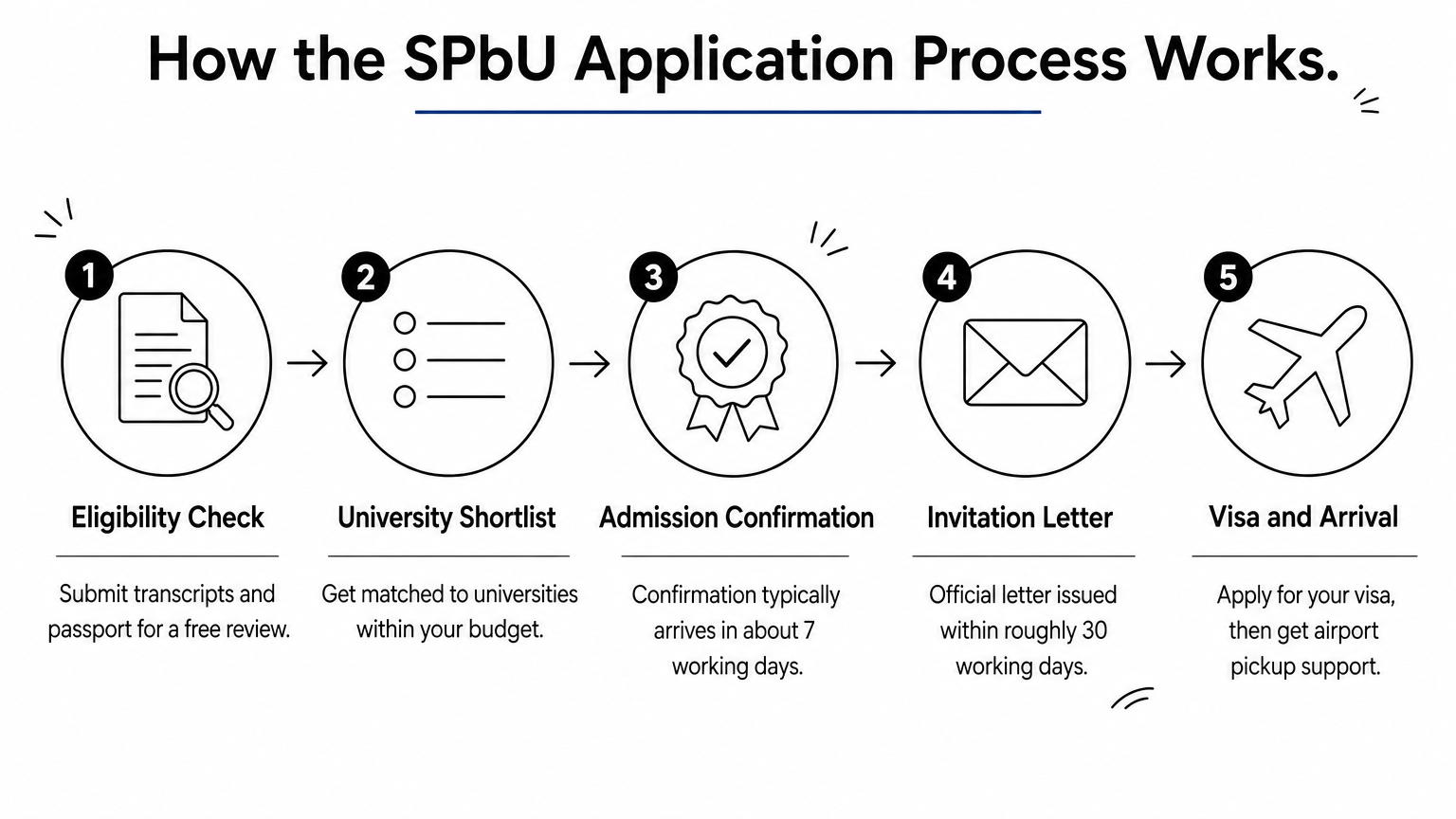
- Submit your academic transcripts and passport copy for a free eligibility check
- Receive a shortlist of universities matching your budget and subject
- Get admission confirmation, typically within about 7 working days
- Receive the official university invitation letter, usually within 30 working days
- Apply for your student visa at the embassy, often completed within a week
- Arrange arrival support, including airport pickup in Saint Petersburg
Compared to applying solo, this sequence removes the guesswork around Russian bureaucratic requirements and gives you a clearer sense of when you’ll actually start classes.
Programs and tuition fees at SPbU
Saint Petersburg State University offers degree tracks in medicine, engineering, international relations, economics, and law, with several programs taught fully in English for international students. Medical degrees remain the biggest draw for applicants from Algeria and similar backgrounds, since a Russian MBBS-equivalent from a WHO-listed university costs far less than comparable programs in Western Europe while still meeting NMC recognition standards back home. That combination of affordability and recognized credentials explains why Saint Petersburg State University shows up so often in comparison lists alongside cheaper regional partner universities.
Cheap tuition means nothing if the degree isn’t recognized where you plan to practice, so check accreditation before you check the price tag.
Typical Tuition Ranges by Program
Tuition at SPbU sits higher than many regional Russian universities, reflecting its reputation and location in a major city. Actual figures vary by faculty and intake year, so always confirm current numbers before budgeting.
| Program Type | Approximate Annual Tuition (USD) |
|---|---|
| General Medicine (MBBS equivalent) | $6,500 – $9,000 |
| Engineering & Technical Sciences | $4,500 – $6,500 |
| Economics & International Relations | $4,000 – $6,000 |
| Law | $3,800 – $5,500 |
Comparing Costs Against Partner Universities
Given these figures, students often ask whether SPbU’s prestige justifies the higher cost compared to RUSBASE’s other partner universities in cities like Ufa, Kazan, and Novosibirsk, where total annual costs, tuition plus housing, can run as low as $1,600 to $4,000. If your budget is tight, a regional university with the same WHO and NMC recognition might make more financial sense than paying a premium for the Saint Petersburg address. Reviewing RUSBASE’s full breakdown of tuition and living costs across its partner network helps you weigh that trade-off honestly before committing to one city over another.
Saint Petersburg State University ranking explained
Ranking tables confuse most applicants because different agencies measure completely different things. The saint petersburg state university ranking varies depending on whether you’re looking at QS World University Rankings, Times Higher Education, or Russia’s own domestic rating systems, and each one weighs research output, faculty citations, and international outlook differently. SPbU typically lands in the 220-280 range on QS World University Rankings, while sitting consistently in the top three or four spots for the st petersburg university ranking among Russian institutions themselves.
A global rank tells you about research output, not whether your specific degree gets recognized where you plan to work.
Why Global and Domestic Rankings Diverge
Globally, SPbU competes against universities with far larger research budgets and international faculty pools, which caps how high it climbs on worldwide lists. Domestically, though, it consistently outranks most regional universities because of its research funding, publication volume, and historic name recognition among Russian employers and government bodies. If you’re comparing it against smaller partner universities in Kazan or Ufa, understand that a lower global number doesn’t mean weaker teaching, it often just reflects a smaller research footprint.
What the Ranking Means for Medical Applicants
Applicants chasing medical degrees should care less about the overall university rank and more about whether the medical faculty specifically holds WHO World Directory listing and NMC recognition, since licensing boards check that directly rather than consulting QS tables. SPbU’s medical programs meet both standards, which matters far more for your future practice than where the university sits on a general ranking list. Treat rankings as one data point, not the deciding factor, when weighing SPbU against other options in RUSBASE’s network.
Student life and living costs in Saint Petersburg
Living in Saint Petersburg costs more than smaller Russian cities, but the trade-off is access to a genuine European-style capital with museums, metro lines running until 1am, and a large enough international student community that you won’t feel isolated. Monthly living expenses for a student typically fall between $350 and $550, covering dormitory or shared apartment rent, food, transport, and basic utilities, before tuition is even factored in. That range sits noticeably higher than Ufa or Kazan, where the same budget can stretch further, so it’s worth planning around actual numbers rather than assumptions.
Housing and Daily Expenses
Dormitory placement through the university runs cheaper than private rentals, and most first-year international students start there before deciding whether to move into shared housing near campus. A typical breakdown looks like this:
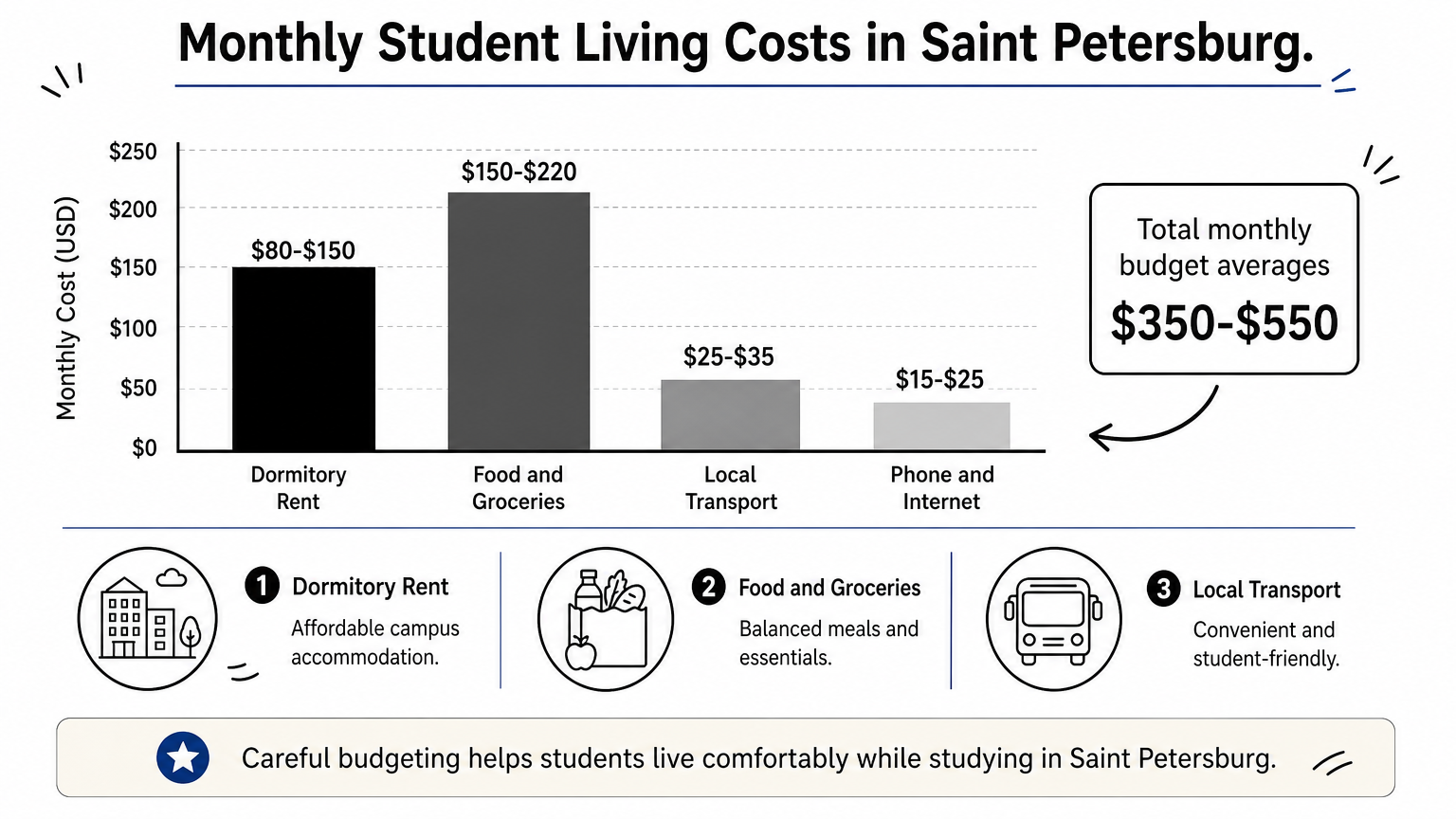
- Dormitory rent: $80-$150 per month
- Food and groceries: $150-$220 per month
- Local transport pass: $25-$35 per month
- Phone and internet: $15-$25 per month
Budget for Saint Petersburg like a European city, not a regional Russian town, and you won’t be caught off guard.
Settling In After Arrival
Getting through your first week matters more than most applicants expect, since registering with local authorities, opening a bank account, and finding your way around an unfamiliar transit system all happen fast after landing. RUSBASE covers this stretch directly through airport pickup and first-week settlement assistance, so you’re not navigating a foreign city alone with jet lag and a stack of paperwork. Many students who arrive without that support lose their first week just figuring out logistics instead of starting classes.
Community and Climate
Winters run long and dark, which surprises students from Algeria more than any tuition figure ever does, so pack accordingly and expect a real adjustment period during your first semester.
Deciding if SPbU fits your goals
Saint Petersburg State University makes sense if you want a globally recognized medical or engineering degree and can afford the higher cost of living in a major city. It makes less sense if your budget is tight and you’d rather stretch the same money further in Kazan or Ufa, where WHO and NMC recognition still apply without the Saint Petersburg price tag. Weighing these trade-offs honestly, rather than chasing prestige alone, is what separates students who thrive abroad from those who struggle financially by year two.
Whatever you decide, the application paperwork, visa timeline, and arrival logistics stay complicated regardless of which city you pick. That’s exactly the gap RUSBASE was built to close, with transparent pricing and hands-on support from your first inquiry through airport pickup. If you’re ready to compare SPbU against other Russian universities side by side, get a free consultation with RUSBASE and let a team already on the ground help you choose with real numbers, not guesswork.
Questions About Your Own Case?
Requirements depend on your nationality and subject. Ask us directly, free of charge.
Book a Free Consultation