
Ufa University of Science and Technology: A Complete Overview
September 30, 2026
If you’re researching the Ufa University of Science and Technology for a bachelor’s application, you’ve probably noticed how little reliable information is out there in English. Most sources repeat the same vague facts about Russia’s regional universities without answering what you actually need: what the university actually offers, what it costs, and what the admissions process really involves.
This guide answers those questions using the university’s own published information. You’ll get UUST’s real background (it’s the result of a 2022 merger of two established Bashkortostan institutions), its academic structure, and what its degree programs look like for international students, particularly in engineering, IT, and the technical sciences, the university’s strongest areas.
We cover tuition as UUST itself publishes it, housing, admission requirements, and what to expect if you’re applying from India, Africa, or the Middle East. As a consultancy that places students directly into Ufa and other Russian cities every year, we’ve built this overview from the university’s official admissions pages and our own placement experience, so you can decide whether Ufa fits your budget and career plans before you commit to an application.
Why international students choose Ufa University of Science and Technology
Most students land on Ufa University of Science and Technology after comparing costs across a dozen countries and realizing their budget doesn’t stretch far enough for the UK, US, or Canada. The university, often shortened to UUST, gives them a recognized degree at a fraction of the price, without sacrificing the quality of instruction or the credibility of the diploma back home.
A merger that built one of Russia’s largest universities
UUST was formed in 2022 when Bashkir State University merged with Ufa State Aviation Technical University, combining decades of research capacity, faculty, and infrastructure under one roof. The result, by the university’s own figures, is one of the largest universities in the Republic of Bashkortostan: roughly 45,000 Russian students and over 2,000 international students, taught by more than 2,500 faculty members, over half of whom hold doctoral or candidate degrees. The merger was backed by the Russian government’s Priority 2030 program, which funds universities to modernize labs and expand research output.
The university now runs 16 faculties and institutes at its main Ufa campus plus 6 branch campuses in Birsk, Ishimbay, Kumertau, Neftekamsk, Sibay, and Sterlitamak, offering roughly 150 fields of study across 700+ programs. Its strongest technical departments trace directly to the aviation-institute side of the merger: the Faculty of Aviation Engines, Power Engineering and Transport, the Institute of Electrical Engineering, the Institute of Technology and Materials, and the Advanced Engineering School "Motors of the Future", alongside the Institute of Informatics, Mathematics and Robotics for computer science and IT.
What the aviation legacy actually looks like on the ground
One detail that separates UUST from a generic regional university: through its aviation-institute roots, the campus maintains its own airfield (LIK Aeroport) with decommissioned military aircraft, including MiG-21, MiG-23, MiG-29, Su-27, and Su-34 jets and Mi-2 and Mi-8 helicopters, used for engineering study rather than as a museum piece. It also runs the only military training center in the Republic of Bashkortostan, where students can complete military registration alongside their degree.
A large, merger-strengthened university with dedicated aviation infrastructure is a different proposition than a small regional college, and that’s what shows up in UUST’s own numbers.
Cost compared to Western alternatives
The price difference is the deciding factor for most families, so it helps to see it side by side.
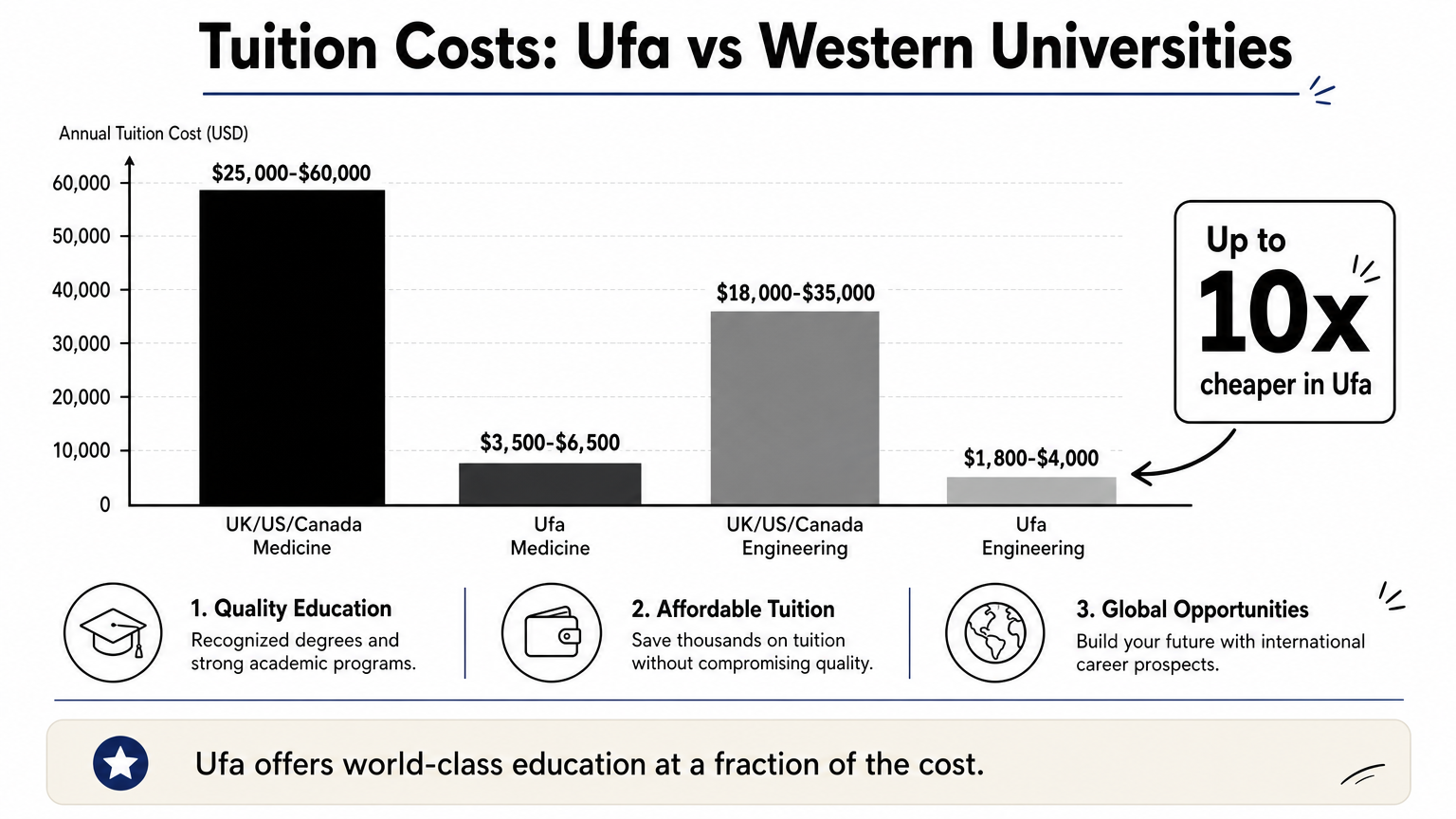
| Destination | Typical annual tuition (engineering/technical) |
|---|---|
| UK / US / Canada | $18,000 to $35,000 |
| Ufa University of Science and Technology | roughly $1,700 to $1,900 |
Add housing, and a full year in Ufa still often costs less than one semester in a Western program.
No IELTS or TOEFL requirement, but instruction is in Russian
Standardized English testing is a genuine obstacle for many strong students, and UUST doesn’t require IELTS or TOEFL scores for admission. That’s not because programs are taught in English, though: instruction at UUST runs in Russian, so the university’s Institute of Continuing Education runs dedicated Russian-language preparatory courses for incoming international students before their first academic year. It’s a language bridge, not an English-language pathway, so applicants should plan for a preparatory year that builds working Russian rather than assuming they’ll study in English.
Ultimately, students choose UUST because it solves two problems at once: affordability and a straightforward admissions path that doesn’t gatekeep on English test scores, provided they’re ready to commit to learning Russian.
How to apply to Ufa University of Science and Technology
International applicants don’t apply through the same portal as Russian citizens applying via the Unified State Exam. UUST runs a dedicated foreign-applicant account (abit.uust.ru) alongside its International Cooperation Office, which handles the process for students applying from abroad. Students working with a consultancy like RUSBASE get help assembling documents correctly and tracking the process through both channels.
Documents you need before applying
Before you send anything to the university, gather a standard document set. Most rejections at this stage come from incomplete paperwork, not weak grades, so double-check everything against the list below.
- Passport copy, valid well beyond your intended study period
- Certificate of secondary or higher education, notarized and translated
- Passport-style photographs (30x40mm, plain white background)
- Completed application form
- Medical certificate, including an HIV test, required for certain programs and for dormitory admission
- Proof of medical insurance
Notarized translation is the step most applicants underestimate. If your documents aren’t translated and certified correctly, the university’s admissions office will bounce them back, adding weeks to your timeline.
The admission and visa timeline
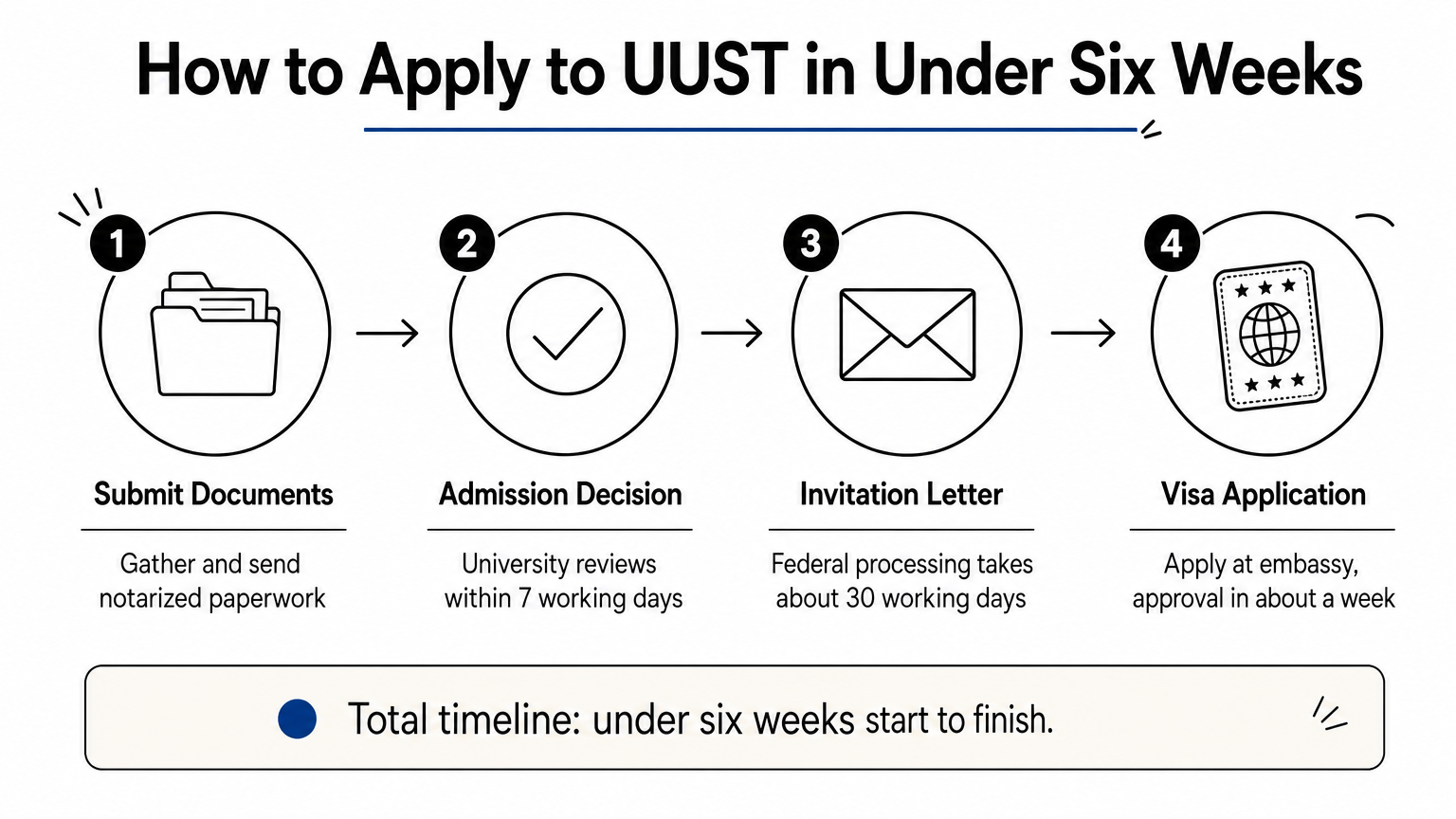
UUST publishes its admission windows for each intake (typically opening in June, with separate deadlines for state-funded and fee-paying places), but it doesn’t publish fixed day-counts for invitation letters or visas, since those steps run through Russian federal channels rather than the university itself. Because that part of the timeline isn’t within any agency’s control, the safer approach is to start the paperwork as early as possible ahead of your intended intake rather than work backward from an assumed number of weeks.
The invitation letter, not the admission decision, is what actually unlocks your visa appointment, and its processing time depends on federal channels the university doesn’t control.
Tuition fees and living costs for international students
Budgeting for Ufa University of Science and Technology starts with understanding that tuition is only part of the picture. Housing, food, and transport in Ufa run far cheaper than in Moscow or Saint Petersburg, which is one reason regional cities like this one attract cost-conscious applicants year after year.
Tuition by program type
UUST publishes its tuition rates on its admissions site for the current intake year, priced in rubles. Full-time engineering and IT bachelor’s programs mostly run 160,000 to 179,300 RUB per year, which converts to roughly $1,700 to $1,900 at current exchange rates; correspondence-format programs cost noticeably less. Because tuition is set in rubles, the USD figure moves with the exchange rate, so confirm the current published number before budgeting.
Pricing at UUST is published upfront on its own site, program by program, rather than negotiated case by case, which matters if you’ve dealt with agencies that quote different numbers depending on who’s asking.
If a university won’t publish its tuition before you apply, that’s a warning sign, not a negotiating tactic.
Housing and monthly expenses
UUST runs one main student campus in Ufa with 15 dormitory buildings and around 1,250 places reserved each year for incoming out-of-town and international students. Dormitory fees aren’t published in USD on the university’s public pages, so get the current rate directly from the admissions office or through a consultancy before budgeting a specific number; expect food, local transport, and personal expenses on top of whatever the dormitory costs. Private apartments exist near campus but cost more than dormitory housing, so most first-year international students start in university accommodation before deciding whether to move off-campus.
What your total first year looks like
Tuition alone for an engineering or IT program runs roughly $1,700 to $1,900 for the year; add dormitory fees, food, and transport, and Ufa still comes in well under a single semester at most Western universities. Get an exact all-in figure from the university’s current fee schedule or from a placement consultancy rather than relying on a generic estimate, since ruble-denominated costs shift with the exchange rate each intake year.
Popular degree programs and campus life at UUST
Beyond engineering, Ufa University of Science and Technology runs a wide academic catalog across 16 faculties and institutes, but international applicants tend to cluster around a handful of programs that offer the clearest career path back home. Knowing which programs actually attract foreign students, and why, helps you avoid picking a niche specialty with weak job prospects outside Russia.
The degree tracks that draw the most applications
Aviation-adjacent engineering fields lead enrollment among international students, a direct legacy of the university’s aviation-institute roots, taught through the Faculty of Aviation Engines, Power Engineering and Transport and the Advanced Engineering School "Motors of the Future." Computer science and IT programs, based in the Institute of Informatics, Mathematics and Robotics, have also grown fast, largely because tuition stays low while demand for software graduates keeps rising globally. Physics, chemistry, and materials science round out the strongest technical departments, alongside established law and economics institutes for students who want a non-engineering track.
- Aviation and mechanical engineering
- Computer science, IT, and applied informatics
- Electrical engineering and electronics
- Physics, chemistry, and materials science
- Law, economics, and management
Pick a program with a recognized professional pathway at an institute with real infrastructure behind it, not just a cheap price tag.
Campus life in a mid-sized Russian city
Compared to Moscow or Saint Petersburg, Ufa’s campus feels smaller and more manageable, especially for first-year students still adjusting to a new country. Dormitories cluster international students together, which naturally builds a support network among Indian, African, and Middle Eastern classmates facing the same adjustment period. Local student life includes cultural clubs, sports facilities, and prayer spaces that accommodate the university’s genuinely international mix, something regional Russian cities have gotten noticeably better at over the past decade.
Adjusting to language and academics
Because core programs are taught in Russian, the preparatory year matters more at UUST than at a university offering English-medium tracks. That year, run through the Institute of Continuing Education, pairs Russian-language instruction with academic groundwork so students aren’t dropped into lectures or lab work without the vocabulary to follow along. Students who treat that year as real preparation, rather than a formality to get through quickly, tend to perform noticeably better once the core curriculum starts.
Where to go from here
Ufa University of Science and Technology gives you what most international applicants actually need: a large, well-resourced institution with genuine engineering and IT infrastructure, published tuition you can plan around, and an admissions process that doesn’t stall on IELTS or TOEFL scores. The 2022 merger didn’t dilute its standing, it strengthened it, and the university’s own numbers on students, faculty, and facilities back that up better than any brochure could. What it does ask of you is a real commitment to learning Russian during your preparatory year, since that’s the language your degree will actually be taught in.
What’s left is the paperwork, and that’s where most applications either move fast or get stuck for months: notarized translations, the foreign-applicant portal, invitation letters, and embassy scheduling. None of it is hard, but all of it is easy to get wrong without someone who’s done it before. If you’re ready to move past research and start your actual application, talk to RUSBASE for a free consultation. We’ll walk you through UUST’s current published tuition and requirements and help you get your documents moving correctly the first time.
Questions About Your Own Case?
Requirements depend on your nationality and subject. Ask us directly, free of charge.
Book a Free Consultation