
FMGE Exam Syllabus: Subjects, Pattern, and Marks Distribution
September 21, 2026
If you’re planning to study MBBS abroad and return to practice in India, the fmge exam syllabus is the one thing you cannot afford to guess at. FMGE, the Foreign Medical Graduate Examination, decides whether your degree from Russia or any other country actually lets you practice medicine back home. Knowing exactly what it covers, before you even pick a university, changes how you prepare from day one.
This article gives you the full breakdown: every subject tested, the fmge exam pattern, and the fmge exam marks distribution across each section. You’ll also see the fmge exam total marks, the qualifying score, and how the paper is structured so there are no surprises on exam day.
We put this together because at RUSBASE, we place students into Russian medical universities recognized by WHO and NMC, and FMGE is the finish line every one of them eventually faces. Understanding the fmge exam marks early lets you choose a program and study plan that actually sets you up to clear it, not just get you a degree.
Why the FMGE syllabus matters for your medical career
Passing the FMGE isn’t a formality tacked onto your MBBS abroad, it’s the actual gate you walk through to practice medicine in India, so it helps to know what the FMGE exam is, its full form, and its purpose before anything else. The National Medical Commission requires every foreign medical graduate to clear this screening test before they can register with the Medical Council or get a state license. Skip understanding the fmge exam syllabus and you’re essentially studying blind for six years, hoping your university’s curriculum happens to line up with what India actually tests. It usually doesn’t line up perfectly, and that gap is where thousands of otherwise capable graduates get stuck year after year.

The syllabus decides how you study, not just what you study
Treating FMGE prep as a last-minute revision exercise after graduation is the single biggest mistake we see among students placed through international programs. The exam covers the same core subjects as any MBBS, Anatomy, Physiology, Pathology, Pharmacology, Medicine, Surgery, Obstetrics and Gynecology, and more, but the emphasis and question style are distinctly Indian. Clinical scenarios reference conditions and drug protocols common in Indian practice, not necessarily what’s emphasized in a Russian, Chinese, or Central Asian curriculum. Knowing this early lets you supplement your regular coursework with FMGE-specific reading from year one instead of cramming a foreign degree’s worth of knowledge into an Indian testing framework in the final months.
The FMGE syllabus isn’t extra material to memorize later, it’s the lens you should be studying through from your very first semester abroad.
A low pass rate makes syllabus mastery non-negotiable
FMGE pass rates have historically hovered in the range of 15 to 25 percent depending on the exam cycle, according to data released by the National Board of Examinations, which conducts the test. That’s not a reason to panic, but it is a reason to take subject-wise coverage seriously rather than relying on generic MBBS revision. Students who map their study schedule against the actual syllabus consistently outperform those who just re-read old textbooks cover to cover. The difference usually comes down to targeted repetition of high-yield topics rather than broad, unfocused review.
It affects which university and country you should even choose
Here’s the part most agents won’t tell you upfront: some foreign medical programs are structured closer to the FMGE syllabus than others, and that difference matters when you’re choosing where to study. Universities with strong clinical rotation hours in subjects like Medicine and Surgery, and curricula that don’t skimp on core diagnostics, tend to produce graduates who transition into FMGE prep more smoothly. This is exactly why we screen NMC-recognised medical colleges in Russia for curriculum quality and WHO recognition before we ever recommend one to a student, because the right degree should set up the right exam outcome, not work against it.
It shapes your timeline for licensing back home
Once you know the syllabus, you can reverse-engineer your entire academic calendar around it. Rather than treating your final year abroad as just "graduation season," you can build in structured FMGE mock tests, subject-wise revision blocks, and weak-area identification while you still have access to faculty and clinical exposure. Students who do this typically sit for FMGE within months of graduating, rather than losing a year figuring out what they should have studied. That head start compounds: earlier licensing means earlier internship placement, earlier practice rights, and a faster route to actually working as a doctor in India instead of sitting on a foreign degree that’s still in limbo.
Ultimately, the syllabus isn’t a bureaucratic checklist, it’s the roadmap connecting your foreign MBBS to your Indian medical career. Get familiar with it early, and every year of your degree becomes preparation rather than a scramble at the finish line.
How to use the FMGE exam pattern to plan your prep
Understanding the fmge exam pattern isn’t just trivia, it’s the framework that tells you how to allocate your study hours. FMGE is split into two papers, each held on the same day, and each paper carries 150 multiple-choice questions with four options and a single correct answer. There’s no negative marking, which changes your test-taking strategy completely: you should never leave a question blank, even a guess costs you nothing but might earn you a mark. Knowing this before your final year lets you build a preparation routine around speed and elimination technique, not just rote recall.
Break the exam down before you plan around it
Here’s the basic structure you’re working with:
| Component | Detail |
|---|---|
| Total papers | 2 (Paper 1 and Paper 2) |
| Questions per paper | 150 |
| Duration per paper | 2 hours 30 minutes |
| Question type | Single-best-answer MCQ |
| Negative marking | None |
| Mode | Computer-based test (CBT) |
Once you see the exam laid out this way, the prep strategy becomes obvious: you’re training for volume and accuracy under time pressure, not writing long-form answers. Practicing full-length mock papers under the same 150-question, 150-minute format matters more than reading extra reference books.
Study for FMGE the way you’ll actually take it: timed, MCQ-only, and with zero fear of guessing.
Build your prep calendar around the paper split
Paper 1 typically leans toward pre-clinical and para-clinical subjects like Anatomy, Physiology, Biochemistry, Pathology, Microbiology, Pharmacology, and Forensic Medicine. Paper 2 leans clinical, covering Medicine, Surgery, Obstetrics and Gynecology, Pediatrics, and Community Medicine, among others. Splitting your revision calendar to mirror this structure, rather than studying subjects in random order, keeps your recall sharp for each paper separately instead of blending everything together in the weeks before the exam.
Mirror this split with a simple weekly plan:
- Weeks 1 through 6: focus entirely on Paper 1 subjects, one subject per week with daily MCQ practice
- Weeks 7 through 12: shift fully to Paper 2 subjects using the same rhythm
- Weeks 13 and 14: full-length mock tests covering both papers back to back
- Final week: revisit only your weakest two or three subjects, don’t start anything new
Registration and scheduling details, along with the official pattern updates, are published by the National Board of Examinations, so check there each cycle rather than relying on secondhand notes. Once the pattern is clear in your head, the next step is matching your effort to where the marks actually sit.
FMGE marks distribution and subject-wise weightage
Once you understand the pattern, the next question is where the marks actually sit. The fmge exam total marks stand at 300, with each paper worth 150 marks and every correct answer earning one full mark. There’s no partial credit and no weightage bonus for harder questions, so a question on Anatomy counts exactly the same as one on Medicine. Passing requires a minimum of 150 marks out of 300, meaning you need to average 50 percent correct across both papers combined, not per subject. That single detail changes how you allocate revision time: a weak subject doesn’t sink you if you’re strong enough elsewhere, but ignoring high-yield subjects entirely almost always does.
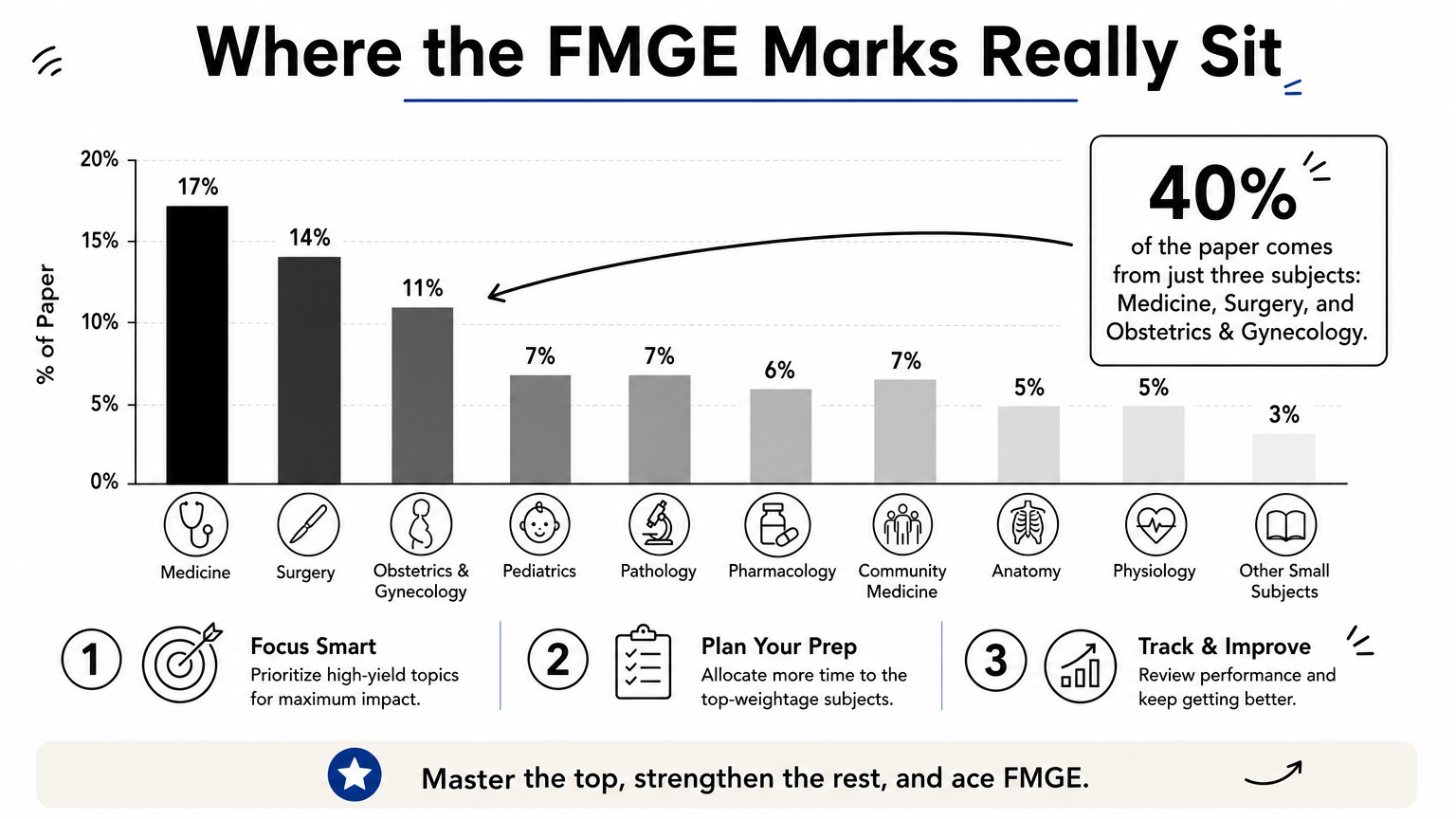
Fifty percent overall, not fifty percent per subject, is the number that should shape your entire revision strategy.
How weightage actually breaks down by subject
The fmge exam marks distribution isn’t published as a fixed percentage per subject by the National Board of Examinations, but analysis of past papers over multiple cycles shows a consistent pattern. Clinical subjects like Medicine, Surgery, and Obstetrics and Gynecology carry noticeably more questions than smaller subjects like Forensic Medicine or ENT, simply because they cover broader clinical ground. Use the table below as a practical guide, built from recurring patterns across recent exam cycles, to prioritize your study hours rather than spreading them evenly across all nineteen-odd subjects.
| Subject Group | Approximate Question Share |
|---|---|
| Medicine (incl. subspecialties) | 15-18% |
| Surgery (incl. subspecialties) | 13-15% |
| Obstetrics and Gynecology | 10-12% |
| Pediatrics | 6-8% |
| Pathology | 6-8% |
| Pharmacology | 5-7% |
| Microbiology | 5-6% |
| Community Medicine (PSM) | 6-8% |
| Anatomy | 4-5% |
| Physiology | 4-5% |
| Forensic Medicine, ENT, Ophthalmology, Dermatology, Psychiatry, Anesthesia, Radiology (each) | 2-4% |
Given this spread, treating every subject as equally important is a common but avoidable mistake. Students who chase fmge exam marks efficiently spend disproportionately more hours on Medicine, Surgery, and Obstetrics and Gynecology, since together these three groups can account for close to 40 percent of the entire paper. Smaller subjects still matter, especially since there’s no negative marking to punish a guess, but they shouldn’t eat into the hours you owe to the high-weightage clinical subjects. Rather than guessing at this balance on your own, cross-check your revision plan against a few recent question papers so your effort actually mirrors what the exam rewards.
A sample revision timeline based on subject weightage
Given the marks distribution above, a generic 12-week countdown that treats every subject equally wastes your best hours on low-yield chapters. Instead, build your calendar so the subjects carrying the most fmge exam marks get the most repetitions, and the smaller subjects get just enough time to lock in the basics. This isn’t about studying less, it’s about studying in the order the exam actually rewards.
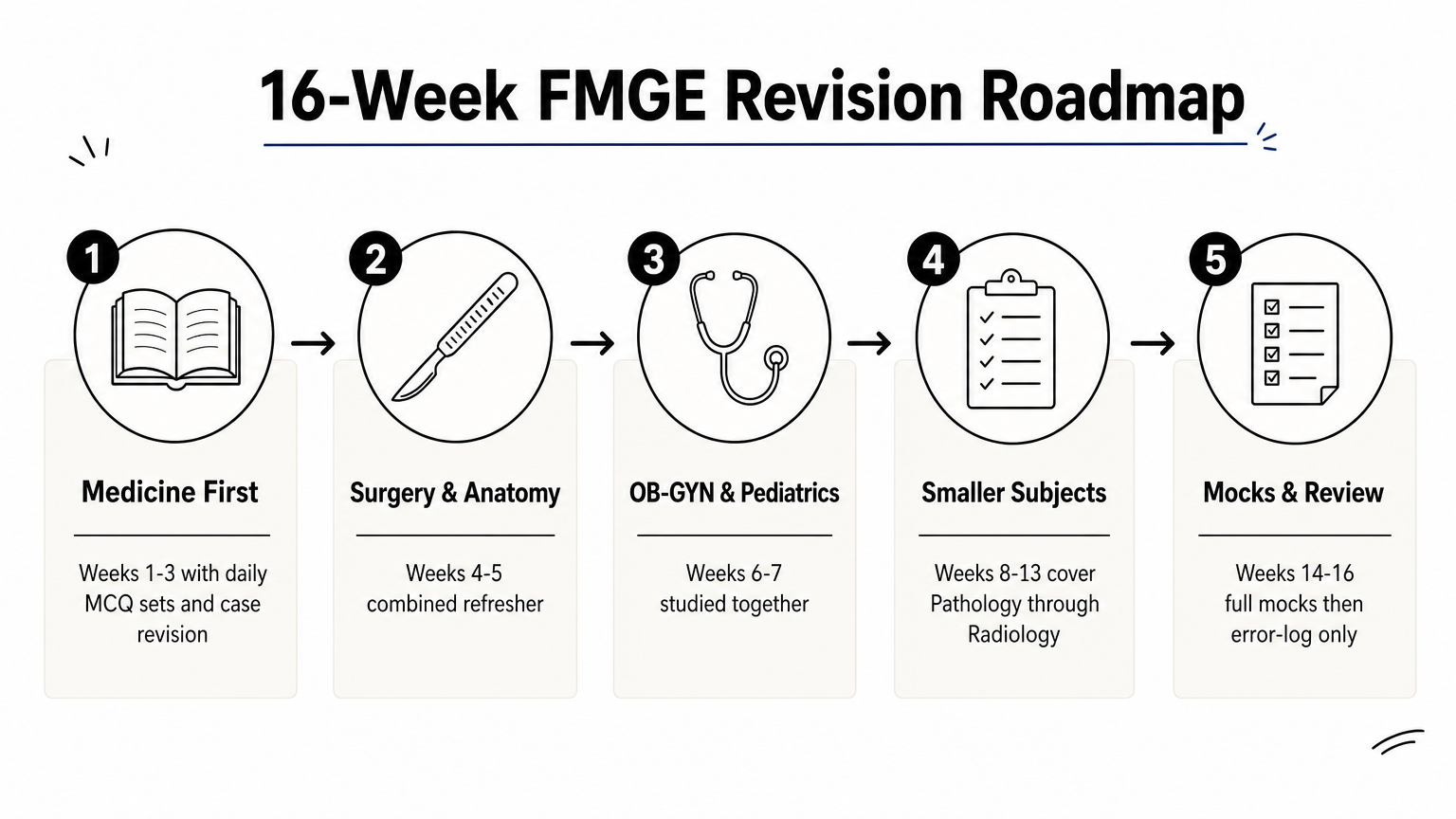
Mapping weeks to weightage
Assume you have roughly 16 weeks before your exam date, which is a realistic window for most final-year students abroad. Split that time so the high-weightage clinical subjects get double the hours of the smaller ones, and leave dedicated weeks for full-length mocks rather than squeezing them in at the end.
- Weeks 1-3: Medicine, with daily MCQ sets and case-based revision
- Weeks 4-5: Surgery, paired with a quick Anatomy refresher since the two overlap heavily
- Weeks 6-7: Obstetrics and Gynecology, alongside Pediatrics
- Weeks 8-9: Pathology and Microbiology together, since question styles often cross over
- Week 10: Pharmacology, with heavy emphasis on drug classes and side-effect profiles
- Week 11: Community Medicine (PSM), which rewards memorization more than reasoning
- Week 12: Physiology and Biochemistry combined revision
- Week 13: Forensic Medicine, ENT, Ophthalmology, Dermatology, Psychiatry, Anesthesia, and Radiology, one day per subject
- Weeks 14-15: Full-length mock tests replicating the real fmge exam pattern, both papers back to back
- Week 16: Error-log review only, no new material
Give the exam your best hours on Medicine, Surgery, and Obstetrics and Gynecology, and the smaller subjects will still fit into what’s left.
Adjusting the plan closer to exam day
Nothing about this timeline is fixed, and you shouldn’t treat it that way. Track your mock test scores subject by subject starting around week 10, and shift extra days toward whichever section keeps pulling your overall percentage down. Ratios matter more than dates here: if Surgery mocks stay weak while Physiology is already solid, borrow a few days from Physiology without guilt. Reviewing your error log after every mock, rather than just noting the score, tells you whether you’re missing concepts or just misreading questions under time pressure, and that distinction changes what you do with your remaining weeks.
Finally, resist the urge to add brand-new subjects or resource books in the last two weeks. Consolidation beats exposure at that stage, and switching sources this late usually costs more than it gains. A timeline built around actual weightage, adjusted with real mock data, gets you to exam day with confidence instead of guesswork.
Turning the syllabus into a study plan
Knowing the fmge exam syllabus, the exam pattern, and the marks distribution only helps if you act on it before you even step onto campus. The biggest advantage doesn’t come from cramming harder in your final year, it comes from choosing a university and curriculum that already lines up with what FMGE tests, so every semester abroad builds toward the exam instead of away from it. Weightage tells you where to spend your hours, the paper split tells you how to organize your calendar, and a realistic timeline turns both into daily habits instead of vague intentions.
Since your MBBS destination shapes how smoothly that transition happens, it’s worth getting guidance before you commit to a program. At RUSBASE, we place students into WHO and NMC recognized Russian medical universities with FMGE outcomes in mind from day one. Book a free consultation with our advisers and build a study-abroad plan that actually sets you up to clear FMGE, not just earn a degree.
Questions About Your Own Case?
Requirements depend on your nationality and subject. Ask us directly — free.
Book a Free Consultation