
FMGE Exam: What It Is, Full Form, and Purpose
September 19, 2026
If you’re planning to study medicine abroad, you’ve probably seen the term FMGE thrown around and wondered what it actually means for your career. The fmge exam is the licensing test every Indian student who graduates from a foreign medical university must clear before practicing medicine in India, and it catches a lot of families off guard when they discover it late in the planning process.
So here’s the direct answer: FMGE stands for Foreign Medical Graduate Examination, a screening test conducted by the National Board of Examinations that checks whether your MBBS-equivalent degree from a country like Russia meets Indian clinical standards. It’s a single, computer-based paper covering the full MBBS syllabus, and understanding its eligibility rules and duration early saves you from surprises after you’ve already enrolled.
In this article, we’ll break down the exam’s full form, its exact purpose, who needs to take it, how long it runs, and the dates that matter most. As a consultancy that places students into recognized Russian medical universities, we walk families through this exact question every week, so we’re covering it the way we’d explain it to you directly.
Why the FMGE exam matters for foreign medical graduates
Without clearing this test, a medical degree earned outside India is essentially a certificate you can frame but can’t use. The National Medical Commission requires every Indian citizen who studies medicine abroad to pass this screening exam before they can register with a State Medical Council or the NMC itself and legally treat patients. This is what the fmge exam means in practical terms: it’s not a formality tacked onto your degree, it’s the actual gate between graduating and working as a doctor in India.

The legal gate to practicing medicine in India
The requirement traces back to the Screening Test Regulations, first notified in 2002 and enforced consistently since. If your MBBS-equivalent degree comes from Russia, Georgia, the Philippines, or any other country, the rule applies the same way, regardless of how well-ranked your university is abroad. Skipping this step isn’t an option if you want a medical license in India, and no amount of academic excellence overseas substitutes for it.
The fmge exam is for one purpose only: confirming you’re safe and qualified to practice medicine on Indian patients.
What the fmge exam is for beyond just checking a box
Beyond the legal requirement, the exam exists to standardize clinical competency across a very diverse pool of foreign medical graduates. Students return from dozens of countries, each with different teaching styles, clinical exposure, and curriculum depth. The National Board of Examinations built this test to make sure everyone entering Indian practice, no matter where they trained, meets a consistent baseline in subjects like medicine, surgery, pediatrics, gynecology, and community health. That’s the real fmge exam meaning behind the paperwork: quality control at a national scale.
Why it matters more if you studied in Russia
Russia sends a large share of India’s foreign medical graduates each year, which means Russian-trained students appear in FMGE numbers more than almost any other group. Historical pass rate data published by the NBE shows foreign graduates clearing the exam at meaningfully lower rates than domestic MBBS students, often somewhere in the 20 to 30 percent range depending on the year and country of study. That gap isn’t because Russian medical education is weak. It’s usually because students aren’t taught to the exact exam format, or their university lacks strong FMGE-focused clinical training in the final years.
This is exactly why choosing a university with a track record of FMGE-oriented preparation matters as much as choosing one with WHO and NMC recognition. At RUSBASE, we only place students in recognized Russian medical universities that align their teaching with what the screening exam actually tests, because a degree that doesn’t lead to a license isn’t much of an investment. Recognition alone confirms your degree is valid on paper; clearing FMGE confirms you can actually practice with it.
Understanding this connection early, before you even choose a university, changes how you plan your entire five or six years abroad. Students who know from day one that FMGE prep needs to run parallel with their coursework consistently perform better than those who start studying for it only after graduation.
Who is eligible to take the FMGE exam
Eligibility for this exam isn’t automatic just because you hold a medical degree from another country. You must be an Indian citizen or Overseas Citizen of India who completed a primary medical qualification abroad, and that qualification has to be recognized in the country where you studied. If you’re wondering who the fmge exam is for, this is the short answer: it’s built specifically for Indian nationals returning home after finishing MBBS-equivalent training overseas, not for foreign nationals or dual citizens practicing outside India.
No Eligibility Certificate before your course, no FMGE registration after it, that’s the rule the NMC won’t bend on.
Getting the Eligibility Certificate from the National Medical Commission before you even enroll abroad is non-negotiable. Skipping this step is one of the most common mistakes families make, and it can block you from sitting the exam entirely no matter how strong your degree is. Here’s what typically needs to be in place:
- An Eligibility Certificate issued by the NMC prior to admission in the foreign university
- Completion of a primary medical course lasting at least 54 months, plus a rotating internship
- A degree from a university and country recognized on the NMC’s approved list
- Original mark sheets, degree certificate, and internship completion proof ready for verification
- No pending disciplinary or academic disqualification from your home state medical council
Qualification alone won’t get you registered, either. The internship completed at your foreign university generally needs to run parallel with, or shortly after, your final academic year, and its duration matters just as much as your coursework. Requirements shift slightly depending on when you started your course, since regulations have been updated more than once since 2002, so checking your specific batch year against current NMC notifications is worth the extra ten minutes.
Students who arrange their Eligibility Certificate through a consultancy familiar with NMC paperwork rarely run into last-minute rejections. RUSBASE handles this verification step for every student we place, confirming eligibility before enrollment rather than after graduation, which is exactly when most of these problems tend to surface for students who went it alone.
How to apply for the FMGE exam
Applying for the fmge exam happens entirely online through the National Board of Examinations’ official portal, and the process runs twice a year, once in June and again in December. Registration windows typically open a few months before each test date, so marking your calendar the moment your final semester abroad wraps up saves you from scrambling later. Most students apply during their last year of coursework or shortly after returning to India with their provisional degree documents in hand.
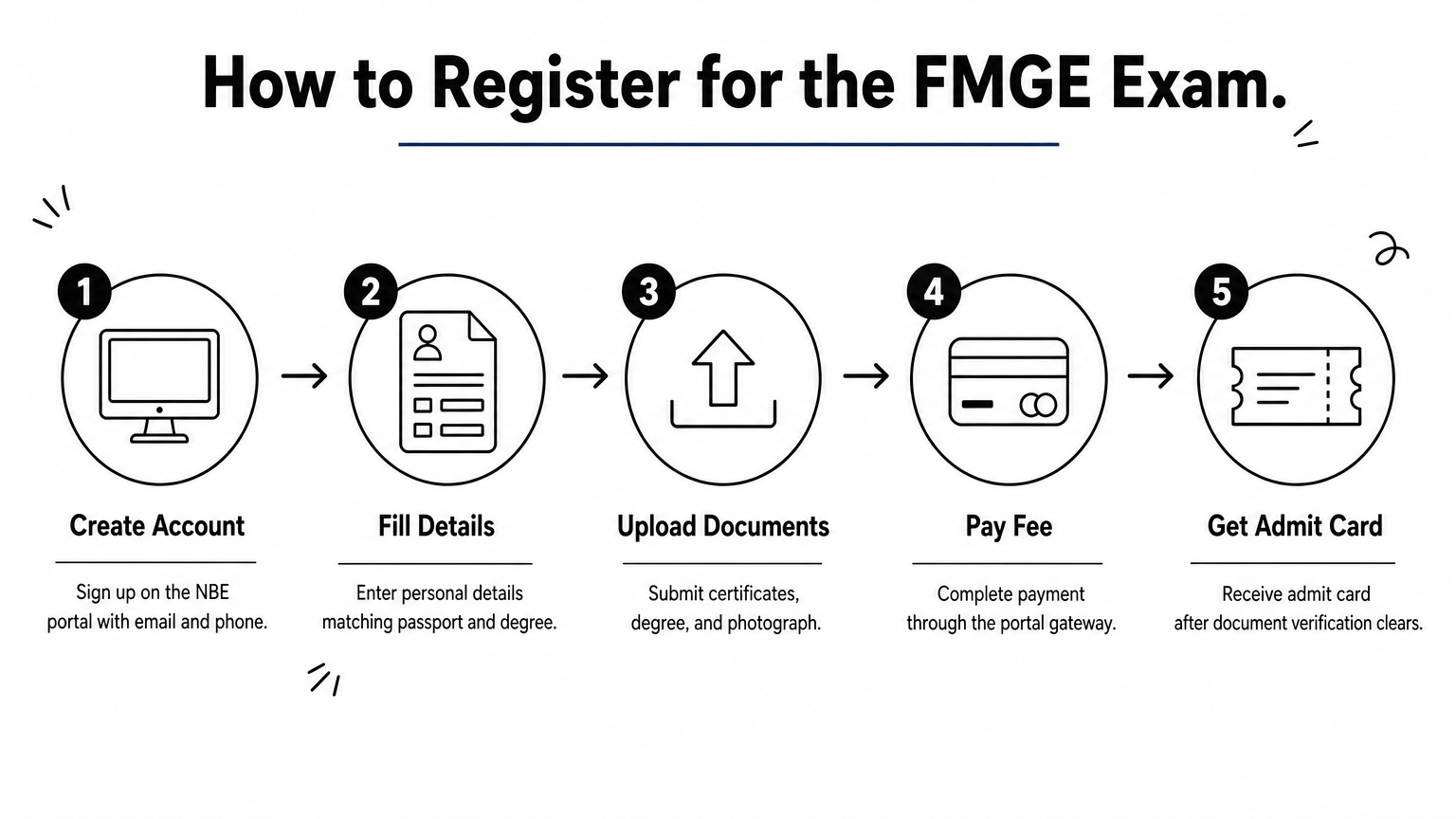
Step-by-step registration process
Getting registered isn’t complicated once you have your paperwork sorted, but missing a single document can delay your entire application cycle. Here’s the general sequence:
- Create an account on the NBE’s official examination portal using a valid email and phone number.
- Fill in personal details exactly as they appear on your passport and degree certificate.
- Upload scanned copies of your Eligibility Certificate, provisional or final degree certificate, internship completion proof, and passport-size photograph.
- Pay the prescribed exam fee through the portal’s payment gateway.
- Submit the form and download your confirmation for records.
- Wait for your admit card, which is released closer to the exam date once document verification clears.
Skip a document at registration, and you’ll lose an entire testing cycle waiting for the next one.
Documents that trip people up
Russian universities issue degree certificates in formats that sometimes confuse first-time applicants, particularly around apostille and translation requirements. Officially attested translations of your mark sheets and internship certificates need to match NBE’s exact specifications, not just a general translation stamp from your university. Failing verification at this stage is one of the top reasons students miss a session entirely, even after passing every academic requirement abroad.
Gathering everything before your final semester ends, rather than after you land back in India, gives you breathing room if corrections are needed. RUSBASE handles document preparation and translation as part of our full-service support, so students we place rarely face the last-minute rejections that catch others off guard during registration.
FMGE exam pattern, duration, and syllabus
Knowing the exact structure of this test before you start preparing saves you from wasting months on the wrong study approach. The fmge exam duration is fixed at three hours, split across two papers of 150 multiple-choice questions each, for a total of 300 questions in a single sitting day. Each question carries one mark, with no negative marking, which changes your test-taking strategy compared to exams like NEET where guessing carries a penalty.
Exam format and structure
Questions arrive as a computer-based test, delivered at designated centers across India rather than on paper. You’ll need to score at least 50 percent, meaning 150 marks out of 300, to clear the exam. Here’s how the format breaks down:
| Component | Details |
|---|---|
| Total questions | 300 (150 per paper) |
| Total duration | 3 hours |
| Question type | Single-best-answer MCQs |
| Negative marking | None |
| Passing score | 50% (150/300) |
| Mode | Computer-based test |
Clearing this exam comes down to breadth, not depth: 300 questions across the entire MBBS curriculum in a single sitting.
Syllabus coverage across subjects
Subjects tested mirror the standard MBBS curriculum you’d have covered abroad, so nothing on the syllabus should feel unfamiliar in theory. Coverage spans anatomy, physiology, biochemistry, pathology, pharmacology, microbiology, forensic medicine, medicine, surgery, obstetrics and gynecology, pediatrics, ophthalmology, ENT, orthopedics, and community medicine. Weightage leans heavily toward clinical subjects like medicine and surgery, which together often account for a large share of total questions, so students who focus revision time proportionally tend to score better than those who study every subject equally.
Revision strategy matters as much as raw knowledge here. Students who studied in Russia often need extra practice translating clinical scenarios into the exact phrasing Indian exams use, since teaching styles differ even when the underlying medical content is identical. Working through previous years’ question banks alongside your final year of coursework, rather than starting cold after graduation, consistently produces stronger results among the students we’ve guided through this exact transition.
What happens after you clear the FMGE exam
Passing the fmge exam turns your foreign degree from a piece of paper into an actual license to practice. Once the National Board of Examinations declares your result, you receive a pass certificate that you then submit to the National Medical Commission or your State Medical Council to complete permanent registration. This registration is what legally allows you to prescribe medicine, sign death certificates, and practice as a doctor anywhere in India, so this step is the entire reason you sat the exam in the first place.

Clearing FMGE doesn’t make you a doctor by itself, registering with the medical council does.
Getting your permanent registration
Registration isn’t automatic just because you passed. You still need to submit a defined set of documents and wait for council processing, which typically takes a few weeks depending on your state. Here’s what the process usually looks like:
- Submit your FMGE pass certificate along with your final degree and internship completion proof.
- Apply to either the NMC or the relevant State Medical Council, depending on where you plan to practice.
- Pay the registration fee and complete any state-specific formalities.
- Receive your registration number, which you’ll use on prescriptions and medical documents going forward.
- Renew registration periodically as required by your state’s medical council rules.
Surgery, general practice, or specialization all become open to you once this number is issued, and most graduates start applying for junior residencies or clinical positions almost immediately after.
What if you don’t clear it the first time
Failing isn’t the end of the road, though it does mean waiting for the next cycle. Since the exam runs twice yearly, unsuccessful candidates simply re-register for the next June or December session with no cap on the number of attempts allowed. Many students who fail their first attempt do so because they underestimated the volume of MCQs rather than lacking clinical knowledge, so a focused second round of question-bank practice usually closes that gap. Retaking the exam costs time, not opportunity, since your degree and eligibility remain valid indefinitely.
Planning your path forward
Clearing the fmge exam isn’t a hurdle you deal with after graduation, it’s a target you plan for from the moment you pick a university abroad. Everything covered here, from eligibility certificates to exam pattern to registration, points to one truth: the choices you make in year one abroad shape how easy or hard this exam feels in year six. Families who treat FMGE as an afterthought consistently struggle more than those who build it into their study plan from the start.
Getting this right means choosing a Russian medical university that actually prepares you for Indian licensing, not just one with a recognized name. That’s the entire reason RUSBASE exists as a consultancy, and it’s why we walk every student through this exact FMGE conversation before they ever sign an enrollment form. If you’re weighing your options, talk to our advisers at RUSBASE and start your placement with the exam already factored into the plan.
Questions About Your Own Case?
Requirements depend on your nationality and subject. Ask us directly — free.
Book a Free Consultation