
Kazan Federal University: Programs, Rankings, and Admissions
September 22, 2026
Searching for Kazan Federal University usually means you have already heard it mentioned alongside Russia’s cheaper, English-friendly medical degrees, and you want to know if the reputation holds up. Maybe a friend studies there, or an agency mentioned it, but you still need actual facts: how the university ranks, what programs it teaches in English, and whether admission is realistic for someone outside Russia.
This article gives you that picture directly. You will find the university’s academic standing, its history as one of Russia’s oldest institutions, and details on the Kazan Federal Medical University program that draws most international applicants. We also cover tuition ranges, degree structure, and what the admissions process actually looks like from application to acceptance letter.
We work with students applying to Kazan and similar Russian universities every week, so this rundown reflects what applicants actually ask us before committing, not just published brochures. By the end, you will know whether Kazan fits your budget, your subject, and your timeline, and what steps come next if it does.
Why choose Kazan Federal University for your studies
Kazan Federal University sits in the top tier of Russian higher education, and that reputation is not marketing spin. It holds National Research University status, a title the Russian government reserves for institutions that combine strong teaching with active research output, and it has been part of the Project 5-100 initiative aimed at pushing select Russian universities into global rankings. For international students weighing Kazan against other destinations, that combination of age, funding, and research output matters more than a glossy campus tour.

A history that predates most Western medical schools
Founded in 1804, Kazan Federal University is one of the oldest universities in Russia, older than most institutions in the UK or US that international students consider today. Nikolai Lobachevsky, the mathematician who developed non-Euclidean geometry, taught and later served as rector here. Leo Tolstoy studied at Kazan before dropping out, and Vladimir Lenin was briefly enrolled before his expulsion for political activity. That lineage is not just trivia. It reflects an institution with deep academic infrastructure, established laboratories, and a medical faculty that has trained doctors for well over a century rather than one built to capture the recent wave of international applicants.
Where KFU stands in the rankings
Kazan consistently appears in the QS World University Rankings and Times Higher Education tables, usually placing among the top five to ten universities within Russia depending on the subject area and year. It ranks particularly well in subjects like chemistry, linguistics, and clinical medicine.
| Metric | Kazan Federal University |
|---|---|
| Founded | 1804 |
| University status | National Research University |
| Typical Russia national rank | Top 5-10 |
| Notable subject strength | Medicine, chemistry, linguistics |
| International students | Thousands, from 90+ countries |
A 200-year-old research university with global rankings and a medical faculty gives you something a brochure can’t: an institution proven over time, not built for the international admissions market.
English-taught medical programs without an IELTS barrier
Most students researching Kazan Federal Medical University care less about rankings tables and more about one practical question: can I study medicine in English without an IELTS or TOEFL score? At KFU, the answer is generally yes. The MBBS-equivalent medical program runs in English for the full six-year course, and admission does not require a standardized English test score for most applicants. This matters enormously for students who are strong academically but have not had access to test prep, or who simply want to avoid the cost and delay of scheduling an exam before applying. It removes a barrier that stops many capable students from even starting an application to universities in the UK, US, or Canada.
A genuinely international student community
Kazan hosts a sizable international student population, drawing heavily from India, Africa, the Middle East, and Central Asia, alongside domestic Russian students. Walking through the medical faculty buildings, you will hear a mix of Hindi, English, Arabic, and Russian in the same hallway. That mix matters practically: it means established support systems, senior students who can answer questions newcomers have, and a campus culture already used to accommodating dietary needs, religious practices, and different academic backgrounds. Choosing a university with this track record of hosting foreign students reduces the culture shock that catches many first-time international students off guard, and it gives you a peer network before you even land in Russia.
How to apply to Kazan Federal University
Getting into Kazan Federal University is more paperwork than exam pressure. Unlike UK or US applications that hinge on standardized test scores and personal statements, KFU admission for international students runs on document verification and academic transcripts. You will not sit an entrance exam for most bachelor’s or medical programs, but you do need every document translated, notarized, and submitted in the right order, and mistakes at this stage cause more delays than any other part of the process.
What you need before you apply
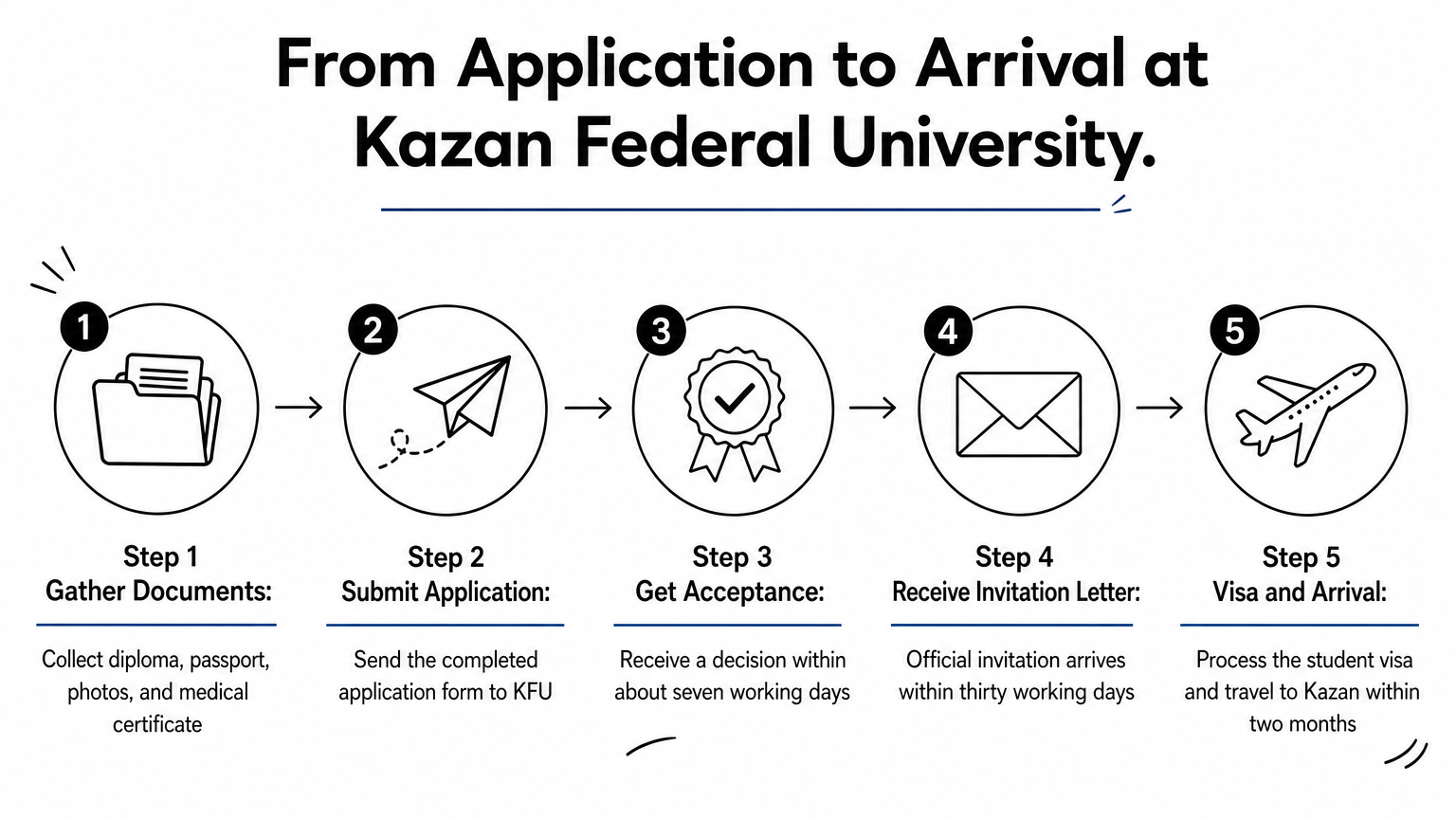
Before you even contact the university, gather the paperwork that proves you finished secondary school and can legally study abroad. Missing one item at the embassy stage can push your arrival back by months, so treat this list as non-negotiable:
- High school diploma and transcripts, translated into English or Russian and notarized
- Valid passport with at least 18 months remaining before expiry
- Passport-sized photographs matching Russian visa specifications
- Medical certificate, including an HIV test result, usually required before the student visa is issued
- Application form for the specific university and program
The typical timeline from application to arrival
Once your documents are in order, the process moves faster than most applicants expect. Here is roughly what to plan for:
| Stage | Typical timeframe |
|---|---|
| Document review and university shortlisting | 1-3 days |
| Acceptance decision from KFU | Within 7 working days |
| Official invitation letter issued | Within 30 working days |
| Student visa processed at embassy | About 1 week |
| Arrival and settling in Russia | Within 2 months of starting |
The application itself rarely fails; incomplete or improperly translated documents are what stall a Kazan admission.
Submitting directly to Kazan Federal University is possible, but most international applicants underestimate how strict Russian universities are about document formatting, apostille requirements, and translation standards, which is exactly where an error costs weeks rather than days. This is the part of the process where a dedicated study-abroad consultancy earns its keep: checking every document before submission, tracking the invitation letter, and coordinating with the visa section so nothing sits unanswered in an inbox. If you want that guided path instead of managing embassy paperwork solo, RUSBASE handles the entire application and visa sequence for Kazan and its partner universities, and you can book a free consultation to see where your documents stand today.
Medical program and degree recognition at KFU
Medicine is the reason most international students ever look up Kazan Federal University in the first place, and the medical faculty deserves that attention. The General Medicine (MBBS-equivalent) program runs six years, taught fully in English, and covers the same core sequence you would expect anywhere: two years of pre-clinical subjects like anatomy, physiology, and biochemistry, followed by four years of clinical rotations in affiliated hospitals across Kazan. Students dissect in real anatomy labs, not just simulations, and clinical years put you in front of actual patients under supervising physicians, which is exactly the hands-on training international students often worry they will not get from a lower-cost degree.
Where the degree is recognized
A medical degree only matters if bodies outside the classroom accept it, and this is where Kazan Federal Medical University graduates have a real advantage. The program is listed in the WHO World Directory of Medical Schools, the global reference database that licensing bodies check before recognizing a foreign medical qualification. It also carries recognition from the National Medical Commission (NMC) in India, which matters enormously given how many Kazan applicants come from Indian states. Recognition at this level confirms the degree meets international structural standards, not that you can practice medicine the moment you graduate.
Recognition from WHO and NMC confirms your degree is real; passing your home country’s licensing exam is still entirely on you.
What recognition does not guarantee
Here is the distinction that trips up families rushing an admissions decision: WHO and NMC listing means the university and program are legitimate, not that licensing is automatic. Graduates returning to India, for example, still sit the FMGE or NExT exam before practicing, exactly as graduates from any other foreign medical university do. Students headed elsewhere face their own country’s equivalent screening exam. RUSBASE tells applicants this upfront rather than glossing over it, because a student who understands the licensing exam requirement going in studies differently than one who assumes the degree alone opens a clinic door.
Why the clinical training holds up
Since Kazan’s teaching hospitals handle real patient loads year-round, clinical rotations expose students to case volumes comparable to what they would see at mid-sized hospitals in their home countries. That volume, combined with faculty who have trained doctors for generations, is why Kazan’s medical graduates consistently perform reasonably on international licensing exams despite the lower tuition cost.
Degree programs and faculties at KFU
Medicine draws the headlines, but Kazan Federal University runs a full academic institution with 16 institutes and faculties covering nearly every major subject a student might want. International applicants often assume KFU is a medical school with a few extra departments attached, but the reality is closer to a comprehensive research university that happens to have an exceptionally strong medical faculty. Engineering, IT, economics, and the humanities all carry accreditation and research funding comparable to what the medical faculty receives.
The main institutes international students consider
Outside medicine, three faculties attract the bulk of foreign applicants: the Institute of Computer Science and Information Technology, the Institute of Management, Economics and Finance, and the Institute of Physics. Each offers bachelor’s and master’s tracks, and several run partial or full English-language instruction to accommodate students who arrive without Russian language skills.
| Faculty/Institute | Popular programs | Language of instruction |
|---|---|---|
| Institute of Fundamental Medicine and Biology | General Medicine, Dentistry, Pharmacy | English/Russian |
| Institute of Computer Science and IT | Software Engineering, Data Science | English/Russian |
| Institute of Management, Economics and Finance | Business Administration, Economics | English/Russian |
| Institute of Physics | Applied Physics, Nanotechnology | Russian (some English tracks) |
| Institute of Philology and Intercultural Communication | Linguistics, Translation Studies | Russian |
Kazan’s strength outside medicine is real, but English-taught options thin out fast once you leave the medical and IT faculties.
Bachelor’s, specialist, and master’s structures explained
Russian universities don’t always map cleanly onto the degree names international students recognize, so it helps to know the structure before you apply. Bachelor’s programs typically run four years, master’s programs run two years on top of that, and medicine follows its own six-year specialist degree track rather than the bachelor’s-master’s split. Postgraduate research through a PhD-equivalent aspirantura program is also available for students who complete a master’s at Kazan or elsewhere and want to stay for doctoral work.
Students comparing faculties should weigh language of instruction as heavily as subject strength. Applying to a Russian-taught engineering program without prior language study means committing to a preparatory year first, while medicine, IT, and business programs let you start coursework in English from day one. That distinction shapes total program length and cost more than the ranking tables ever will.
Tuition fees and cost of living in Kazan
Money is usually the deciding factor for families comparing Kazan against universities in the UK, US, or Canada, and the numbers are not close. Tuition at Kazan Federal University for the English-taught medical program typically runs far below what a comparable seat costs in Western institutions, and the university publishes these figures rather than making applicants request a quote. That transparency matters when you’re budgeting six years in advance, since a program that hides its real cost until after you’ve applied usually means the number goes up, not down.
What tuition actually costs by program
Before committing, compare tuition across the programs international students consider most, since medicine, engineering, and business degrees carry different price points despite similar teaching quality.
| Program | Approx. annual tuition (USD) | Program length |
|---|---|---|
| General Medicine (MBBS-equivalent) | $4,000-$6,000 | 6 years |
| Dentistry | $5,000-$7,000 | 5 years |
| Engineering/IT bachelor’s | $2,500-$4,000 | 4 years |
| Business/Economics bachelor’s | $2,000-$3,500 | 4 years |
Six years of medical tuition at Kazan can cost less than a single year at many Western medical schools, without sacrificing WHO-recognized training.
Living costs beyond tuition
Housing eats up the second-largest share of a student’s budget, and Kazan keeps this affordable compared to Moscow or Saint Petersburg. University dormitories typically cost $50-$100 a month, while private apartments shared with roommates run $150-$300 depending on location and condition. Groceries, transportation, and mobile data for a single student usually add another $150-$250 a month, putting total monthly living expenses somewhere between $250 and $450 for most students who aren’t chasing a luxury lifestyle.
Comparing total cost against Western alternatives
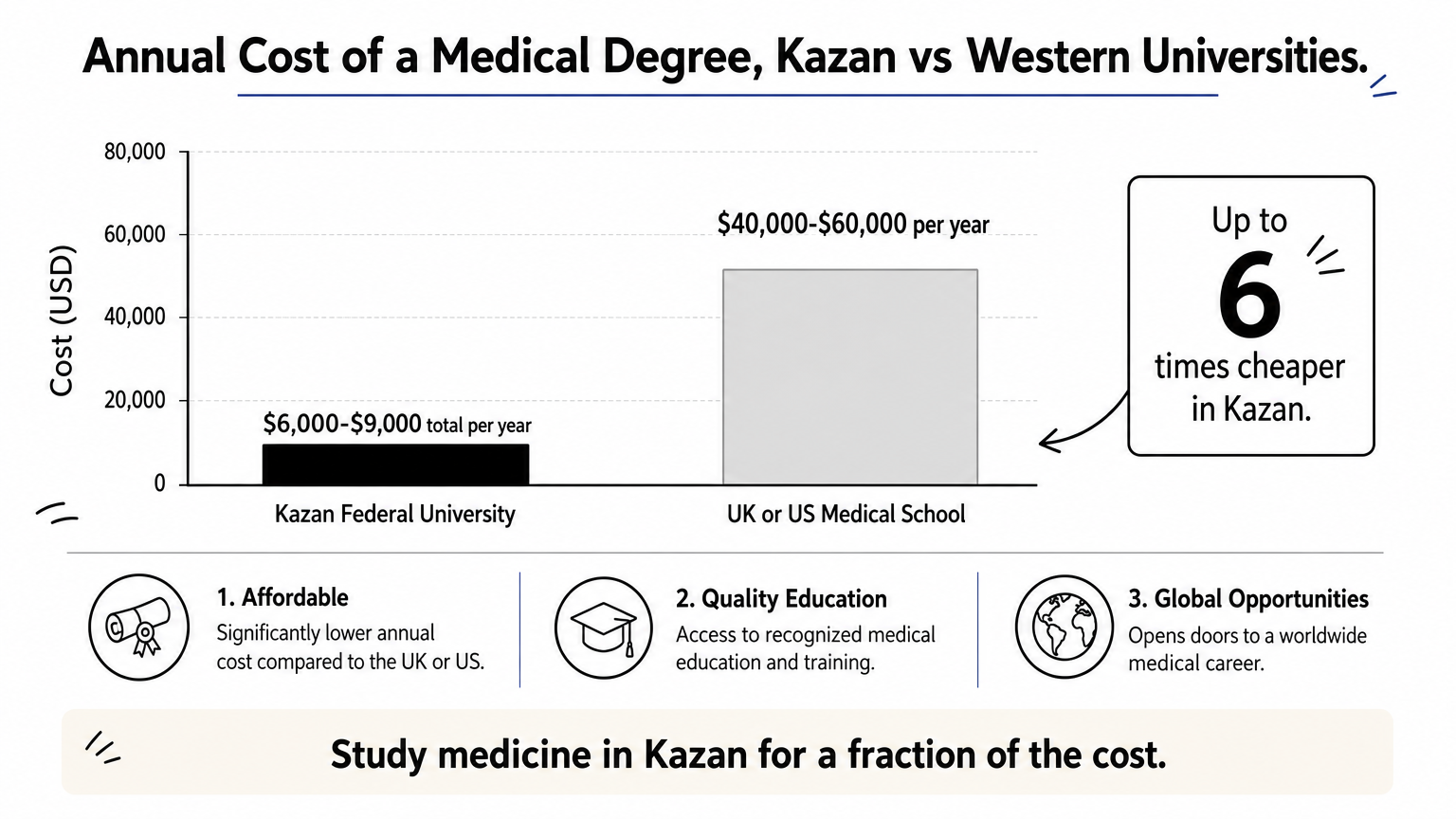
Adding tuition and living costs together tells the real story. A student in Kazan can expect to spend somewhere around $6,000-$9,000 a year all-in for a medical degree, while equivalent programs in the UK or US routinely exceed $40,000-$60,000 a year once tuition, housing, and insurance are factored in. That gap is not marginal; it’s the difference between a family financing six years comfortably and one taking on decades of student debt. Budgeting for Kazan should still include a buffer for flights home, visa renewal fees, and health insurance, since these get overlooked when students only compare headline tuition numbers between countries.
Campus life and student support at KFU
Student life at Kazan Federal University runs on a rhythm that international applicants rarely expect from a Russian city. Kazan itself is a multicultural capital with a large Muslim population, mosques and churches within blocks of each other, and a city government that actively courts foreign students. That context shapes daily life more than most rankings tables ever could, since a supportive campus culture matters just as much as academic strength once you’re actually living there.
Housing and dormitory life
Most first-year international students live in university dormitories, and KFU runs several specifically for foreign students near the medical faculty. Rooms are shared, usually two to three students per unit, with communal kitchens and bathrooms on each floor. Basic but functional describes it accurately: heating works reliably through Kazan’s cold winters, Wi-Fi is standard, and security staff check ID at the entrance around the clock. Students who want more privacy after their first year typically move to private apartments once they know the city and have found roommates they trust.
Support systems for international students
Every faculty at KFU maintains an international student office that handles the paperwork locals take for granted: visa registration renewals, migration card updates, and translation help for anything official. Students also get access to:
- Russian language courses, often mandatory in year one for non-medical programs
- Buddy or mentor systems pairing new arrivals with senior international students
- Medical insurance coordination through the university’s partner clinics
- Religious accommodation, including prayer rooms and halal food options in several dining halls
A university that handles visa renewals and religious accommodation without students having to ask is the kind of support that keeps international students enrolled and finishing their degree.
Food, community, and daily life
Dining near campus reflects who actually studies there. Indian, Middle Eastern, and Central Asian restaurants cluster around student housing, and several dormitory cafeterias now offer halal and vegetarian options as standard rather than special request. Community matters here too: student associations organized by nationality host regular events, which gives newly arrived students an instant social circle instead of months of isolation.
Safety and getting around
Kazan ranks among Russia’s safer major cities, and public transport, buses, the metro, and ride-hailing apps, makes getting to class or the hospital rotations straightforward without needing a car. For families worried about sending a teenager abroad for the first time, that combination of low crime, walkable neighborhoods, and an established international community answers a concern that tuition numbers alone never address.
Deciding on Kazan Federal University
Kazan Federal University earns its reputation through substance, not marketing. You get a 200-year-old research institution, a WHO-recognized medical program taught fully in English, no IELTS requirement, and tuition that leaves families with money left over rather than debt. Add a genuinely international student body and a city that already knows how to support foreign students, and the case for Kazan holds up under scrutiny rather than falling apart once you dig into it.
What still trips up applicants is the paperwork: translations, apostilles, visa timing, and knowing which documents actually satisfy the embassy. That’s the part worth getting right the first time, since a rejected invitation letter or a missed deadline costs months you don’t get back.
If Kazan fits your budget and your subject, don’t navigate that process alone. Book a free consultation with RUSBASE and get a straight answer on whether your documents and timeline are ready to move forward.
Questions About Your Own Case?
Requirements depend on your nationality and subject. Ask us directly — free.
Book a Free Consultation