
MBBS Education in Russia: The Complete Guide for Students
September 13, 2026
If you’re comparing options for MBBS education in Russia, you’ve probably already found a dozen agents promising the world and quoting different numbers for the same university. That’s frustrating when you’re trying to plan a medical degree budget with your family and need real figures, not sales pitches.
Here’s the direct answer: Russian medical universities offer WHO and NMC recognized MBBS degrees for roughly $1,600 to $11,000 a year in tuition, most programs skip the IELTS or TOEFL requirement, and admission typically takes about a week once your documents are in order. Cities like Moscow, Kazan, and Ufa host reputable medical universities that Indian students have attended for decades, with total costs still far below what you’d pay in the UK, US, or Canada.
This guide walks through everything you need before applying: how the six-year program is structured, which universities are worth shortlisting, what the real admission requirements look like, how visa and arrival logistics work, and what to budget for beyond tuition. We’ll also flag the red flags that trip up first-time applicants, so you can make this decision with facts instead of guesswork.
Why choose Russia for your MBBS education
Thousands of Indian students choose MBBS in Russia every year, and the reasons go beyond just cost. Russian medical universities have trained international students since the Soviet era, and many campuses run entire departments in English specifically for foreign applicants. That history matters: it means the labs, hospital tie-ups, and faculty experience with non-Russian speakers are already established, not bolted on to chase enrollment numbers.
Recognized degrees without the guesswork
Global recognition is the first thing every parent asks about, and rightly so. The universities worth shortlisting are listed with the World Health Organization and approved by India’s National Medical Commission, which means graduates can sit for the FMGE/NExT screening exam back home and practice legally in India or register in dozens of other countries. Skipping this check is the single most common mistake families make when they pick a university based on a glossy brochure instead of verifying its NMC status directly.
A degree that isn’t NMC-listed is a degree you can’t practice with in India, no matter how good the campus looks in photos.
The cost of MBBS in Russia versus other options
Cost is where Russia genuinely stands apart. Private medical colleges in India routinely charge $50,000 to $100,000 in total for a management-quota MBBS seat, and that’s before donations some colleges still expect informally. Studying medicine in the UK, US, or Canada can run past $200,000 for the full program once living costs are added. Russian universities, by comparison, keep tuition transparent and predictable across the six-year course.
| Destination | Approx. total tuition (6 years) | Entrance exam pressure | English-medium option |
|---|---|---|---|
| Russia | $10,000 to $66,000 | Low, mostly document-based | Yes, at most partner universities |
| India (private/management quota) | $50,000 to $100,000+ | High (NEET cutoff, capitation) | Yes |
| UK/US/Canada | $150,000 to $250,000+ | High (MCAT/UCAT, GPA thresholds) | Yes |
Examining these numbers side by side is usually the moment families stop hesitating and start shortlisting actual medical universities.
No IELTS, no capitation, less bureaucracy
Getting into a Russian medical program doesn’t hinge on an English proficiency score. Most partner universities accept students directly once NEET qualification and academic transcripts are in place, which removes months of test prep that Indian students would otherwise spend on IELTS or TOEFL. Requirements still exist, of course, but they’re document-based rather than exam-based, and that alone shortens the runway from decision to enrollment considerably.
A genuinely international classroom
Hospitals attached to these universities treat real patients from day one of clinical rotations, and classrooms mix students from India, Africa, the Middle East, and Central Asia. Living and studying alongside that mix builds the kind of clinical exposure and cultural adaptability that a purely domestic program can’t replicate. Many graduates say the hands-on hospital access, sometimes starting in year two or three rather than year five, was more valuable to their clinical confidence than anything in the lecture hall.
Fast timelines that respect your year
Speed matters when a NEET result comes out and admission windows elsewhere are already closing. Russian universities typically confirm admission within about a week of document submission, issue the official invitation letter within a month, and get a student visa processed within another week or so. Compare that to domestic counseling rounds that can drag on for months with no guaranteed seat at the end. For a student who wants a medical degree without losing an academic year to uncertainty, that turnaround is a real, practical advantage, not just a marketing line.
How to apply for MBBS admission in Russia
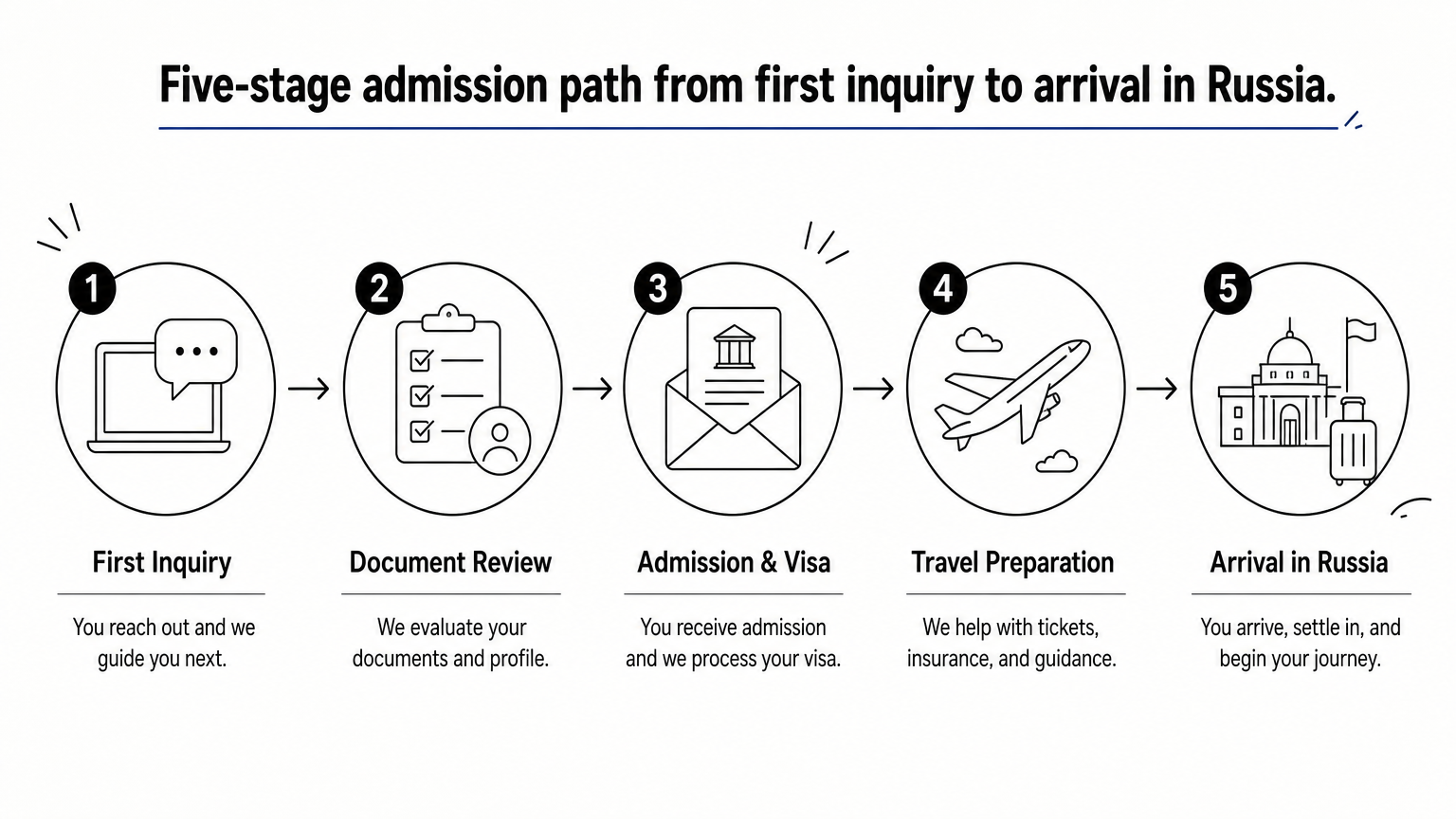
Getting into a Russian medical program isn’t the maze people expect. Once you understand the sequence, most of the confusion disappears, and the whole process from first inquiry to landing in Russia usually wraps up in under two months. Knowing this sequence in advance is what separates families who apply calmly from those who panic every time an agent asks for another document.
The document checklist you actually need
Before you shortlist colleges in Russia for MBBS, get your paperwork in order. Universities and the Russian consulate expect the same core set of documents from nearly every applicant, so gathering them early saves weeks later.
- Passport valid for at least 18 months from your intended travel date
- Class 10 and 12 mark sheets, with 12th showing Physics, Chemistry, and Biology
- NEET scorecard and admit card
- Passport-sized photographs (usually 6 to 10, per embassy specs)
- Birth certificate and a medical fitness certificate
- Notarized and, where required, apostilled copies of the above
Half of all admission delays trace back to one missing or unnotarized document, not the university itself.
Step-by-step from inquiry to enrollment
Most applicants who study MBBS in Russia follow the same five-stage path, and knowing what happens at each stage keeps expectations realistic:
- Consultation and shortlisting: You share your budget, NEET score, and city preference; a genuine adviser tells you honestly which universities fit, not just which ones pay the biggest commission.
- Document submission: You send scanned copies of the checklist above for university review.
- Admission confirmation: Universities typically confirm within about 7 working days once documents check out.
- Invitation letter and visa: The official invitation arrives within roughly 30 working days, and the student visa is usually processed within another week.
- Travel and arrival: Most students land in Russia within two months of starting the process, with airport pickup arranged in advance.
Where honest guidance changes the outcome
The biggest risk in this whole process isn’t Russian bureaucracy, it’s agents who promise a seat at a university that doesn’t fit your budget or NEET score, then scramble to fix it after you’ve paid fees. A trustworthy consultancy tells you upfront which medical universities are realistic and shortlists accordingly, rather than chasing every applicant toward the same handful of
MBBS fees and cost of living in Russia
Understanding the real cost of MBBS in Russia means looking past the tuition sticker price and adding hostel fees, food, and everyday expenses. Most families ask about the fee for MBBS in Russia first, but the total budget also depends on the city you pick and how you choose to live once you’re there. Getting both numbers right before you commit avoids the mid-course scramble that hits students who only planned for tuition.
Tuition fees by year and program
Across partner universities, published tuition for a six-year MBBS program runs from about $1,600 to $11,000 per year, depending on the university’s reputation, city, and clinical facilities. Universities in Moscow and Saint Petersburg sit at the higher end of that range, while cities like Ufa, Kazan, and Novosibirsk offer the same WHO and NMC recognized curriculum for less. Transparent, upfront pricing matters here because some agents quote a low headline number and add hidden charges once you’ve paid the deposit.
If a university won’t give you a written fee schedule before you apply, that’s your answer about how transparent they’ll be later.
Living costs students actually pay
Beyond tuition, monthly living costs in Russia are modest compared to Western study destinations. A student sharing a hostel room typically spends far less than someone renting privately in a big city, and food costs vary a lot depending on whether you cook or eat out.
| Expense category | Typical monthly cost (USD) |
|---|---|
| Hostel accommodation | $50 to $150 |
| Food (self-cooked) | $80 to $150 |
| Food (mostly eating out) | $150 to $250 |
| Local transport | $10 to $25 |
| Phone/internet | $10 to $20 |
| Miscellaneous | $30 to $50 |
Overall, most students manage on $200 to $400 a month outside tuition, and that figure holds fairly steady across the smaller cities where RUSBASE’s partner universities operate.
Why the fee of MBBS in Russia varies by university
Variation in the fee of MBBS in Russia usually comes down to hostel quality, hospital tie-ups, and how established the English-medium program is. Older, well-known universities with decades of international enrollment sometimes charge a bit more, but their placement records and hospital access often justify it. Younger or lesser-known institutions may quote lower fees, but it’s worth checking their NMC listing status before assuming the discount is worth it.
Working through this budget with someone who knows the actual per-university numbers, not just a rough estimate, is what turns a vague plan into a real one. That’s exactly the kind of shortlisting a transparent, on-the-ground adviser should walk you through before you commit to any single campus.
Top medical universities for MBBS in Russia
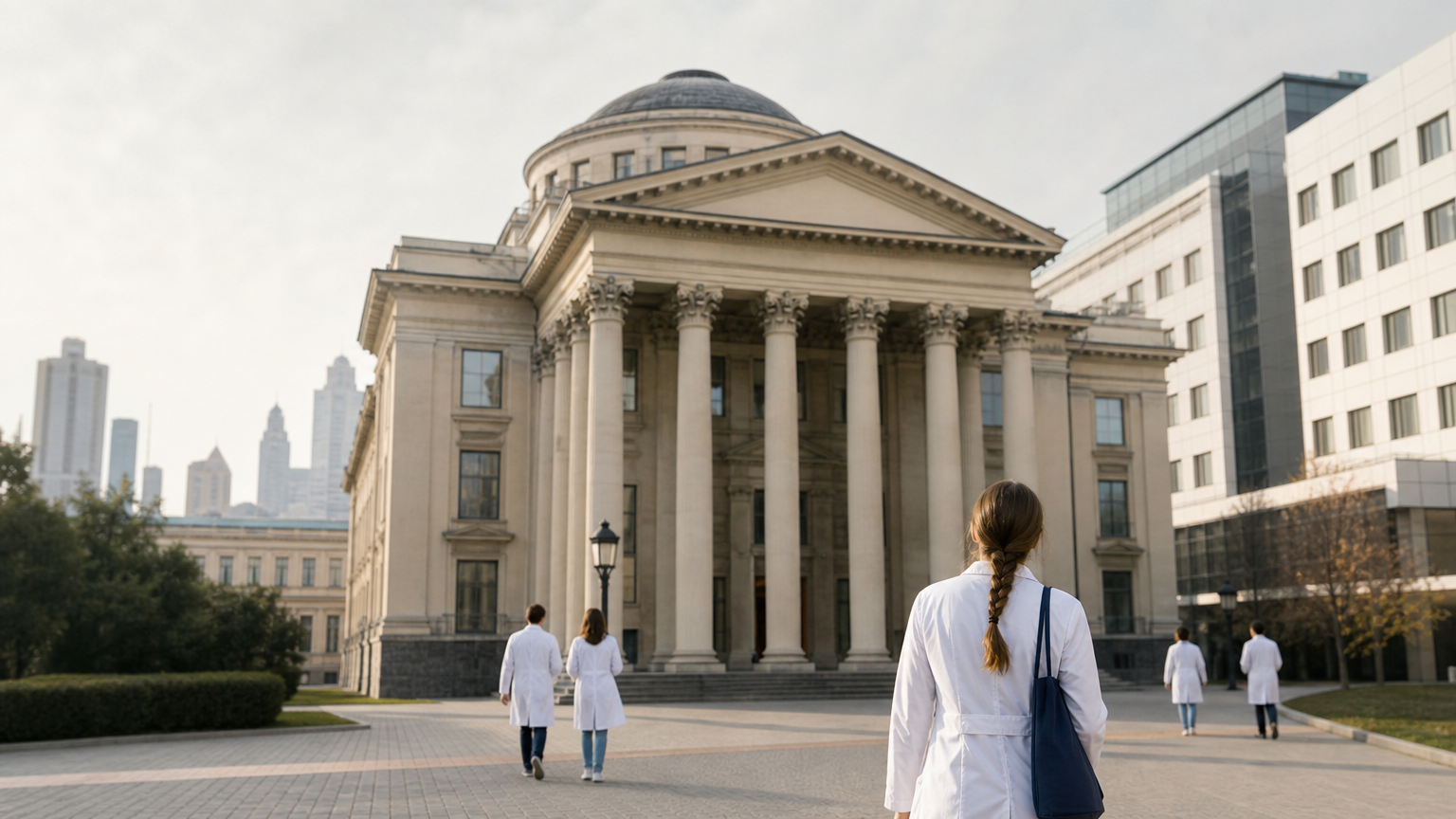
Picking from colleges in Russia for MBBS feels overwhelming until you narrow the list to universities with real WHO listing, NMC approval, and a genuine track record with international students. RUSBASE works with 24+ partner universities across seven cities, and the shortlist below reflects the ones that consistently show up as reliable choices for students comparing mbbs colleges in russia on budget, city, and clinical exposure.
What separates a solid choice from a risky one
Before ranking anything, check three things: NMC listing status, the age of the university’s international faculty (established programs run smoother than brand-new ones), and whether the hospital tie-ups give students actual patient contact, not just observation. A university that ticks all three boxes is worth paying a bit more for.
The right university isn’t the cheapest one, it’s the one whose hospital lets you touch a stethoscope before your final year.
Cities and universities worth shortlisting
Each city has its own character, and that affects both cost and daily life. Moscow and Saint Petersburg carry name recognition and stronger hospital networks, while Ufa, Kazan, and Novosibirsk offer identical WHO/NMC recognized curriculum at a noticeably lower price.
| City | Known for | Approx. annual tuition (USD) |
|---|---|---|
| Moscow | Established international faculty, dense hospital network | $6,000 to $11,000 |
| Saint Petersburg | Long history with foreign medical students | $5,000 to $9,000 |
| Kazan | Strong reputation, lower cost of living | $2,500 to $5,500 |
| Ufa | Budget-friendly, solid clinical rotations | $1,600 to $4,000 |
| Novosibirsk | Smaller classes, quieter city life | $2,000 to $4,500 |
| Sevastopol | Coastal setting, growing international intake | $2,200 to $4,800 |
General Medicine remains the standard degree offered across all six cities, and every university on this list teaches the program in English from year one.
Matching the university to your budget and goals
Someone with a tighter budget and no strong preference for a big-city lifestyle usually does better in Ufa or Kazan, where tuition sits at the lower end and living costs stay manageable. Students who want name recognition for future residency applications abroad, or who simply want the energy of a larger city, often lean toward Moscow or Saint Petersburg despite the higher fee. Undergraduates weighing mbbs degree in russia options should also ask directly about the year clinical rotations begin, since some universities start hospital exposure earlier than others. Talking through this shortlist with an adviser who knows the per-university numbers, rather than a generic list copied from a website, is what actually narrows twenty-four options down to three that fit your NEET score and your family’s budget.
MBBS course duration, syllabus, and structure
A Russian MBBS runs for six years, followed by a mandatory one-year clinical internship, which brings the full mbbs course duration to seven years before you’re eligible to sit the FMGE or NExT screening exam back home. That timeline matches most international medical programs, but the way the years are split is worth understanding before you commit, since it directly affects when you start touching patients instead of just reading about them.
How the six years break down
Broadly, the program divides into a pre-clinical phase focused on foundational sciences and a clinical phase built around hospital rotations. Universities structure this slightly differently, but the pattern below holds across most partner campuses.
| Year | Focus |
|---|---|
| 1 to 2 | Anatomy, physiology, biochemistry, histology, medical Russian basics |
| 3 | Pathology, pharmacology, microbiology, first hospital exposure |
| 4 to 5 | Clinical rotations: internal medicine, surgery, pediatrics, obstetrics, gynecology |
| 6 | Advanced clinical postings, elective rotations, exam preparation |
| Internship year | Supervised hospital duty under practicing physicians |
Six years of coursework means nothing if the internship year doesn’t put a stethoscope in your hand under real supervision.
Language, credits, and how classes actually run
English-medium instruction covers the full syllabus at nearly every partner university, so you’re not translating textbooks mid-lecture. Most programs still include a basic Russian language course in year one, since you’ll need conversational Russian to talk with patients and hospital staff once clinical rotations begin. Credits transfer to a recognized MBBS equivalent once you graduate, and the syllabus itself mirrors what India’s National Medical Commission expects: anatomy and physiology in the early years, followed by systems-based clinical training that mirrors what any mbbs degree in russia applicant would study at a WHO-listed institution elsewhere.
Where clinical exposure actually starts
Exactly when hands-on hospital work begins varies by university, and this is one detail worth confirming before you enroll rather than after. Some campuses attach students to hospital wards as early as year two for observation, then hand over more responsibility by year four. Others hold clinical exposure back until year four across the board. If studying MBBS in Russia matters to you for the practical experience, not just the degree, ask specifically about ward access timing during your consultation, since that single detail shapes how confident you’ll feel walking into your internship year. Universities that start early consistently produce graduates who describe the internship as a continuation of what they already knew, not a first encounter with a real patient.
Student life, accommodation, and food in Russia
Moving to a new country for six years is a bigger adjustment than most students expect, and daily life in Russia looks different from what you’ll find in India or the West. Once the initial culture shock wears off, most students settle into a routine that mixes hostel life, hospital rotations, and a genuinely international friend group, and that combination is part of what makes studying MBBS in Russia feel manageable rather than isolating.
Where students actually live
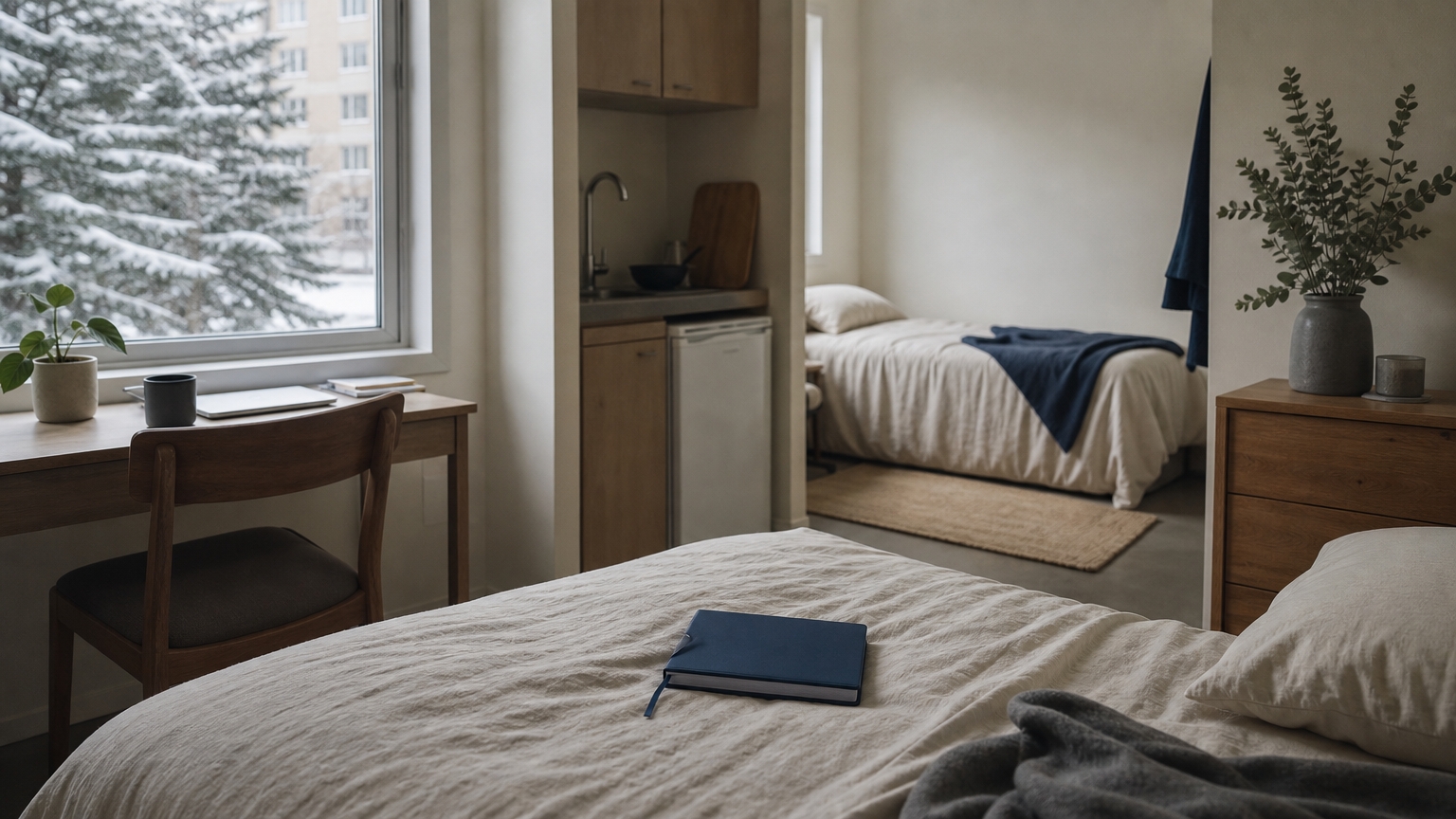
Most universities house first-year and second-year students in on-campus hostels, with rooms typically shared between two or three students. Rooms come furnished with a bed, desk, and storage, and hostels are usually a short walk or a quick metro ride from the main teaching building. Rent sits inside the $50 to $150 monthly range covered earlier, and upgrading to a private apartment later in the program is common once students want more independence or are studying with a partner.
- Wi-fi and heating included in most hostel packages
- Shared kitchens on most floors for cooking
- 24-hour security at the majority of partner university hostels
- Laundry facilities on-site or nearby
A hostel room two minutes from your lecture hall matters more in a Russian winter than any brochure photo will show you.
Food, halal options, and daily routine
Cooking your own meals is the cheapest way to eat well, and shared hostel kitchens make this straightforward once you know your way around a local grocery store. Cities like Moscow, Kazan, and Ufa (Kazan and Ufa especially, given their large Muslim populations) have well-established halal butchers and grocery stores, so students who need halal or vegetarian food generally don’t struggle to find it. Indian grocery stores selling rice, lentils, and spices exist in most university cities too, and student groups often cook communal meals on weekends, which helps homesickness fade faster than eating alone every night.
Weather, safety, and settling in
Winter is the single biggest adjustment for students arriving from India, with temperatures dropping well below freezing from November through March in most university cities. A proper winter jacket, boots, and layered clothing aren’t optional, and most seniors and university international offices point new arrivals toward the same one or two shops in town where everyone buys their first winter kit. Safety on campus and in student neighborhoods is generally solid, and universities that host large numbers of international students tend to have staff who speak English and can help with everyday problems, from a doctor’s visit to a lost document, well before a student’s Russian is fluent enough to handle it alone.
Career opportunities after completing MBBS in Russia
A degree is only as good as what you can do with it afterward, and this is where the WHO and NMC recognition mentioned earlier actually pays off. Graduates of an mbbs degree in russia from a properly listed university walk out with a qualification that opens doors in India, across the Gulf, in parts of Africa, and in several countries that accept WHO-recognized medical training without extra hurdles.
Practicing in India after graduation
Once you finish the six-year program plus internship, you’ll need to clear the FMGE or NExT screening exam to register with India’s National Medical Commission and practice legally back home. This exam tests the same core subjects you studied in Russia, so students who took clinical rotations seriously, rather than treating them as a formality, generally clear it without repeated attempts. Coaching centers across India specifically prepare returning students for this exam, and starting that prep during your final year in Russia, rather than after you land, saves months.
The FMGE isn’t a formality, it’s the one exam standing between your Russian degree and an Indian medical license.
Options beyond India
Because the underlying degree carries WHO recognition, graduates aren’t limited to one country’s licensing path. Depending on where you eventually want to practice, the route usually looks like one of these:
- India: Clear FMGE/NExT, then register with the state medical council.
- Gulf countries (UAE, Saudi Arabia, Qatar): Sit for the relevant licensing exam (DHA, MOH, or QCHP), often after a supervised residency period.
- United States or Canada: Clear the USMLE or MCCQE sequence, a longer path but open to WHO-listed graduates.
- UK: PLAB exam route, again open to recognized international degrees.
Higher study and specialization
Many graduates don’t stop at the MBBS. Postgraduate specialization, whether pursued in India through NEET-PG or abroad, is a common next step, and the broad clinical exposure gained during Russian hospital rotations often gives these students an edge in interviews, since they’ve handled real patients earlier than peers from more theory-heavy programs. Some also stay in Russia briefly for research assistantships or short clinical fellowships before returning home, using that time to strengthen a residency application.
Setting a career target before you even choose a university matters more than students realize. If your goal is practicing in India, prioritize universities with strong FMGE pass rates among alumni. If it’s the Gulf or the West, ask about research opportunities and English-medium clinical documentation during your consultation, since that paperwork trail matters later. RUSBASE’s free consultation is a good place to map that path out before you commit to a city.
MBBS in Russia vs MBBS in India: a quick comparison
Deciding between mbbs studies in russia and a private seat back home comes down to three things: money, seat certainty, and how soon you actually touch a patient. Every family runs this comparison eventually, and the numbers rarely favor the domestic private route once you add up the real cost of a management quota seat.
Seats, cutoffs, and the NEET reality
Government medical colleges in India take a tiny fraction of NEET applicants, and private colleges fill the gap at a price most middle-class families can’t absorb without loans or donations. Studying MBBS in Russia sidesteps that bottleneck entirely, since admission is document-based rather than a scramble for a shrinking number of seats. You still need a qualifying NEET score to register with the NMC later, but you’re not competing against a million other applicants for the same 100 seats.
A NEET score gets you eligible everywhere, but only Russia turns that eligibility into a guaranteed seat within a week.
Cost, timeline, and clinical exposure side by side
Putting the two paths next to each other makes the trade-offs obvious fast:
| Factor | MBBS in Russia | MBBS in India (private) |
|---|---|---|
| Total 6-year cost | $10,000 to $66,000 | $50,000 to $100,000+ |
| Admission basis | Documents + NEET qualification | NEET rank + capitation in many cases |
| Time to admission | About 1 to 2 months | Often 6+ months of counseling rounds |
| English-medium teaching | Yes, at partner universities | Yes |
| Clinical exposure start | Year 2 to 4, depending on university | Typically year 4 to 5 |
| Global recognition | WHO-listed, NMC-approved | NMC-recognized domestically |
Hospitals attached to Russian universities often bring students onto the wards earlier than the standard Indian curriculum does, which matters if hands-on confidence is a priority for you.
What each path actually gives you
Studying in India keeps you close to family and avoids the adjustment of a new language and climate, and that’s worth something for students who genuinely struggle with being far from home. Russia trades that comfort for a lower cost of MBBS in Russia, faster admission, and, at many universities, earlier ward access. Neither path is universally right, but the math tends to favor Russia for families where a private Indian seat would mean a loan that follows the student for a decade after graduation.
Ultimately, the decision hinges on what your family can realistically finance without derailing the next ten years, and on how comfortable your child is with living abroad through the coldest winters they’ve experienced. Weighing both honestly, rather than defaulting to whichever option feels more familiar, is what leads to a choice you won’t second-guess two years into the program.
Your next steps toward studying in Russia
Getting MBBS education in Russia right comes down to three decisions: picking a WHO and NMC recognized university that fits your budget, getting your documents in order early, and working with someone who tells you the truth about which campus actually suits your NEET score. Everything else, the visa, the flight, the winter jacket, sorts itself out once those three pieces are settled.
Nothing in this guide replaces a direct conversation about your specific numbers. Tuition, hostel costs, and clinical exposure timelines all shift depending on which of the 24+ partner universities fits you, and a generic list won’t tell you that. What will is a free consultation where you share your NEET score, budget, and preferred city, and get an honest shortlist back within a day.
If you’re ready to stop guessing and start comparing real numbers for real universities, book your free consultation with RUSBASE and get a shortlist built around your own situation, not a generic brochure.
Questions About Your Own Case?
Requirements depend on your nationality and subject. Ask us directly — free.
Book a Free Consultation