
QS World University Rankings 2027: Top Universities Explained
September 25, 2026
You want a straight answer to a simple question: which universities actually rank at the top of the world right now, and what does that ranking mean for your application. The QS World University Rankings get referenced everywhere, but most explanations skip the part students in Tunisia and across North Africa actually need, which is how these numbers translate into real admission decisions and real budgets.
This article breaks down the QS World University Rankings 2027 methodology, walks through the current top universities by overall position, and shows you how to read the qs world university rankings by subject when your target field matters more than the general league table. You will also see how earlier editions, including the qs world university rankings 2023 and 2024 lists, shifted over time, so you can spot real trends instead of one-year noise.
At RUSBASE, we work with students weighing exactly this kind of decision every day, especially those considering medical degree programs in Russia that carry WHO and NMC recognition. Rankings matter, but so does affordability and admission speed, and this guide connects both.
1. How the QS World University Rankings are calculated
Most students see a number next to a university name and assume it’s a single, simple score. It isn’t. QS World University Rankings are built from nine weighted indicators, and a school can jump or drop several spots year over year just because one input shifted, not because the actual teaching quality changed. Understanding the formula matters more than memorizing this year’s list, because it tells you what the ranking is actually measuring, and what it isn’t.
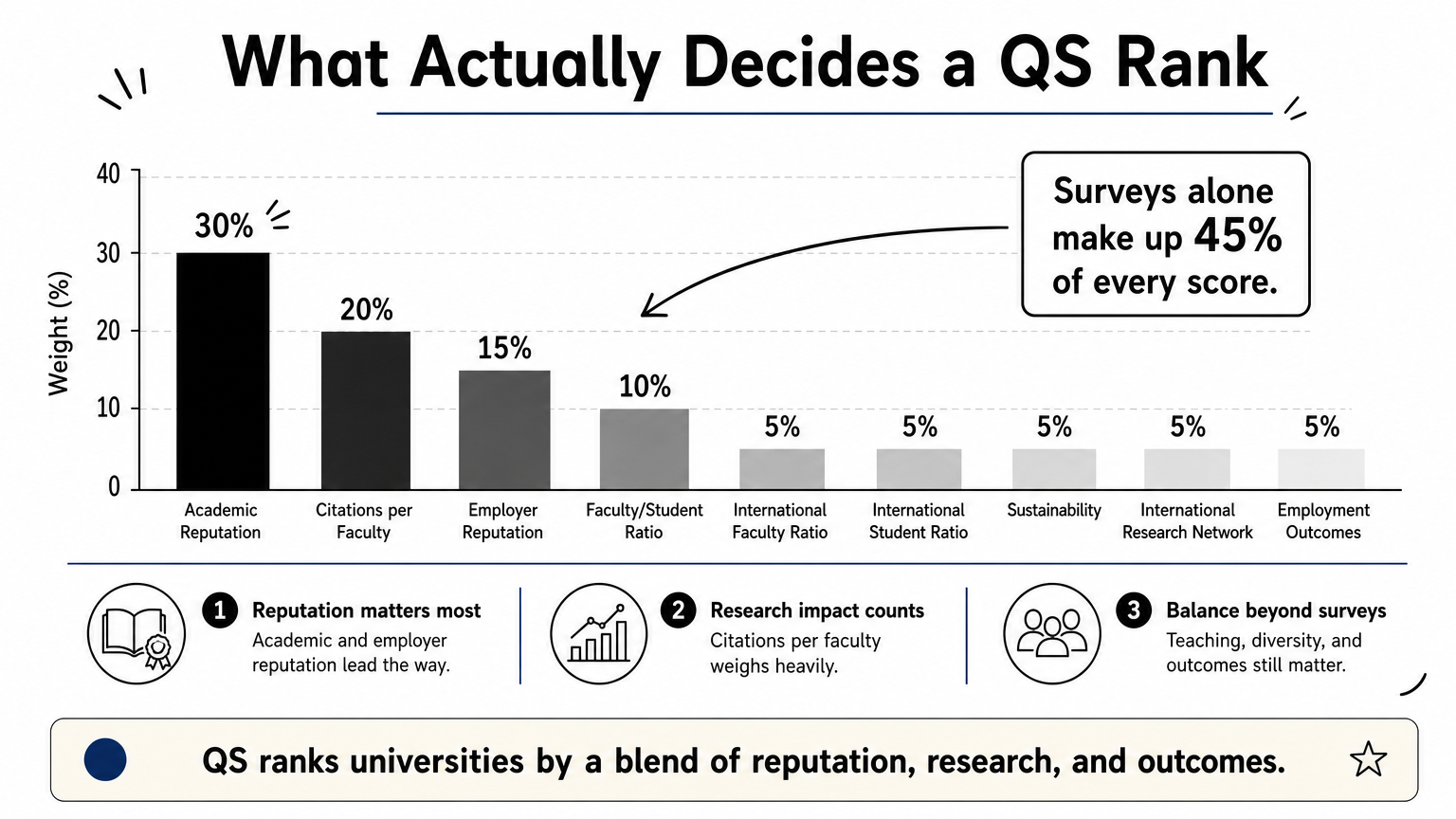
Academic and employer reputation surveys carry the heaviest combined weight, drawing on responses from tens of thousands of academics and hiring managers worldwide. Citations per faculty measures research output relative to staff size, which is why smaller research-heavy institutions like Caltech often punch above their overall size. Newer indicators like sustainability and employment outcomes were added in recent editions to capture things students actually care about: will this degree lead to a job, and does the institution operate responsibly.
| Indicator | Weight | What it measures |
|---|---|---|
| Academic Reputation | 30% | Survey of academics on research quality |
| Employer Reputation | 15% | Survey of employers on graduate readiness |
| Citations per Faculty | 20% | Research output and impact |
| Faculty/Student Ratio | 10% | Teaching capacity and class sizes |
| International Research Network | 5% | Cross-border research collaboration |
| Employment Outcomes | 5% | Graduate employment success |
| International Faculty Ratio | 5% | Staff diversity |
| International Student Ratio | 5% | Student body diversity |
| Sustainability | 5% | Environmental and social impact |
Since surveys make up 45% of the total score, reputation among academics and employers still decides most of the outcome.
A university’s QS position reflects reputation and research output more than it reflects teaching quality or student satisfaction.
Subject-specific tables use a different mix of indicators tailored to each field, which is why the qs world university rankings by subject can tell a very different story than the overall list. A university ranked 40th overall might sit in the global top 10 for a specific subject like medicine or engineering, and that distinction matters far more to your application than the headline number. Comparing editions, from the qs world university rankings 2019 through the 2023 and 2024 versions, also shows how methodology tweaks alone can move rankings without any real change on campus.
2. Massachusetts Institute of Technology (MIT)
QS 2027 rank and overall score
MIT holds the number one spot in the QS World University Rankings 2027, a position it has defended for over a decade. Its overall score sits near a perfect 100, driven by top marks in academic reputation, employer reputation, and citations per faculty. If you’re scanning world university rankings for a benchmark of what “top-tier” actually looks like, MIT is that reference point.

What makes it stand out
MIT’s research output per faculty member outpaces almost every other institution globally, which is exactly what the citations indicator rewards. Employers surveyed by QS consistently rank MIT graduates among the most job-ready in the world, a signal that matters more to your career than the rank number itself.
A number-one QS rank tells you MIT’s research and reputation are unmatched, not that every classroom experience there will suit every student.
Strongest subjects and programs
Computer science, electrical engineering, and physics dominate MIT’s subject tables, each holding the global top spot for years running. Mechanical engineering and data science also place in the world’s top three, making MIT the reference school whenever engineering programs get compared.
Tuition costs for international students
MIT charges roughly $60,000 per year in tuition alone, before housing and living costs that push total annual expenses past $85,000. For students in Tunisia and North Africa weighing that figure against far lower-cost paths, including medical degree programs in Russia that run $1,600 to $11,000 a year, the gap is not subtle.
3. Imperial College London
QS 2027 rank and overall score
Imperial College London sits inside the global top five in the QS World University Rankings 2027, consistently trading places with Oxford and Cambridge for the UK’s highest spot. Its overall score benefits from near-perfect marks in citations per faculty and employer reputation, two indicators where STEM-focused schools tend to outperform broader universities. Checking qs top university rankings year over year, Imperial rarely drops out of the top ten, which makes it one of the most stable names on the list.
What makes it stand out
Unlike Oxford or Cambridge, Imperial focuses almost entirely on science, engineering, medicine, and business, with no arts or humanities faculties diluting its research output per student. That specialization pushes its citations per faculty score higher than most general universities, since every department is publishing in high-impact STEM fields. Employers surveyed by QS also rate Imperial graduates especially highly in engineering and medicine hiring pools.
Imperial’s narrow academic focus is exactly why it outranks larger, broader universities on research-heavy indicators.
Strongest subjects and programs
Medicine, mechanical engineering, and materials science all place in the global top ten, with electrical engineering close behind. Business students benefit from Imperial’s ties to London’s financial sector, giving the business school an edge in employer reputation.
Tuition costs for international students
International tuition at Imperial runs between $45,000 and $58,000 per year depending on the program, with medicine at the higher end. London living costs add another $15,000 to $20,000 annually, a total that dwarfs the medical degree programs in Russia RUSBASE arranges for a fraction of that price.
4. Stanford University
QS 2027 rank and overall score
Stanford lands inside the global top five in the QS World University Rankings 2027, holding steady near the same position it has occupied for several editions running. Its overall score benefits from standout marks in employer reputation and international research network, reflecting Stanford’s deep ties to Silicon Valley and global research partnerships. Anyone tracking qs top university rankings over the last few cycles will notice Stanford rarely drifts outside the top ten.
What makes it stand out
Stanford’s proximity to the tech industry gives it an employer reputation score that few universities can match, since graduates move directly into companies founded by Stanford alumni. The university also draws some of the highest research funding per faculty member in the US, which feeds directly into its citations per faculty performance.
Stanford’s ranking strength comes from industry ties as much as academic output, a combination that shapes what recruiters expect from its graduates.
Strongest subjects and programs
Computer science, engineering, and business consistently place in the global top five, with Stanford’s Graduate School of Business ranked among the very best worldwide. Earth sciences and statistics also hold top-ten global positions, giving Stanford unusual breadth beyond its tech-heavy reputation.
Tuition costs for international students
International students pay roughly $62,000 per year in tuition at Stanford, with total costs including housing and fees climbing past $90,000 annually. That figure sits far above what students exploring university rankings for budget reasons can realistically plan around, which is exactly why RUSBASE routes so many families toward affordable medical degree programs that cost a fraction of a single Stanford semester.
5. University of Oxford
QS 2027 rank and overall score
Oxford holds a top-five position in the QS World University Rankings 2027, a spot it has traded with Cambridge and Imperial for several editions running. Its overall score leans heavily on academic reputation, where centuries of research output still carry weight with the academics QS surveys each year. Looking across the 2023 qs world university rankings and the current edition, Oxford’s position barely moves, which tells you reputation-driven scores change slowly even when other indicators shift.

What makes it stand out
Oxford’s tutorial system, small group teaching led directly by faculty, sets it apart from most large research universities on this list. That structure doesn’t feed into the QS formula directly, but it does explain why employer reputation scores stay consistently high among graduates entering law, policy, and academia.
Oxford’s rank rewards centuries of accumulated research reputation more than any single recent achievement.
Strongest subjects and programs
History, law, and English literature dominate Oxford’s subject tables, each holding a global top-three position. Medicine and politics also place inside the world’s top five, giving Oxford unusual strength across both humanities and clinical fields.
Tuition costs for international students
International tuition at Oxford ranges from $35,000 to $50,000 per year, with medicine and engineering sitting at the top of that range. Add Oxford’s living costs, often $18,000 annually, and the total quickly exceeds what most families budget for a single degree, a gap RUSBASE’s medical degree programs close for a fraction of the price.
6. Harvard University
QS 2027 rank and overall score
Harvard sits inside the global top five in the QS World University Rankings 2027, a position it has held with only minor fluctuation for over a decade. Its overall score draws strength from academic reputation, where Harvard consistently posts one of the highest marks of any school QS surveys. Anyone comparing the 2023 qs world university rankings to this year’s edition will notice Harvard’s rank barely shifts, since reputation scores built over generations rarely move fast.
What makes it stand out
Harvard’s endowment, the largest of any university on earth, funds research facilities and faculty positions that few competitors can match. That financial depth feeds directly into citations per faculty and international research network scores, since Harvard can recruit top researchers from anywhere and fund long-term projects without chasing grants.
Harvard’s ranking reflects institutional wealth and reputation as much as it reflects any single program’s teaching quality.
Strongest subjects and programs
Law, business, and medicine anchor Harvard’s subject tables, each holding a global top-three spot for years running. Political science and economics also place inside the world’s top five, giving Harvard unusual reach across policy-adjacent fields that feed directly into government and finance careers.
Tuition costs for international students
International students pay close to $58,000 per year in tuition at Harvard, with total costs including housing and fees pushing past $85,000 annually. Families comparing that figure against RUSBASE’s medical degree programs in Russia, priced between $1,600 and $11,000 a year, are looking at two entirely different financial realities.
7. University of Cambridge
QS 2027 rank and overall score
Cambridge rounds out the UK’s top-five presence in the QS World University Rankings 2027, trading places with Oxford and Imperial depending on the edition. Its overall score leans on academic reputation and citations per faculty, two indicators where Cambridge’s centuries-old research output still pays dividends. Tracking the qs world university rankings 2024 against this year’s list shows Cambridge holding within a spot or two of its usual position, a pattern typical of reputation-driven scores.
What makes it stand out
Cambridge’s college system splits students into smaller residential communities, each with its own tutors and traditions, layered on top of the main university structure. That setup doesn’t appear anywhere in the QS formula, but it shapes the faculty/student ratio and small-group teaching that feeds Cambridge’s strong academic reputation scores year after year.
Cambridge’s rank rewards research depth built over centuries, not any recent shift in teaching methods.
Strongest subjects and programs
Natural sciences, mathematics, and engineering all sit inside the global top five, with computer science close behind. Medicine and law also place among the world’s best, giving Cambridge a rare mix of strength across both clinical and humanities fields.
Tuition costs for international students
International tuition at Cambridge runs from $38,000 to $52,000 per year, with clinical medicine at the top of that range. Add roughly $16,000 in annual living costs, and the total dwarfs what RUSBASE’s medical degree programs charge for a comparable WHO-recognized qualification.
8. California Institute of Technology (Caltech)
QS 2027 rank and overall score
Caltech holds a spot inside the global top fifteen in the QS World University Rankings 2027, an impressive position given its total enrollment is smaller than a single Harvard undergraduate class. Its overall score leans almost entirely on citations per faculty and academic reputation, since Caltech’s tiny size means every researcher’s output carries outsized weight in the formula. Scanning the qs world university rankings by subject confirms this pattern, with Caltech punching well above its overall rank in physics and engineering tables.
What makes it stand out
Caltech enrolls fewer than a thousand undergraduates total, yet it produces research output that rivals institutions ten times its size. That concentration is exactly why the citations per faculty indicator rewards Caltech so heavily, since research papers get divided across a much smaller staff count than at comparable universities.
Caltech proves that a tiny student body and a narrow academic focus can outscore far larger universities on research-driven indicators.
Strongest subjects and programs
Physics, chemistry, and aerospace engineering anchor Caltech’s subject tables, each holding a global top-five position for years running. Applied mathematics and planetary science also place among the world’s best, reflecting Caltech’s close ties to NASA’s Jet Propulsion Laboratory.
Tuition costs for international students
International tuition at Caltech runs close to $60,000 per year, with total costs including housing pushing past $88,000 annually. Families weighing that figure against RUSBASE’s medical degree programs know exactly which direction the math points.
9. ETH Zurich
QS 2027 rank and overall score
ETH Zurich holds the top spot outside the UK and US in the QS World University Rankings 2027, typically landing just outside the global top ten. Its overall score rests heavily on academic reputation and citations per faculty, both areas where Switzerland’s flagship technical university has built a reputation stretching back over a century. Reviewing the qs world university rankings by subject confirms ETH’s strength runs deepest in engineering and natural sciences rather than across every field.
What makes it stand out
Switzerland’s public funding model gives ETH Zurich research resources that rival private US institutions, without the tuition price tag attached. Alumni including multiple Nobel laureates in physics and chemistry feed directly into the academic reputation score QS surveys each year.
ETH Zurich shows that public funding, not private endowments, can produce a genuine top-ranked research university.
Strongest subjects and programs
Civil engineering, earth sciences, and materials science all place inside the global top five, with mechanical engineering close behind. Mathematics and physics also rank among the world’s strongest programs, reflecting ETH’s long-standing focus on hard sciences over broader liberal arts offerings.
Tuition costs for international students
International students pay remarkably little at ETH Zurich, often under $1,500 per year in tuition, though Zurich’s living costs run high at roughly $20,000 annually. Even with that added expense, families comparing world university rankings against total cost still find RUSBASE’s medical degree programs competitive for students prioritizing medicine specifically over engineering.
10. QS rankings by subject, region, and past editions
Global rank only tells half the story, and the qs world university rankings by subject table often changes which school makes sense for your specific degree. A university sitting at 40th overall can hold a top-five spot in medicine or engineering, and that subject-level position matters far more once you’re comparing actual program quality rather than campus-wide reputation. Regional tables add another layer, letting you compare universities within Asia, Europe, or the Middle East against peers facing similar funding and labor markets rather than against MIT or Harvard.
Comparing editions over time shows how much these lists actually move. The qs world university rankings 2019 looked noticeably different from the qs world university rankings 2023 release, partly because QS added new indicators like sustainability and employment outcomes along the way, not because universities suddenly improved or declined.
| Edition | Notable shift |
|---|---|
| 2019 | Pre-sustainability metric, reputation-heavy weighting |
| 2023 | Employment outcomes indicator introduced |
| 2024 | International research network gains weight |
| 2027 | Current edition, refined subject weightings |
Memorizing a single year’s snapshot won’t help you as much as spotting the trend across several editions.
A university’s subject rank matters more to your application than its overall global position ever will.
Subject and regional tables exist precisely because a single overall number can’t capture everything worth knowing about a degree program.
Making the rankings work for your decision
The QS World University Rankings give you a starting point, not a final answer. MIT, Oxford, Cambridge, and the rest of this list earn their spots through decades of research output and reputation, but that same prestige comes with price tags most families in Tunisia and North Africa simply can’t stretch to. Ranking position tells you almost nothing about whether a degree fits your budget, your timeline, or your career plans in medicine specifically.
Use the subject tables, not just the overall list, when you’re choosing a program, and weigh cost alongside prestige rather than after it. If a WHO-recognized, NMC-approved medical degree at a fraction of Western tuition sounds like the better fit than chasing a top-ten badge, talk to RUSBASE about your options. A free consultation costs nothing, and it beats guessing your way through an application that a ranking table alone can’t finish for you.
Questions About Your Own Case?
Requirements depend on your nationality and subject. Ask us directly, free of charge.
Book a Free Consultation