
Scholarship for Study in Russia: How to Study for Free
September 16, 2026
Searching for a scholarship for study in Russia usually starts the same way for every Indian student: you’ve seen the tuition numbers for the UK, US, or Canada, done the math, and realized you need another way in. The good news is that Russia does offer government-funded seats through its Open Doors and Ministry of Education quotas, and thousands of international students get through every year without paying tuition at all.
But here’s the honest answer to "how to study in Russia for free": scholarships are competitive, limited in number, and not guaranteed for every subject or university, especially popular medical programmes. If you’re only counting on a free seat, you need a backup plan, because most students end up combining a partial scholarship with Russia’s already low, transparent tuition rates rather than studying entirely free.
This article breaks down the real fully funded scholarship options open to Indian students, who actually qualifies, how the application timeline works, and what your realistic costs look like if a scholarship doesn’t come through. No inflated promises, just what actually gets you a seat.
Why a Russia scholarship is worth pursuing
Getting a fully funded scholarship changes the math for a family that’s already stretched thin by application fees, flight tickets, and living costs abroad. Russia’s Ministry of Education, through the Open Doors and government quota programs, funds tuition for thousands of international students every academic year, and a fair number of those seats go to Indian applicants in engineering, humanities, and yes, medicine. Even a partial award, say 50% off tuition, can be the difference between a family taking a loan and paying as they go.

A scholarship doesn’t just cut your bill; it turns a five-year medical degree from a stretch goal into something you can actually plan around.
The real cost gap you’re closing
Understanding why this matters means looking at the numbers side by side. Even without a scholarship, tuition for MBBS in Russia sits far below what you’d pay in the UK, US, or Canada. Add a scholarship on top, and the gap becomes hard to ignore.
| Destination | Avg. annual MBBS tuition (no scholarship) | With a partial/full Russia scholarship |
|---|---|---|
| Russia | $4,000 – $7,000 | $0 – $3,500 |
| UK | $25,000 – $45,000 | Rarely available for medicine |
| USA | $40,000 – $65,000 | Extremely limited for internationals |
| Canada | $30,000 – $50,000 | Limited, mostly need-based |
Figures are approximate averages compiled from published university fee schedules and RUSBASE’s own tuition data across partner institutions.
What a scholarship changes for your total budget
Housing, food, and daily expenses in Russian student cities like Ufa, Kazan, and Novosibirsk already run lower than in London or Toronto. Once you strip out tuition entirely, or cut it in half, your remaining costs are almost entirely living expenses, which are manageable even on a modest family budget. Combining a scholarship for indian students to study in Russia with these already-low living costs is how a lot of families make five or six years of medical education fit inside a budget that wouldn’t cover two years elsewhere.
Money isn’t the only reason to chase a scholarship, though. Winning one, even a partial award, signals to visa officers and university admissions boards that you cleared an academic bar, which can smooth other parts of the process. It also gives you breathing room if the ruble shifts against the rupee during your degree, since a locked-in tuition waiver doesn’t move with the exchange rate the way an out-of-pocket fee does.
Recognition still matters more than the discount
Before you get excited about a free seat, check that the university offering it is actually listed in the WHO World Directory of Medical Schools and recognized by the National Medical Commission in India. A scholarship at an unrecognized or poorly ranked university saves you money upfront but can cost you your license to practice later. This is where working with someone who tracks NMC and WHO status medical university by medical university, rather than just chasing whichever school hands out the most scholarship seats, actually protects your long-term goal.
Sevastopol, Moscow, and Saint Petersburg host some of the most competitive scholarship allocations, but competitive doesn’t mean impossible. Thousands of seats are distributed nationally each cycle, and applicants who apply early, with complete documents and realistic subject choices, do get through. The point of chasing a scholarship isn’t just to study for free; it’s to make sure the free or discounted seat you land is one that actually leads somewhere once you graduate.
Types of scholarships for studying in Russia
Not every scholarship for study in Russia works the same way, and mixing them up is where a lot of applicants waste time chasing the wrong program. Broadly, four categories of funding for international students in Russia exist for Indian students, and each has its own funding source, competition level, and paperwork trail. Knowing which bucket you’re aiming for before you start an application saves weeks.
Government-to-government and Open Doors awards
The Open Doors Olympiad is Russia’s flagship route to a fully funded seat. It’s an academic competition open to international students, and top scorers get full tuition coverage plus, in many cases, a monthly stipend. Separately, the Ministry of Education and Science quota allocates thousands of seats each year through bilateral agreements between Russia and countries including India, distributed via the Russian Embassy’s education wing rather than direct university applications. Both routes are genuinely free if you win them, but both are also the most competitive, since seats are capped nationally and shared across every applying country.
The bigger the discount, the bigger the queue, so apply to government quotas early and never as your only plan.
University-specific and merit-based waivers
Many partner universities run their own scholarship pools independent of the federal quota. These typically cover 25% to 70% of tuition based on entrance exam scores, prior academic records, or participation in a university olympiad, and they’re renewed yearly if you maintain a minimum GPA. This is the category where a study in Russia scholarship search actually turns into a realistic offer for most Indian applicants, because eligibility criteria are set by the university, not a national committee, and there are simply more seats to go around.
| Scholarship type | Typical coverage | Competitiveness | Who administers it |
|—|—|—|
| Open Doors Olympiad | 100% tuition + stipend | Very high | Russian government |
| Ministry quota | 100% tuition | High | Embassy/Ministry |
| University merit award | 25% – 70% tuition | Moderate | Individual university |
| Partner-negotiated waiver | 10% – 50% tuition | Low to moderate | Agency/university agreement |
Partner-negotiated tuition reductions
Outside official scholarship programs, some universities offer negotiated fee reductions to students who apply through a recognized education partner, particularly for medical seats that would otherwise sit unfilled. These aren’t labeled "scholarships" on paperwork, but they function the same way on your invoice. RUSBASE tracks which of its partner universities currently offer these reductions, since availability shifts by intake and by city, and this is often the fastest realistic path to a lower bill if the Olympiad or quota route doesn’t come through in time.
How to apply for a scholarship step by step
Applying for a scholarship for study in Russia isn’t a single form you fill out once. It’s a sequence of steps spread across months, and missing one deadline usually means waiting for the next intake cycle. Whether you’re aiming for the Open Doors Olympiad, a Ministry quota seat, or a university merit award, the process follows a similar shape, just with different gatekeepers.
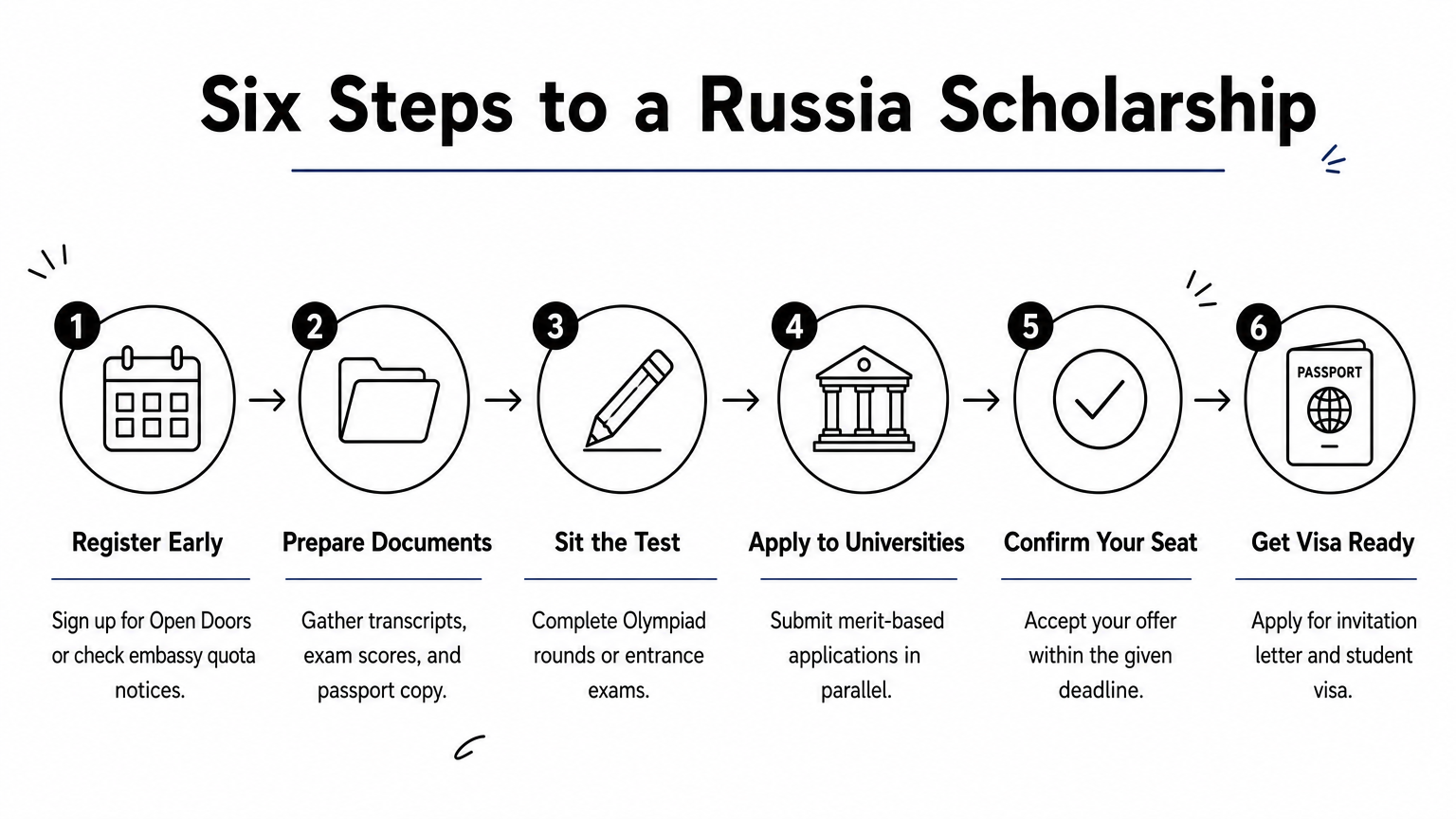
The application sequence
Before anything else, register your interest early, most scholarship windows open six to nine months before the academic year starts, and late applicants get whatever seats are left over. From there, the process generally runs like this:
- Register on the official portal for the Open Doors Olympiad or check embassy notices for Ministry quota openings, usually announced between January and April.
- Prepare your academic file, including transcripts, entrance exam scores if applicable, and a passport copy, translated and notarized where required.
- Sit any required test or Olympiad round, since Open Doors involves subject-specific online rounds before a final stage.
- Submit university-specific applications in parallel, since merit-based waivers run on their own timeline and don’t wait for the federal result.
- Wait for the results letter, then confirm your seat within the stated deadline, usually within two to three weeks of the offer.
- Apply for your invitation letter and visa once your seat, scholarship or not, is confirmed.
Applying to only one scholarship route is the single most common reason Indian students end up paying full tuition by default.
Where timing actually breaks down
Most missed opportunities aren’t about weak grades, they’re about sequencing. Students wait for an Olympiad result before starting a university application, lose six weeks, and then find the university’s own scholarship round has already closed. Running the government route and the university route side by side, rather than one after the other, is what actually protects your shot at a discount.
Why a single point of contact matters here
Once you’re juggling an embassy quota deadline, a university’s internal scholarship form, and your own document translations, small errors creep in fast, a missing apostille here, an expired transcript there. This is exactly the stage where working through RUSBASE helps, since a single adviser tracks every deadline across your applications instead of you managing three separate portals with three separate document formats. Realistic sequencing, not luck, is what gets a scholarship application across the line, and it’s also why RUSBASE will tell you plainly if a particular scholarship route isn’t worth your time this cycle, rather than let you burn weeks on a long shot. If a scholarship genuinely isn’t likely to come through for your subject or intake, you’ll hear that early enough to pivot to a low-cost paid seat instead, which keeps your overall timeline intact even without free tuition.
Eligibility criteria and documents you need
Qualifying for a scholarship for study in Russia comes down to two things: your academic record and your paperwork. Universities and the Ministry both check grades first, then verify that every document in your file is complete, translated, and notarized correctly. Skip a step here, and even a strong applicant gets bumped to the next intake.

Academic and age requirements
Government quota seats and Open Doors both set a minimum grade threshold, usually 60% or higher in your Class 12 science subjects for medical applicants, though individual universities sometimes accept slightly lower scores if the rest of your file is strong. Age limits typically cap undergraduate applicants at 25 and postgraduate applicants at 35, though exceptions exist for research-based programs. Neither route requires IELTS or TOEFL for English-taught degrees, which removes one common barrier for Indian students who haven’t sat an English proficiency test.
No scholarship committee waives a missing document just because your grades are excellent.
The document checklist that actually gets checked
Before you submit anything, get every document a Russian university expects into the right format. Missing notarization or an unofficial translation is the single most common reason applications stall mid-review.
- Passport valid for at least 18 months beyond your intended start date
- Class 10 and Class 12 mark sheets, notarized and translated into Russian or English
- Migration and transfer certificates from your previous school
- Medical fitness certificate, including an HIV test result no older than three months
- Passport-size photographs meeting the specific size and background requirements set by the embassy
- Statement of purpose or motivation letter, required for Open Doors and most merit-based waivers
- Entrance exam or Olympiad scorecard, where applicable
Where applicants lose points without realizing it
Attested transcripts trip up more applicants than weak grades do. Indian mark sheets need apostille certification before they’re accepted abroad, and that process alone can take two to three weeks through India’s Ministry of External Affairs, so start it the moment you decide to apply, not after you’ve been shortlisted. Documents also expire in a practical sense: a medical fitness certificate older than three months gets rejected outright, so time your health checkup close to your actual submission date rather than early in your planning.
Gathering everything twice, once for the scholarship application and again for your visa file, wastes time you don’t have during a tight admissions window. This is where having someone check your file against both the scholarship checklist and the embassy’s separate visa requirements before you submit saves you a rejected application and a lost cycle. A complete, correctly notarized file, submitted on time, beats a slightly stronger transcript with a missing apostille every single time.
What the scholarship covers and what it doesn’t
A fully funded scholarship almost never means every expense disappears. Most Russian government and university awards cover tuition fees only, and sometimes a modest monthly stipend for living costs. Everything else, flights, visa fees, housing deposits, textbooks, and daily food, usually stays on your own budget. Knowing this split before you accept a seat keeps you from assuming "free study in Russia" means zero spending for five years.
What’s typically included
Open Doors winners and Ministry quota holders generally get tuition waived in full, and in many cases a stipend of roughly 2,000 to 3,000 rubles a month, enough to cover part of your food budget but not much beyond it. University merit awards, by contrast, almost always cover tuition only, with no stipend attached. Neither route pays for your dormitory rent outright, though subsidized student housing is usually available on top of the scholarship at a separate, low fixed rate.
A scholarship pays your tuition invoice, not your grocery bill, so budget for both from day one.
What’s usually excluded
Housing deposits, visa processing fees, medical insurance, and your flight to Russia sit outside almost every scholarship package. Textbooks and lab materials for medical programs can also add a few hundred dollars a year that scholarship funding doesn’t touch. Renewal isn’t automatic either: most university merit awards require you to maintain a set GPA every semester, and falling below it can mean losing the discount mid-degree, not just at renewal time.
| Cost item | Covered by scholarship | Typically your responsibility |
|---|---|---|
| Tuition fees | Yes (full or partial) | Remainder, if partial |
| Monthly stipend | Yes, government routes only | N/A |
| Dormitory rent | No | Yes, at subsidized rate |
| Flights and visa fees | No | Yes |
| Medical insurance | No | Yes |
| Textbooks/lab materials | No | Yes |
Budgeting for the gap
Given this breakdown, most families planning a study in Russia scholarship for indian students pathway still set aside $2,500 to $4,000 a year for living costs, insurance, and travel, even if tuition itself is fully waived. Realistic budgeting, not the scholarship headline number, is what actually protects you from a mid-year cash crunch. Talking through the full cost picture with an adviser who’s placed students in your target city, rather than relying on a university brochure, gives you numbers you can actually plan a family budget around instead of guessing at what a "free" seat really costs.
Planning your next move toward studying in Russia
A scholarship for study in Russia can genuinely cut your family’s costs, but it shouldn’t be the only plan you build your future on. Government quotas and Open Doors seats are real and worth applying for, yet they’re capped, competitive, and never guaranteed for every subject or intake. Building your timeline around a realistic mix of scholarship applications and Russia’s already low, transparent tuition rates protects you from losing a year while waiting on a long shot. Success here comes down to sequencing, complete paperwork, and choosing a WHO-listed, NMC-recognized university over whichever school hands out the most seats. Every family we’ve guided through this process gets further by applying early and keeping a backup route open, not by betting everything on one scholarship result. If you want a straight answer on what you actually qualify for this cycle, and which universities still have scholarship seats worth chasing, talk to a RUSBASE adviser about your options and get a realistic plan instead of another brochure.
Questions About Your Own Case?
Requirements depend on your nationality and subject. Ask us directly — free.
Book a Free Consultation