
Russia Student Visa Fees from India: Full Cost Breakdown
September 30, 2026
You have your university offer letter in hand, and now you need real numbers for the visa, not vague ranges from a forum post. Searching for student visa for russia from india fees usually means one thing: you want to know exactly what you will pay before you commit to a plane ticket.
Here is the direct answer. The cost of a Russian student visa from India includes a consular fee, a mandatory invitation letter charge, and often service fees from whoever is handling your paperwork. These add up differently depending on whether you apply solo or through an agency, and the student visa for russia from india price can shift based on processing speed and which city’s consulate handles your application.
This article breaks down every line item you will actually pay, from the invitation letter cost to embassy charges and optional expedited processing. We built this guide around what we see daily while helping students from India secure admission and visas for medical and other programs at Russian universities, so the figures reflect current, real-world costs rather than outdated estimates.
Why the advertised visa fee isn’t your real cost
Most websites quote you a single number, something like "Russia student visa fee: ₹2,000," and leave it there. That number is real, but it’s also incomplete. It covers only the consular processing fee, which is the charge the Russian embassy or consulate collects for stamping your visa. It says nothing about the invitation letter you legally need before you can even apply, nothing about translation and notarization, and nothing about service charges if anyone other than you is handling the paperwork. Treat that advertised figure as the floor, not the total.
The consular fee is only the starting point
The Russian consulate in India charges a processing fee based on your visa category and how fast you need it turned around. Standard processing typically runs lower than expedited service, and the fee itself hasn’t changed dramatically in recent years, which is why so many blogs still quote it as "the" cost. But this fee assumes you already have a valid invitation letter, the official document a Russian university sends confirming your admission and inviting you into the country. Without it, the consulate won’t even accept your application, so the consular fee is never a cost you pay in isolation.
The number you see advertised as "the visa fee" is almost never the number you actually pay at the end.
The invitation letter is mandatory, not optional
Here’s where a lot of students get caught off guard. The invitation letter isn’t a formality your university tosses in for free. Some universities include it as part of the admission package; others charge a separate processing fee for issuing it, and that fee can range widely depending on the institution. If you’re applying independently, without a consultancy managing the university relationship, you may not know this charge exists until the university’s admissions office asks for it partway through your application. Universities that work with agencies like RUSBASE typically bundle invitation letter processing into the admission support, which is one reason the true cost of going through an agency for admissions to Russia universities often ends up lower than piecing it together yourself, not higher.
Service and agency fees change the math
If you use a study-abroad consultancy or a visa facilitation service, you’ll pay a service fee on top of the government charges. This is where costs vary the most, because service fees aren’t standardized the way consular fees are. Some agencies charge a flat package rate covering admission support, invitation letter processing, and visa document preparation together. Others charge piecemeal, billing you separately for each stage, which can look cheaper upfront but often totals more once you add everything up. Compare quotes on what’s actually included, not just the headline number.
| Cost component | Who charges it | Is it optional? |
|---|---|---|
| Consular visa fee | Russian embassy/ consulate | No |
| Invitation letter processing | University or agency | No |
| Document translation/notarization | Certified translator/ notary | No |
| Agency service fee | Consultancy (if used) | Yes, but often reduces total risk |
| Expedited processing surcharge | Consulate | Yes |
| Courier/travel to consulate | Third party | Depends on location |
Translation and notarization add up quietly
Your academic transcripts, passport copies, and medical certificates typically need to be translated into Russian and notarized before the consulate or university will accept them. This isn’t part of the consular fee, and it’s rarely mentioned in the initial quotes students see online. Depending on how many documents you’re submitting and where you get them translated, this can add a meaningful chunk to your total spend. Students who assemble their documents piecemeal, translating one paper at a time as universities request them, often pay more per document than those who batch everything at once through a single service.
Currency conversion and bank charges eat into your budget
Quoted fees are usually listed in Russian rubles or US dollars, but you’re paying in Indian rupees, which means your bank or payment provider takes a cut on the conversion. Wire transfer fees, foreign transaction charges on your card, and unfavorable exchange rates at the point of payment can add several hundred rupees you never budgeted for. This is a small line item individually, but across consular fees, invitation letter payments, and any service charges, it compounds. Xchange rate volatility also means the rupee figure you calculate today might differ slightly by the time you actually pay, so build in a small buffer rather than budgeting to the exact rupee.
What all this adds up to is simple: the advertised visa fee is real, but it’s one line in a longer invoice. Your actual out-of-pocket cost includes the invitation letter, document prep, possible service fees, and the invisible cost of currency conversion. Students who budget only for the consular fee are almost always surprised later, usually at the worst possible time, right before a deadline.
How to calculate your total Russia student visa cost
Instead of hunting for one magic number, build your own total from five components: consular fee, invitation letter fee, document prep, service fees if you use an agency, and a currency buffer. Add these together and you get a realistic figure for student visa for russia from india fees, not a marketing number pulled from a single website. This exercise takes fifteen minutes and saves you from a nasty surprise three weeks before your flight.
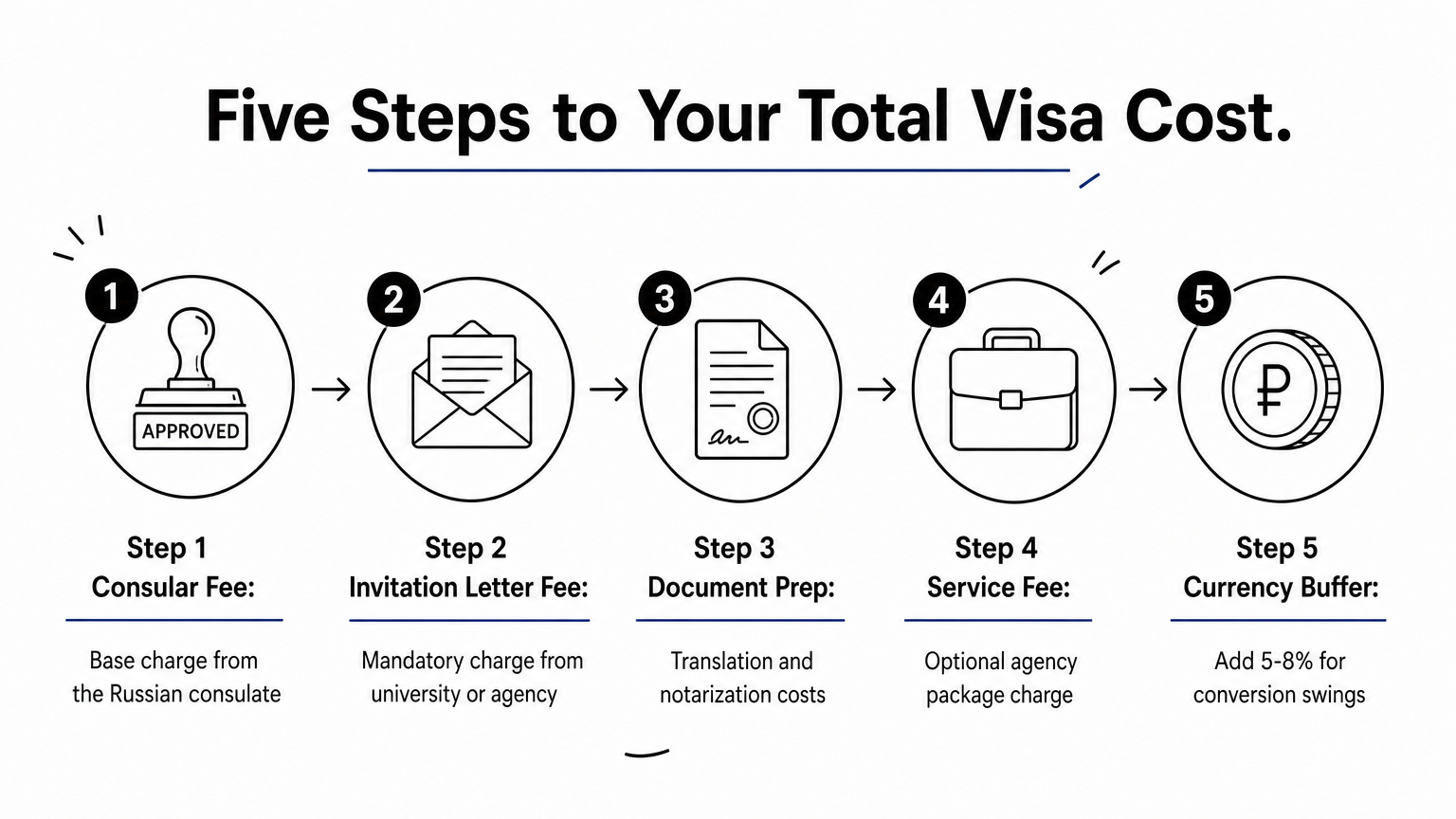
Add up every line item before you compare quotes, because two "visa fee" numbers rarely mean the same set of charges.
Use a simple five-part formula
Here’s the formula we walk students through before they commit to any university or agency:
Total visa cost = Consular fee + Invitation letter fee + Document prep + Service fee (if any) + Currency buffer (5-8%)
Work through each line with the actual quote in front of you, not an estimate from a forum thread. If a university or agency can’t tell you the invitation letter fee upfront, treat that as a red flag rather than a detail to sort out later.
Run the numbers with a worked example
Say you’re applying for a medical program with standard, non-expedited processing. Here’s roughly how the math plays out for a solo applicant handling everything independently versus one going through a consultancy package.
| Cost component | Solo applicant (approx.) | Agency package (approx.) |
|---|---|---|
| Consular fee | ₹2,000-4,000 | Included |
| Invitation letter | ₹3,000-7,000 | Included |
| Translation/ notarization | ₹2,000-5,000 | Included |
| Service fee | None | Flat package rate |
| Currency buffer | ₹300-600 | Minimal |
These figures move depending on the consulate, the university, and how fast you need your invitation letter processed, but the structure stays the same. Often what surprises solo applicants isn’t any single line, it’s that three or four of these charges land in the same two-week window right before departure, straining a budget that looked fine on paper a month earlier.
Adjust for your specific situation
Numbers shift based on a few variables you should account for before finalizing your budget. Your city matters, since consular jurisdictions across India can have slightly different processing charges and turnaround times. Your program matters too, because medical degrees sometimes require additional document verification that non-medical programs skip entirely. Timing matters most of all: applying with three months of runway lets you use standard processing, while applying six weeks before your intake forces expedited fees that inflate your total by a noticeable margin.
Keeping a running spreadsheet beats trusting memory. List each fee, the date it’s due, and who charges it. This single habit catches double payments, missed deadlines, and the moment when a "free" invitation letter turns out to carry a processing charge nobody mentioned at the start.
Russia student visa fees by entry type and speed
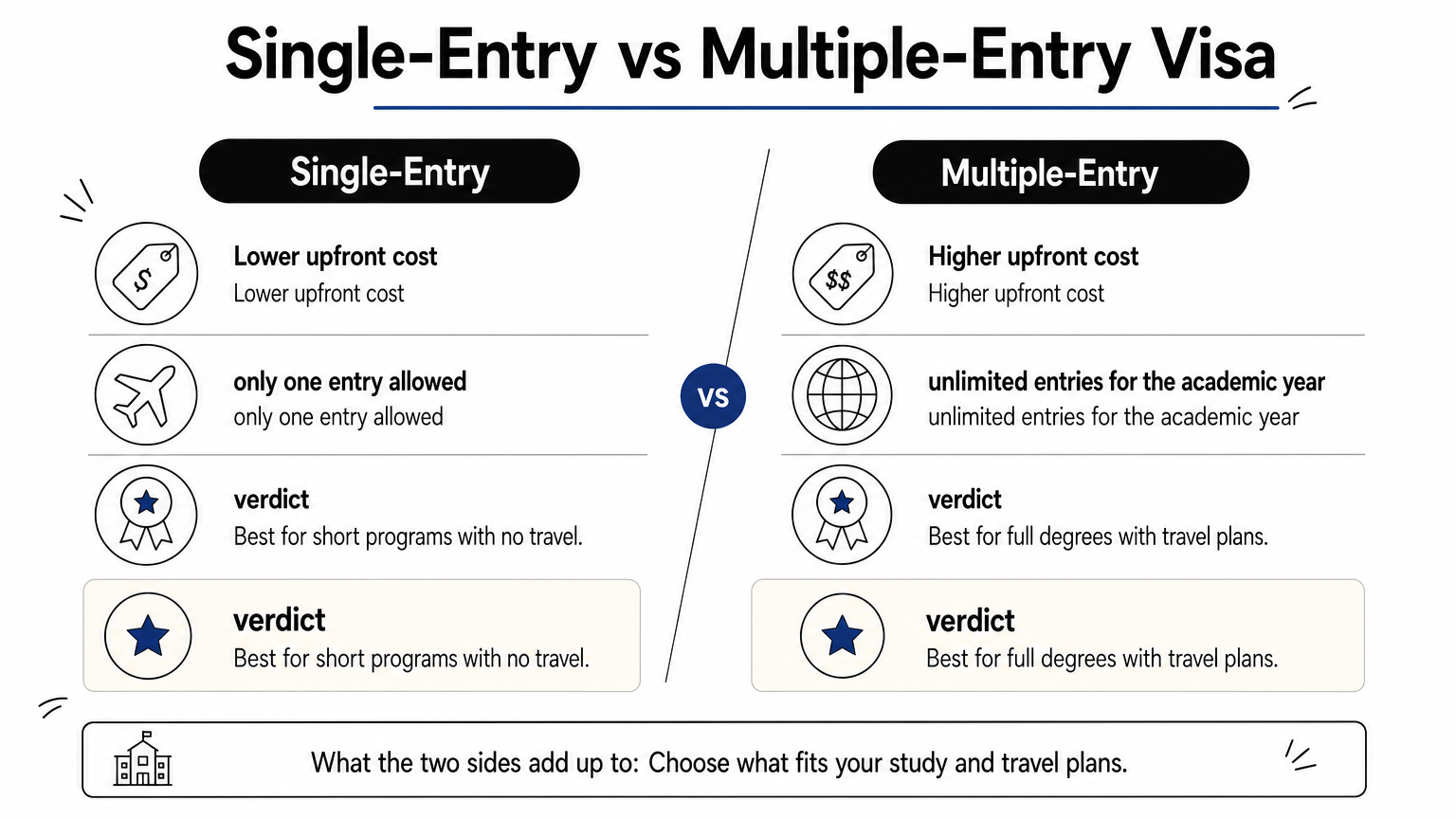
Russia doesn’t hand out one generic student visa. The consulate issues single-entry, double-entry, or multiple-entry visas, and the type stamped on your passport changes what you pay and how often you can cross the border without reapplying. Most students studying a full degree program end up needing a multi-entry visa for the academic year, since a single-entry visa strands you if you fly home for a break and need to come back. Get the entry type wrong at the application stage and you’re paying twice, once for the mistake and once for the correction.
Single-entry vs. multiple-entry pricing
A single-entry visa costs less upfront but only lets you enter Russia once. If your program runs multiple semesters and you plan to visit home during vacations, a multiple-entry visa is worth the higher fee, because reapplying from scratch each time you travel costs more in consular fees and lost time than paying for multi-entry coverage from the start.
| Entry type | Typical use case | Relative cost |
|---|---|---|
| Single-entry | Short program, no travel plans during studies | Lowest |
| Double-entry | One planned trip home mid-program | Moderate |
| Multiple-entry | Full degree, multiple semesters, travel flexibility | Highest, but cheapest over time |
Paying more for a multiple-entry visa upfront almost always costs less than reapplying every time you travel.
Standard vs. expedited processing
Processing speed is the second lever that moves your total. Standard processing takes longer but costs less, while expedited processing gets your visa turned around faster for a surcharge the consulate adds on top of the base consular fee. If you applied with three or four months of runway before your intake, standard processing works fine and keeps your student visa for russia from india fees closer to the baseline. If you’re applying six weeks out because your invitation letter took time to arrive, you’ll likely pay the expedited rate just to make your intake date.
How intake timing changes your entry type needs
Intake timing and entry type interact more than most students expect. Applicants who start the process early, right after receiving their offer letter, usually qualify for standard processing and have time to request the correct multi-entry visa without a rush surcharge. Students who wait until the last month often get pushed into expedited processing and, in the scramble, sometimes accept whatever entry type the consulate processes fastest, even if it’s not the one they’ll actually need six months later. Requesting the right entry type from day one avoids a second visa application mid-year.
Because these variables stack, it helps to lock in your entry type and processing speed before you calculate a final budget rather than after. RUSBASE handles this as part of its visa support and invitation letter processing for partner university admissions, so students get the correct entry type matched to their actual program length instead of guessing and paying for corrections later. That single decision, made early, is often the difference between a predictable visa bill and one that creeps up every time you need to travel or extend your stay.
Extra costs beyond the visa fee itself
Once you’ve accounted for the consular fee and the invitation letter, a second wave of costs shows up that has nothing to do with the visa stamp itself but everything to do with getting you legally into Russia and settled. These charges rarely appear in the headline number anyone quotes for student visa for russia from india fees, yet they’re unavoidable if you want a clean, trouble-free arrival. Budget for them the same way you budget for the visa, because skipping one usually means paying a penalty or a rush fee later to fix it.

Medical tests and health insurance
Before you travel, most Russian universities and the visa process itself require proof of health insurance valid in Russia, along with certain medical tests, sometimes including an HIV test with results in a specific format. These aren’t free, and the price depends on which clinic you use and how quickly you need results. Skipping this step isn’t an option since immigration authorities check for valid coverage on arrival, and universities won’t complete enrollment without it. Buy insurance early rather than at the last minute, since rushed policies from unfamiliar providers sometimes cost more and cover less.
The visa gets you on the plane, but insurance and medical clearance are what get you through immigration on the other side.
Migration card and registration after landing
Every foreign student must register their migration card within a set number of days after arriving in Russia, and this registration carries its own small fee, usually handled through the university’s international office or a local migration service. Miss the registration window and the fine is far steeper than the fee itself, sometimes running into thousands of rubles plus complications for future visa renewals. Universities working with agencies like RUSBASE typically walk new students through this step in the first week, which is part of why end-to-end visa and arrival support matters more than it looks on paper before you leave India.
Photos, biometrics, and courier costs
Applications need passport-style photos meeting exact specifications, and some consular offices now require biometric appointments, both of which come with their own small charges. If you’re not applying in person, add courier fees for sending your passport and documents to the consulate and getting them back. None of these individually break your budget, but they stack up:
- Passport photos meeting consulate specifications
- Biometric appointment fee, where applicable
- Courier or travel cost to the consulate
- Printing and document binding for the application packet
Arrival costs many students forget
Landing in a new country brings a final round of expenses that have nothing to do with paperwork but everything to do with actually starting your life there. Airport pickup, local SIM cards, temporary housing before your dorm assignment is confirmed, and basic winter clothing if you’re arriving in colder months all cost money that a visa fee calculator never mentions. Planning for these upfront, rather than discovering them at the airport with an empty wallet, keeps your first week in Russia from turning into a stressful scramble instead of the start of your degree.
How to pay your Russia student visa fees
Once you know your total, the next question is practical: how do you actually hand over the money without losing a chunk of it to fees or delays. Payment methods for a student visa for russia from india price vary depending on whether you’re paying the consulate directly, the university for your invitation letter, or an agency handling the whole package. Get this wrong and you either lose money on conversion or, worse, submit a payment the consulate won’t accept and lose time you don’t have.
Consular fees usually mean cash or demand draft
Most Russian consulates and visa application centers in India still expect payment in a specific form, often a demand draft or cash in Indian rupees, rather than a card swipe at the counter. Policies differ slightly between the Moscow embassy’s consular jurisdiction and regional centers, so confirm the accepted method before your appointment rather than assuming a credit card will work. Showing up with the wrong payment format is one of the most common reasons applicants get turned away and have to rebook, which costs you both time and, often, a second courier or travel charge.
Confirm the accepted payment method before your appointment, not after you’ve already made the trip.
University and agency fees typically go through wire transfer
Invitation letter charges and any agency service fee usually move through international wire transfer or a payment gateway the university or consultancy sets up for foreign students. This is where currency conversion costs bite hardest, since a wire transfer from an Indian bank to a Russian university account can carry both a flat transfer fee and a less favorable exchange rate than what you see quoted online. Ask upfront whether the university accepts payment in Indian rupees through a local partner, since that route sometimes avoids the worst of the conversion loss.
| Payment type | Typical method | Common pitfall |
|---|---|---|
| Consular fee | Cash or demand draft | Card not accepted at counter |
| Invitation letter fee | Wire transfer | High conversion loss |
| Agency service fee | Wire transfer or local gateway | Hidden processing charge |
| Document courier | Cash on delivery | Extra charge for return shipping |
Reduce conversion loss with a payment checklist
Running every payment through the same bank or the cheapest available channel keeps your total closer to what you originally budgeted. A short checklist before you send any money:
- Confirm the exact accepted currency and payment method for each recipient
- Compare your bank’s conversion rate against the mid-market rate before transferring
- Ask if a local payment gateway can avoid international wire fees
- Keep receipts for every payment, since universities and consulates sometimes ask for proof at a later stage
- Send payments in one batch where possible instead of several small transfers, which multiplies flat fees
Why bundled payment through an agency simplifies things
Students applying through a consultancy often pay one consolidated invoice instead of juggling separate payments to the university, the consulate, and a translator. RUSBASE structures its admissions and visa support packages this way specifically because scattered payments are where students lose the most money to conversion fees and missed deadlines. Paying once, in a currency and method confirmed in advance, removes a surprising amount of the friction that otherwise turns visa payment into its own small project.
Common mistakes that quietly inflate your visa cost
Most students don’t blow their budget on one big expense. They bleed money through small, avoidable errors that stack up quietly until the final total looks nothing like the number they planned for. Watching hundreds of applications move through the process shows the same handful of mistakes repeating year after year, and almost all of them are fixable before you even submit paperwork.
Applying without confirming the invitation letter fee first
Students frequently accept a university offer and start the visa process before asking what the invitation letter fee actually is. By the time the university’s admissions office mentions the charge, the student has already booked flights or promised a start date, leaving no room to negotiate or shop around. Ask for this figure in writing before you commit to a university, not after you’ve already paid a deposit.
Every fee you don’t ask about upfront becomes a fee you pay at the worst possible moment.
Waiting too long and paying the expedited surcharge
Timing mistakes cost more than almost anything else on this list. Applicants who wait until six or eight weeks before intake almost always get pushed into expedited processing, which adds a surcharge on top of the standard consular fee for no benefit beyond speed. Nothing about a rushed application is better than a calm one, so starting the moment your offer letter arrives protects both your timeline and your wallet.
Choosing the wrong entry type and paying to fix it
Getting stuck with a single-entry visa when your program actually needs multiple entries is a mistake that costs twice: once for the original visa and again for the correction or reapplication. Students who don’t clarify their travel plans before applying often discover this only when they try to fly home for a break and realize their visa won’t let them back in.
Skipping document batching and paying per-document translation rates
Sending documents for translation one at a time, as each requirement surfaces, usually costs more per page than batching everything through a single translator at once. Rushed, individual translation requests also carry higher per-document rates in many cases, since the translator has no volume to justify a discount.
Ignoring currency timing and losing money on conversion
Transferring money for consular fees, invitation letters, and service charges on different days at different exchange rates means paying whatever rate happens to apply that day, rather than shopping for the best one. Batching payments and checking the mid-market rate before transferring keeps this loss to a minimum.
Here’s a quick reference for the mistakes that cost students the most, ranked by how often they show up in real applications:
| Mistake | Why it costs extra |
|---|---|
| Not confirming invitation letter fee early | Locked into a price after committing to flights |
| Applying six weeks before intake | Forces expedited processing surcharge |
| Wrong entry type selected | Requires a second application later |
| Translating documents one at a time | Higher per-document rate |
| Scattered currency transfers | Loses money on unfavorable rates each time |
Each of these mistakes is preventable, and none of them require special knowledge beyond asking the right question at the right time. Getting your student visa for russia from india fees under control isn’t about finding a secret discount. It’s about closing the small gaps where money quietly leaks out before you notice.
Planning your Russia student visa budget
You now have every line item that makes up student visa for russia from india fees: the consular charge, the invitation letter, translation and notarization, currency buffers, and the arrival costs nobody mentions upfront. Add them together with the formula from earlier, confirm each figure in writing before you commit, and you’ll walk into your consulate appointment with a number that actually holds up instead of one that quietly grows with every fresh surprise.
Budgeting well here isn’t about finding a hidden discount. It’s about asking the right questions early, locking in your entry type, and paying through channels that don’t bleed money on conversion. Students who do this rarely get blindsided three weeks before departure.
If you’d rather skip the guesswork entirely, talk to RUSBASE about your admission and visa costs before you apply anywhere. One conversation now saves you from paying for mistakes later.
Questions About Your Own Case?
Requirements depend on your nationality and subject. Ask us directly, free of charge.
Book a Free Consultation