
Study Engineering Abroad for Indian Students: Fees by Country
September 30, 2026
If you’re comparing options to study engineering abroad for Indian students fees, you already know the numbers vary wildly between countries. A mechanical or computer science degree can run you $40,000 a year in the US, or a fraction of that in Eastern Europe, and most comparison articles online just don’t break down the real cost of tuition plus rent plus visa fees in one place.
This guide answers the money question directly. You’ll see actual fee ranges by country, so you can compare a UK engineering program against options in Russia, Germany, or elsewhere without guessing. We also flag where low-cost or near-free tuition genuinely exists, since a few public university systems still offer it to international students under specific conditions.
We built this list around what actually matters when you’re budget-conscious: published tuition rates rather than vague estimates, total cost of attendance including housing, and countries where admission doesn’t hinge on IELTS or TOEFL scores. By the end, you’ll know which countries fit your budget and which programs are worth applying to first.
1. Russia: affordable degrees with no IELTS required
Engineering degrees in Russia cost less than almost anywhere else with recognized universities, and that’s the main reason so many Indian families now shortlist it first. You get English-taught programs in mechanical, civil, computer science, and petroleum engineering at public universities that publish their fees openly, so you’re not stuck emailing admissions offices and waiting weeks for a quote.

Tuition fees
Most partner universities in Russia charge between $3,000 and $6,000 a year for engineering degrees, depending on the city and specialization. Moscow and Saint Petersburg sit at the higher end of that range, while universities in Ufa, Kazan, and Novosibirsk often come in cheaper without any real drop in program quality. A four-year B.Tech-equivalent degree can therefore cost under $20,000 in total tuition, a figure that’s hard to match anywhere else on this list.
A four-year engineering degree in Russia can cost less in total than a single year in the US or UK.
| City | Typical annual tuition (engineering) |
|---|---|
| Ufa | $3,000 – $4,000 |
| Kazan | $3,200 – $4,500 |
| Novosibirsk | $3,500 – $5,000 |
| Moscow | $4,500 – $6,500 |
| Saint Petersburg | $5,000 – $6,500 |
Cost of living
Housing and daily expenses stay low outside the two biggest cities. Budget roughly $150 to $300 a month for a hostel or shared apartment, plus $100-150 for food, in cities like Ufa or Kazan. Moscow and Saint Petersburg push that total closer to $500-600 a month once you factor in rent and transport, which is still well below equivalent costs in London or Toronto.
Top universities
Russia’s engineering strength runs deeper than most Indian applicants expect, with over two dozen partner universities spread across six cities. Institutions worth shortlisting include Bashkir State Medical University’s affiliated technical programs, Kazan Federal University, Novosibirsk State Technical University, and several Moscow-based polytechnics that hold recognition in the WHO World Directory framework for combined science programs alongside standard ABET-adjacent engineering tracks.
Admission requirements
Russia stands out because IELTS/TOEFL isn’t required at most partner universities, which removes months of prep time and hundreds of dollars in test fees for applicants. What you typically need instead is:
- Class 12 marksheet with physics, chemistry, and math
- Valid passport
- Notarized and translated academic documents
- A short online interview or document review
Admission decisions usually land within 7 working days, and the official invitation letter needed for your visa follows within 30 working days, which is fast compared to most Western application cycles.
Post-study work opportunities
Graduates can apply for a post-study work permit tied to a job offer, though Russia’s system is less structured than Canada’s or Germany’s for automatic stay-back rights. Many students instead use their degree to sit for licensing exams back home or pursue further study in Europe. If you want a full comparison of universities, tuition, and visa steps mapped to your specific budget, RUSBASE’s free consultation walks through shortlisting before you commit to any application.
2. Germany: near-free tuition at public universities
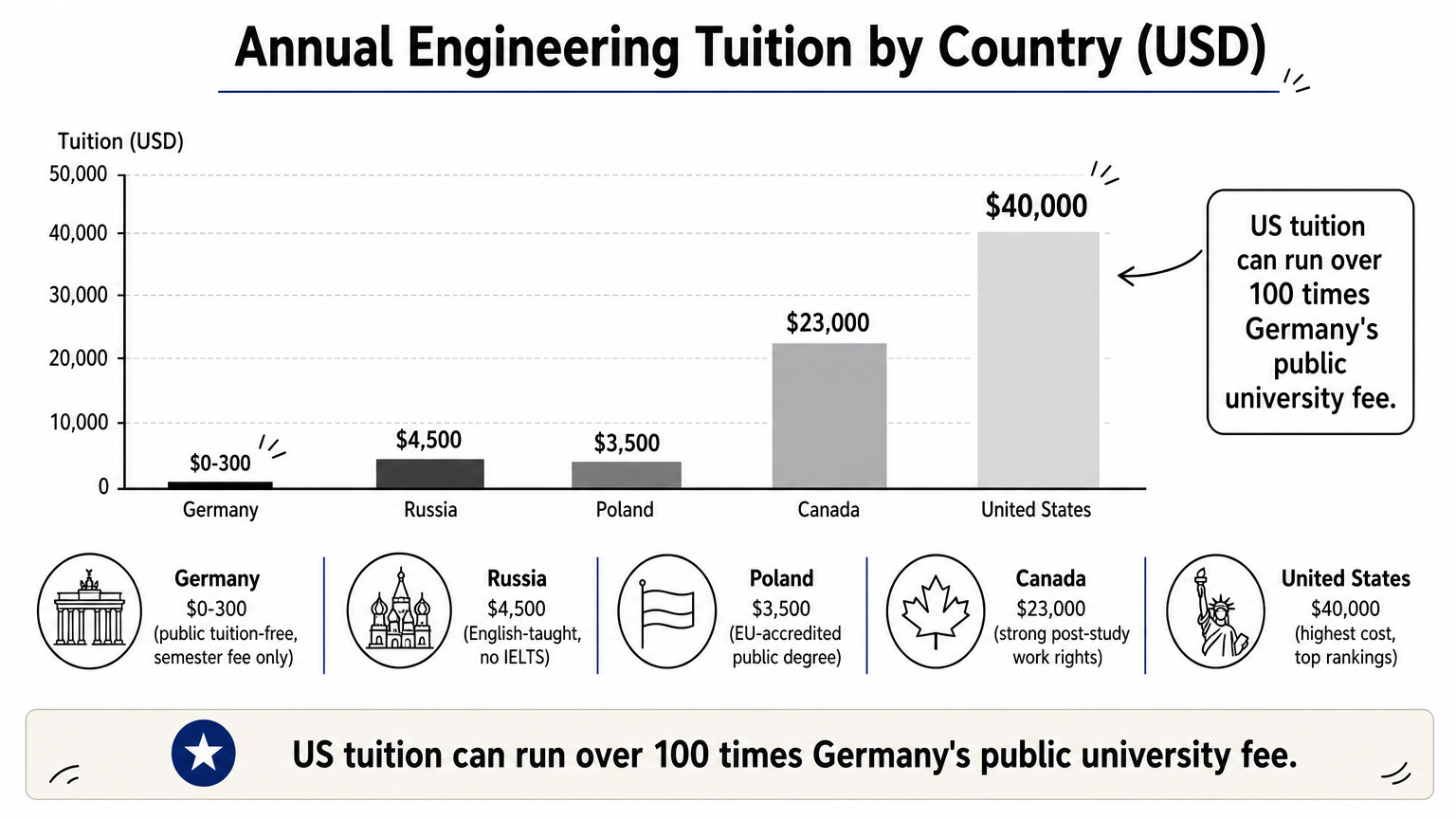
Germany draws Indian engineering applicants for one reason above all: most public universities charge no tuition fees, even for international students, because the country treats higher education as a public good rather than a revenue stream. You’ll still pay a small semester contribution, but it’s nowhere close to what you’d spend in the US or UK for a comparable mechanical or electrical engineering degree.
Tuition fees
Public universities across most German states charge €0 in tuition, with only a semester fee of roughly €150-350 covering administration and a public transport pass. Baden-Württemberg is the exception, charging non-EU students around €1,500 per semester. Private universities and specialized technical institutes run higher, often €10,000-20,000 a year, so sticking with public TU (Technische Universität) programs is where the real savings show up.
Germany’s public universities can make an engineering degree nearly tuition-free, but living costs still add up fast.
Cost of living
Budget €850-1,100 a month for rent, food, health insurance, and transport, with Munich and Berlin sitting at the top of that range and smaller university towns like Aachen or Dresden coming in cheaper. Germany requires proof of a blocked bank account, currently around €11,904 for the year, to cover these expenses before your visa gets approved.
Top universities
RWTH Aachen, TU Munich, and TU Berlin consistently rank among the strongest engineering schools in Europe, with strong industry ties to companies like Siemens and Bosch.
Admission requirements
German universities generally expect strong academic transcripts, a German or English language certificate depending on the program, and often a year of prior university study or a foundation year (Studienkolleg) before direct entry. Some programs still ask for IELTS or an equivalent proficiency test, per DAAD guidance.
Post-study work opportunities
Graduates get an 18-month post-study work visa to find a job related to their field, and Germany’s engineering sector actively recruits international graduates into full-time roles afterward.
3. Poland: low-cost EU degrees taught in English
Poland gives Indian students a genuine EU degree without the price tag that usually comes with studying in Western Europe. Engineering programs at public technical universities run in English, carry full EU accreditation, and cost a fraction of what you’d pay in the UK or a private American school, which is exactly why students who want to study engineering abroad for Indian students free of the usual Western tuition shock keep landing on Poland’s shortlist.
Tuition fees
Expect $2,500 to $5,000 a year for engineering programs at public universities like AGH University of Krakow or Warsaw University of Technology, with private institutions running slightly higher at $4,000-6,000. A full four-year bachelor’s rarely tops $20,000 in total tuition, putting Poland close to Russia on raw affordability but with the added weight of an EU-recognized diploma.
Poland pairs EU accreditation with tuition fees that rival some of the cheapest countries outside Europe entirely.
Cost of living
Cities like Krakow, Wroclaw, and Poznan keep monthly expenses down to roughly €400-600, covering a shared apartment, groceries, and local transport. Warsaw runs somewhat higher, closer to €700-800 a month, but still undercuts most Western European capitals by a wide margin.
Top universities
Warsaw University of Technology, AGH University of Krakow, and Gdansk University of Technology anchor Poland’s engineering reputation, with strong programs in mechanical, civil, and computer engineering that draw students from across South Asia and the Middle East.
Admission requirements
Applicants generally need:
- Class 12 marksheet with physics, chemistry, and math
- English proficiency proof (IELTS often accepted but not always mandatory, depending on the program)
- A completed application form and passport copy
- Sometimes a short entrance exam for oversubscribed programs
Post-study work opportunities
Graduates receive a 9-month job-search visa after finishing their degree, and Poland’s growing tech and manufacturing sectors have made it easier for engineering graduates to convert that into a longer-term work permit within the EU.
4. Malaysia: British and Australian degrees at local prices
Malaysia lets Indian students earn a branch-campus degree from a UK or Australian university without paying UK or Australian tuition. Monash University and the University of Nottingham both run full engineering campuses in Malaysia, issuing the same parchment students get in Melbourne or Nottingham, but at a fraction of the cost. That combination of brand-name recognition and lower fees makes Malaysia a serious contender for anyone comparing options to study engineering abroad for Indian students fees on a tighter budget.
Tuition fees
Expect $4,000 to $8,000 a year at branch campuses like Monash Malaysia or Nottingham Malaysia, and somewhat less, around $3,000-5,000, at strong local institutions such as Universiti Teknologi Malaysia. A four-year engineering degree typically totals $16,000-30,000, which undercuts the home campuses of these same universities by well over half.
A Monash or Nottingham engineering degree costs a fraction in Malaysia of what it costs at the home campus.
Cost of living
Kuala Lumpur and Johor Bahru keep monthly costs to roughly $400-600, covering shared housing, food, and local transport. That’s noticeably cheaper than Australia or the UK, where equivalent living costs often run double.
Top universities
Monash University Malaysia, University of Nottingham Malaysia, and Universiti Teknologi Malaysia lead the field, with strong placement records in mechanical, electrical, and petroleum engineering.
Admission requirements
Applicants generally need:
- Class 12 marksheet with physics, chemistry, and math
- IELTS or equivalent, usually 6.0-6.5, though some pathway programs waive it with a foundation year
- Passport copy and completed application form
- Proof of funds for the student visa
Post-study work opportunities
Malaysia doesn’t offer an automatic long-term stay-back visa like Canada, but graduates can apply for employment passes tied to a confirmed job offer, and many use the degree as a stepping stone toward further study or work in Australia or the UK given the shared accreditation.
5. Taiwan: budget-friendly tech and engineering education
Taiwan rarely comes up when Indian families first research where to study engineering abroad, but it should. The island runs some of Asia’s strongest semiconductor and electronics industries, and its universities have built engineering programs to match, all while charging tuition that stays well under what you’d pay in Australia or Canada. Taiwan also funds a wide range of government scholarships specifically aimed at international STEM students, which is why it keeps surfacing in searches for options to study engineering abroad for Indian students free of the usual Western price tag.
Tuition fees
Public universities charge roughly $2,500 to $4,000 a year for engineering degrees, and several Taiwanese government scholarships cover tuition entirely for qualifying applicants. Private universities run higher, closer to $4,500-6,000, but still undercut most Western options by a wide margin.
Taiwan combines semiconductor-industry engineering strength with tuition that rarely tops $4,000 a year.
Cost of living
Taipei runs $500-700 a month for housing, food, and transport, while cities like Tainan or Hsinchu drop that closer to $350-450. Either way, Taiwan stays cheaper than Singapore or Australia for a comparable standard of living.
Top universities
National Taiwan University, National Cheng Kung University, and National Tsing Hua University anchor the country’s engineering reputation, with particularly strong programs in electrical engineering, materials science, and computer engineering tied directly to Taiwan’s chip manufacturing sector.
Admission requirements
Applicants typically need a Class 12 marksheet with strong math and physics scores, English proficiency proof (IELTS or TOEFL, though some programs accept a strong academic record instead), and a completed scholarship or university application depending on the funding route chosen.
Post-study work opportunities
Graduates can apply for a job-seeking visa valid up to a year, and Taiwan’s tech manufacturers actively recruit engineering graduates, particularly in semiconductor design and production roles where demand still outpaces local supply.
6. France: subsidized fees at public universities
France runs one of Europe’s most heavily subsidized higher education systems, and that subsidy extends to international students at public engineering schools, not just French nationals. Indian applicants comparing study engineering abroad for Indian students fees often overlook France because English-taught options are fewer than in Germany or Poland, but the ones that exist come with government-backed tuition caps that keep costs remarkably low for a Western European degree.
Tuition fees
Public universities and engineering schools (grandes écoles) charge €2,770-3,770 a year for undergraduate and master’s programs respectively, a rate set by the French government and applied uniformly regardless of nationality. Private engineering schools run considerably higher, often €8,000-15,000 a year, so sticking with public institutions is where the real value sits.
France subsidizes public engineering tuition so heavily that a full degree can cost less than one semester in the US.
Cost of living
Paris pushes monthly expenses to €1,000-1,200, covering rent, food, and transport, while smaller cities like Lyon, Toulouse, or Grenoble bring that down to roughly €700-850. Grenoble in particular has built a reputation as an engineering hub, which keeps costs reasonable without sacrificing program quality.
Top universities
Grenoble INP, INSA Lyon, and CentraleSupélec anchor France’s engineering strength, with strong industry partnerships in aerospace, energy, and electronics that regularly place graduates directly into French and multinational firms.
Admission requirements
Applicants generally need a Class 12 marksheet with strong math and physics scores, proof of English proficiency (IELTS around 6.0-6.5) for English-taught tracks, and in some cases a French language certificate if the program requires partial instruction in French. A personal statement or motivation letter carries more weight in French admissions than in most other countries on this list.
Post-study work opportunities
Graduates receive a residence permit valid for up to two years to search for or start a job in their field, and France’s engineering sector, particularly aerospace and automotive, actively hires international graduates who studied at recognized public institutions.
7. Canada: moderate costs with strong job prospects
Canada sits in the middle of the pack when Indian families compare study engineering abroad for Indian students fees, cheaper than the US or UK but pricier than Russia, Poland, or Taiwan. What draws applicants here isn’t rock-bottom tuition, it’s the combination of moderate costs, strong industry connections, and one of the clearest paths to permanent residency of any country on this list.

Tuition fees
Engineering programs at Canadian universities typically run $18,000 to $28,000 a year for international students, with schools like the University of Toronto and UBC sitting near the top and regional universities in provinces like Manitoba or Saskatchewan coming in lower. A four-year degree can total $70,000-110,000 in tuition alone, which puts Canada well above Russia or Poland but still under comparable programs in the US.
Canada’s tuition sits above Eastern Europe but well below the US, and the payoff is a faster route to permanent residency.
Cost of living
Budget $1,000-1,500 a month for rent, food, and transport in cities like Toronto or Vancouver, while smaller university towns such as Waterloo or Halifax bring that closer to $800-1,000. Winter clothing and health insurance add a few hundred dollars more that first year, something many applicants underestimate when budgeting.
Top universities
University of Toronto, University of Waterloo, and University of British Columbia lead Canada’s engineering rankings, with Waterloo in particular known for its co-op program that places students in paid industry work terms throughout the degree.
Admission requirements
Applicants generally need a Class 12 marksheet with strong math and physics grades, IELTS scores around 6.5-7.0, and a study permit backed by proof of funds covering tuition plus one year of living expenses.
Post-study work opportunities
Graduates qualify for a Post-Graduation Work Permit lasting up to three years, which stands as one of the strongest stay-back options anywhere, and many use that window to apply for permanent residency through Express Entry.
8. United Kingdom: prestigious degrees, higher fees
The UK carries brand weight that few countries on this list can match, and that reputation comes at a real cost. Indian families researching study engineering abroad for Indian students fees often start here because of the global ranking of UK engineering schools, then recalibrate once they see the tuition numbers alongside London rent.
Tuition fees
Undergraduate engineering programs typically charge £20,000 to £38,000 a year, with Russell Group universities like Imperial College London sitting at the top of that range. A three-year bachelor’s, the standard UK length, can total £60,000-110,000 in tuition alone, before you add a single month of rent.
A UK engineering degree costs roughly three times what the same field costs in Poland or Russia, for a three-year rather than four-year program.
Cost of living
London runs £1,300-1,600 a month for rent, food, and transport, while cities like Manchester, Sheffield, or Glasgow bring that down to roughly £900-1,100. Health surcharge fees, currently paid upfront as part of the visa, add several hundred pounds more per year that many applicants forget to budget for.
Top universities
Imperial College London, University of Manchester, and University of Edinburgh anchor the UK’s engineering strength, each with strong industry placement in aerospace, civil, and electrical engineering.
Admission requirements
Applicants generally need:
- Class 12 marksheet with strong math and physics grades
- IELTS score, typically 6.5-7.0 overall
- A completed UCAS application with personal statement
- Proof of funds covering tuition and living costs for the visa
Post-study work opportunities
Graduates qualify for the Graduate Route visa, giving them two years to work in the UK without needing a job offer tied to their student status. Many use that window to move into a Skilled Worker visa once they secure a permanent engineering role, per UK government guidance.
9. United States: top rankings but the highest costs
The US tops nearly every global engineering ranking, and that pull explains why so many Indian families still consider it despite the price. Anyone comparing study engineering abroad for Indian students fees across this whole list will find the US sitting at the far end, the most expensive option by a wide margin once tuition, rent, and insurance are added together.
Tuition fees
Engineering programs at US universities typically charge $25,000 to $55,000 a year, with private schools like MIT or Stanford sitting near the top and state universities offering somewhat lower out-of-state rates for international students. A four-year bachelor’s degree can total $100,000-220,000 in tuition alone, easily five to ten times what the same degree costs in Russia or Poland.
A US engineering degree can cost more than a house back home, before you’ve paid a single month of rent.
Cost of living
Budget $1,200-2,000 a month for rent, food, and transport in cities like Boston or San Francisco, while university towns in the Midwest or South bring that closer to $800-1,100. Health insurance is mandatory and often adds $2,000-3,000 a year on top, a cost many first-time applicants miss when budgeting.
Top universities
MIT, Georgia Tech, and Purdue University anchor the country’s engineering strength, with deep research funding and strong placement into firms like Boeing, Intel, and NASA-affiliated labs.
Admission requirements
Applicants generally need a strong Class 12 transcript with math and physics, SAT or ACT scores for many undergraduate programs, TOEFL or IELTS proof of English proficiency, and financial documentation covering the full first-year cost before the visa is issued.
Post-study work opportunities
Graduates can apply for Optional Practical Training, giving STEM graduates up to three years of work authorization tied to their degree field, per US Department of Homeland Security guidance. That window often becomes the bridge toward an H-1B sponsorship for those who land a permanent engineering role.
10. Australia: quality education with rising expenses
Australia rounds out this list as a strong academic choice with costs that have climbed steadily over the past few years. Indian families weighing study engineering abroad for Indian students fees often shortlist Australia for its research output and post-study visa policy, but the tuition and rent numbers now sit closer to the UK than to Canada, so it pays to budget carefully before committing.
Tuition fees
Engineering programs typically charge AUD 35,000 to 50,000 a year (roughly $23,000-33,000), with Group of Eight universities like the University of Melbourne and University of Sydney at the top of that range. A four-year bachelor’s can total AUD 140,000-200,000 in tuition alone, putting Australia ahead of Canada in cost but still below most US private schools.
Australia’s tuition has crept up close to UK levels, so the old reputation as a cheaper Commonwealth option no longer holds.
Cost of living
Sydney and Melbourne run AUD 1,800-2,400 a month for rent, food, and transport, while cities like Adelaide or Brisbane bring that down to roughly AUD 1,400-1,700. Health insurance (OSHC) is mandatory for the full visa duration and adds another AUD 600-900 a year.
Top universities
University of Melbourne, University of Sydney, and Monash University anchor Australia’s engineering reputation, with strong programs in civil, mining, and mechatronic engineering tied to the country’s resources and infrastructure sectors.
Admission requirements
Applicants generally need a Class 12 marksheet with strong math and physics grades, IELTS scores around 6.5-7.0, a completed visa application (subclass 500), and proof of funds covering tuition plus living costs for the first year.
Post-study work opportunities
Graduates qualify for the Temporary Graduate visa, offering two to four years of work rights depending on qualification level, per Australian Government Department of Home Affairs guidance. That stretch gives engineering graduates real time to secure sponsored roles and pursue permanent residency through skilled migration pathways.
Finding the right country for your budget
Ten countries, ten fee structures, and one clear pattern: tuition scales with brand name, not necessarily with teaching quality. Russia, Poland, and Taiwan deliver recognized engineering degrees for a fraction of what you’d pay in the US or Australia, while Germany and France prove that even Western Europe can stay affordable if you stick to public institutions. Canada and the UK sit in between, trading higher costs for stronger post-study work rights.
Your decision really comes down to three numbers: total tuition, monthly living costs, and how fast you need a visa. If budget and speed matter more than brand prestige, Russia’s combination of low fees, no IELTS requirement, and 7-day admission decisions is hard to beat on this list. Talk through your specific subject and budget with RUSBASE’s free consultation before you shortlist a single university.
Questions About Your Own Case?
Requirements depend on your nationality and subject. Ask us directly, free of charge.
Book a Free Consultation