How to Study in Russia for Pakistani Students: Full Guide
September 26, 2026
If you’re a Pakistani student weighing your options for study in Russia for Pakistani students, you’re probably tired of vague answers about cost, visas, and whether your future degree will even be recognized back home. Tuition in the UK or Canada can run past $20,000 a year, and many programs still demand IELTS scores you haven’t had time to prepare for. Russia solves both problems, with affordable tuition starting around $1,600 a year and English-taught programs that skip the language test entirely.
This guide answers exactly what you came here for: which universities accept Pakistani students, what documents you need, how much you’ll actually spend on tuition and living costs, and how the visa process works from application to arrival. We also cover degree recognition, since Pakistani students pursuing medicine need programs listed with the WHO and accepted by PMDC back home.
We’ll walk through university selection by city and budget, the admissions timeline, scholarship opportunities, and what to expect once you land in Russia, including housing and first-week logistics. RUSBASE has guided students through this exact process, so every step here reflects what actually happens, not just what’s promised on a website.
What Pakistani students should know before applying
Before you shortlist a single university, sort out the facts that actually determine whether your degree will hold up once you’re back home. Pakistani students head to Russia mostly for medicine, engineering, and business programs, and each of these has different recognition rules, entry requirements, and costs that catch families off guard if nobody explains them upfront.
Degree recognition matters more than rankings
Getting a degree that’s cheap and fast means nothing if it won’t let you practice. For medical students, the two checkboxes that matter are listing in the WHO World Directory of Medical Schools and acceptance by the Pakistan Medical and Dental Council (PMDC) for licensing exams back home. Not every Russian medical school ties both boxes, so confirm this before you apply, not after you’ve paid a deposit. RUSBASE only partners with universities that clear both standards, which is worth checking directly on our partner universities page rather than taking an agent’s word for it.
A cheap medical degree that your home country won’t recognize isn’t a shortcut, it’s a dead end.
No IELTS or TOEFL required
Most Pakistani students already study in English through school and college, so proving English proficiency through a formal test can feel like an unnecessary hurdle. Most Russian universities partnered with RUSBASE skip the IELTS and TOEFL requirement entirely for English-taught programs, relying instead on your academic transcripts and a short interview. This alone can save you months of prep time and a $200+ test fee.
Tuition and living costs at a glance
Russia’s real advantage over the UK, US, or Canada is cost, but the numbers vary a lot by city and program. Here’s a rough breakdown Pakistani students should budget around:
| Expense | Typical Annual Cost (USD) |
|---|---|
| Tuition (medical/engineering) | $1,600 – $11,000 |
| Hostel accommodation | $600 – $1,500 |
| Food and daily living | $1,200 – $2,000 |
| Health insurance | $150 – $300 |
Compare that to a UK medical program, where tuition alone often exceeds $20,000 a year before living costs even enter the picture.
Academic calendar and intake timing
Since most Russian universities run intakes in September with a smaller secondary intake in February, timing your application matters. Documents, translations, and visa processing take real weeks, not days, so starting three to four months before your target intake gives you breathing room instead of a scramble.
Step 1. Choose your university and program
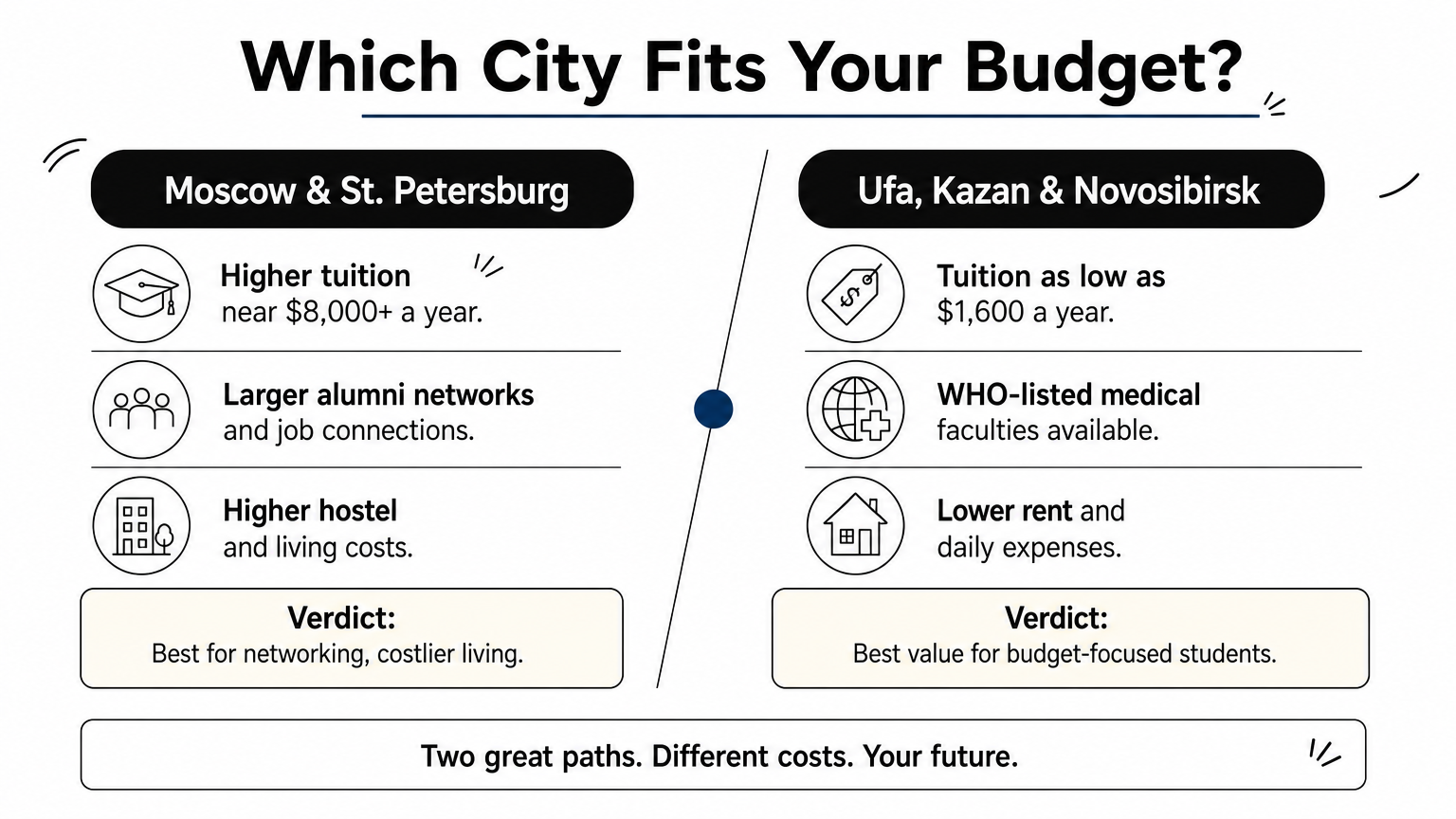
Start by matching your budget and career goals to a specific city, not a vague idea of "studying in Russia." Moscow and Saint Petersburg carry higher living costs but offer the biggest alumni networks, while cities like Ufa, Kazan, and Novosibirsk run tuition on the lower end without cutting corners on WHO-listed medical faculties. Sevastopol is another option worth a look if you want coastal living at a fraction of Moscow’s rent.
Match the city to your budget and program
For Pakistani students focused on MBBS-equivalent degrees, narrow your list to universities that publish real, upfront tuition instead of quoting a range only after you inquire. RUSBASE’s partner universities page lists tuition, city, and program length side by side, so you can compare a $1,600-a-year option in Ufa against an $8,000 program in Moscow without emailing five different agents first.
Pick the city first, then the university, because living costs vary more than tuition does.
Check program length and language of instruction
Most English-taught medical programs run six years including an internship year, while engineering and business degrees typically run four. Confirm the language of instruction for every year, since some universities switch to Russian-medium clinical rotations in later years without warning international applicants upfront.
Shortlist three to five options
Don’t apply to one university and hope. Build a shortlist based on:
- Confirmed WHO and PMDC-aligned recognition status
- Total cost including hostel and food, not just tuition
- Program length and language of instruction per year
- City size and climate, since northern cities get cold winters fast
- Available intake dates matching your timeline
A free consultation with RUSBASE over WhatsApp can shortcut this research, since we’ve already vetted which programs actually deliver on paper promises.
Step 2. Prepare your documents and meet requirements
Once you’ve picked your shortlist, the next hurdle is paperwork, and this is where most delays happen. Pakistani students applying to study in Russia need a specific set of attested documents before a university will even review an application, so gather everything early rather than scrambling once an intake deadline approaches.

Gather your academic documents
Every university on RUSBASE’s partner list asks for the same core set of files, though exact requirements shift slightly by program. Build your folder around this checklist:
- Matriculation and intermediate (FSc/A-Level) certificates and transcripts
- Valid passport with at least 18 months before expiry
- Passport-sized photographs (usually 6-10 copies)
- Medical fitness certificate from a licensed doctor
- HIV test result, required by most Russian universities
- No-objection certificate if you’re under a scholarship or government bond
Get certificates attested and translated
Russian universities won’t accept raw Pakistani transcripts. Every academic document needs notarized translation into Russian or English, followed by attestation from Pakistan’s Higher Education Commission (HEC) and the Ministry of Foreign Affairs. RUSBASE handles this translation and attestation step directly for applicants, which typically saves two to three weeks compared to arranging it independently through a local notary.
Skipping proper attestation is the single most common reason applications get rejected at this stage.
Meet the age and academic score requirements
Most medical programs require a minimum of 60% marks in FSc pre-medical (or equivalent) with biology, chemistry, and physics as core subjects. Engineering programs are more flexible on subject combination but still expect strong math and physics scores. Applicants should be at least 17 by the start of the academic year, and there’s no strict upper age limit for most partner universities, though younger applicants tend to move through visa processing faster.
Step 3. Submit your application and get accepted
With your attested documents ready, applying is the fastest step in the entire process. Send your complete file, either directly through RUSBASE or via your university’s admissions portal, and most partner universities respond to a properly prepared file within 48 hours. RUSBASE submits applications on your behalf to multiple universities at once, so you’re not stuck waiting on one admissions office before trying another.
What the university checks before accepting you
Admissions officers review your academic transcripts against the program’s minimum score requirements, confirm your medical fitness certificate and HIV test, and check that your attestation paperwork matches HEC and Ministry of Foreign Affairs records exactly. Any mismatch, even a misspelled name between passport and transcript, sends your file back for correction and adds a week or more to your timeline.
Careful pre-screening before submission is why acceptance rates for properly prepared applicants run close to 100 percent.
Receiving your acceptance and invitation letter
Once approved, you’ll typically get a conditional acceptance letter within 7 working days, confirming your seat pending final document verification. The university then issues an official invitation letter, the document Russia’s Ministry of Foreign Affairs requires before you can apply for a student visa, usually within 30 working days of acceptance. RUSBASE tracks this timeline for every student we place, following up directly with the international office instead of leaving you to guess at your application’s status.
Keep a paper trail
Gather digital and physical copies of every acceptance letter, receipt, and email confirmation you receive along the way. You’ll need these again during your visa application, and again at the airport when Russian immigration officers ask for proof of enrollment.
Step 4. Apply for your visa and plan your arrival
Once your invitation letter lands in your inbox, the visa clock starts. Pakistani students apply for a Russian student visa at the Russian Embassy in Islamabad or the consulate in Karachi, and with a complete file, approval typically takes about a week. This is the final gate before travel, so double-check every document against your invitation letter before booking your embassy appointment.
Book your embassy appointment
Schedule your visa appointment as soon as you receive the official invitation, since embassy slots fill up fast during the September intake rush. Bring your passport, invitation letter, acceptance letter, medical certificate, HIV test, and visa application form filled out exactly as instructed. RUSBASE reviews this file before submission, catching the small errors, like a passport number typo, that otherwise bounce applications back and cost you another week.
A one-week visa turnaround only happens when your paperwork is flawless the first time.
What to pack and confirm before you fly
Beyond clothes and essentials, carry printed and digital copies of every document from your application, plus enough cash for your first week until you set up a local bank card. Confirm your flight lands during daylight hours if possible, since many first-time travelers find nighttime arrivals in unfamiliar cities more stressful.
Arrival and your first week in Russia
RUSBASE arranges airport pickup for every student we place, so you won’t be navigating an unfamiliar city alone with heavy luggage. Our team helps with hostel check-in, local SIM card setup, and pointing you toward the nearest halal food options and pharmacy during your first week. Settling in fast matters more than people expect, since orientation week at most universities starts within days of your arrival, not weeks after.
Ready to start your journey to Russia
Studying medicine or engineering abroad shouldn’t mean gambling on degree recognition or drowning in test prep. Pakistani students who choose study in Russia for Pakistani students get WHO-listed medical programs, no IELTS requirement, and tuition that leaves room in the family budget for actual living, not just fees. Every step in this guide, from shortlisting a WHO and PMDC-aligned university to clearing embassy paperwork, is something RUSBASE has walked students through directly, not theory pulled from a brochure.
What separates a smooth admission from a stressful one usually comes down to preparation and having someone check your paperwork before a university does. That’s exactly where a local partner earns its keep, catching a typo on a passport number before it costs you a week, or confirming a program’s recognition status before you pay a deposit.
If you’re ready to move past research and start your actual application, book a free consultation with RUSBASE and get a straight answer on your university options today.
Questions About Your Own Case?
Requirements depend on your nationality and subject. Ask us directly, free of charge.
Book a Free Consultation