
How to Study in Russia in English: 2027 Guide
September 21, 2026
If you are searching for ways to study in Russia without spending years learning the language first, you are not alone. Thousands of students from Tunisia, India, and across Africa and Asia ask the same question every intake cycle: can you actually get a real degree, taught fully in English, without IELTS or TOEFL scores, and without paying Western tuition prices. The answer is yes, and this guide shows you exactly how.
This article walks you through the full process to study in English in Russia, from picking a WHO-recognized medical program to submitting documents and getting your visa approved. You will see real tuition ranges, city options like Moscow, Kazan, and Ufa, and the paperwork universities actually require for the 2026 intake, not vague estimates.
We built this guide from years of placing students directly with partner universities, so every step reflects what actually happens during admissions, not theory. By the end, you will know how to shortlist programs, budget realistically, and avoid the delays that trip up first-time applicants.
What you need to know before you apply
Before you fill out a single form, you need to understand how Russian higher education actually works for foreign students, because it differs from the UK or Canadian systems you might be used to comparing it to. Universities in Russia run separate tracks: some programs are taught fully in Russian, others fully in English, and a handful offer a preparatory year that bridges the two. If your goal is to study in Russia in English, you need to confirm the program’s language of instruction before you apply, not after you land, because switching tracks mid-degree is rarely possible.
English-taught vs Russian-taught programs
Most of the demand we see from students in Tunisia, India, and across Africa is for English-taught medical and engineering degrees, and for good reason: you skip a year or more of language study and start your professional coursework immediately. That said, some fields (law, pure sciences, a few technical specializations) are still mostly offered in Russian, so if you want to study in Russian instead, plan for a foundation year of language training first. Either path is legitimate. The choice comes down to your timeline and career goals, not one being objectively better than the other.
Degree recognition matters more than rankings
If you’re aiming for a medical degree, recognition is the single most important factor in your decision, above tuition cost or campus location. Check that the program appears in the WHO World Directory of Medical Schools and, if you’re from India, that it’s recognized by the National Medical Commission. Skipping this check is the most common and most expensive mistake applicants make; a cheap degree that isn’t recognized where you plan to practice is not a bargain.
A low tuition fee means nothing if your degree isn’t recognized where you plan to practice.
Application timelines and intakes
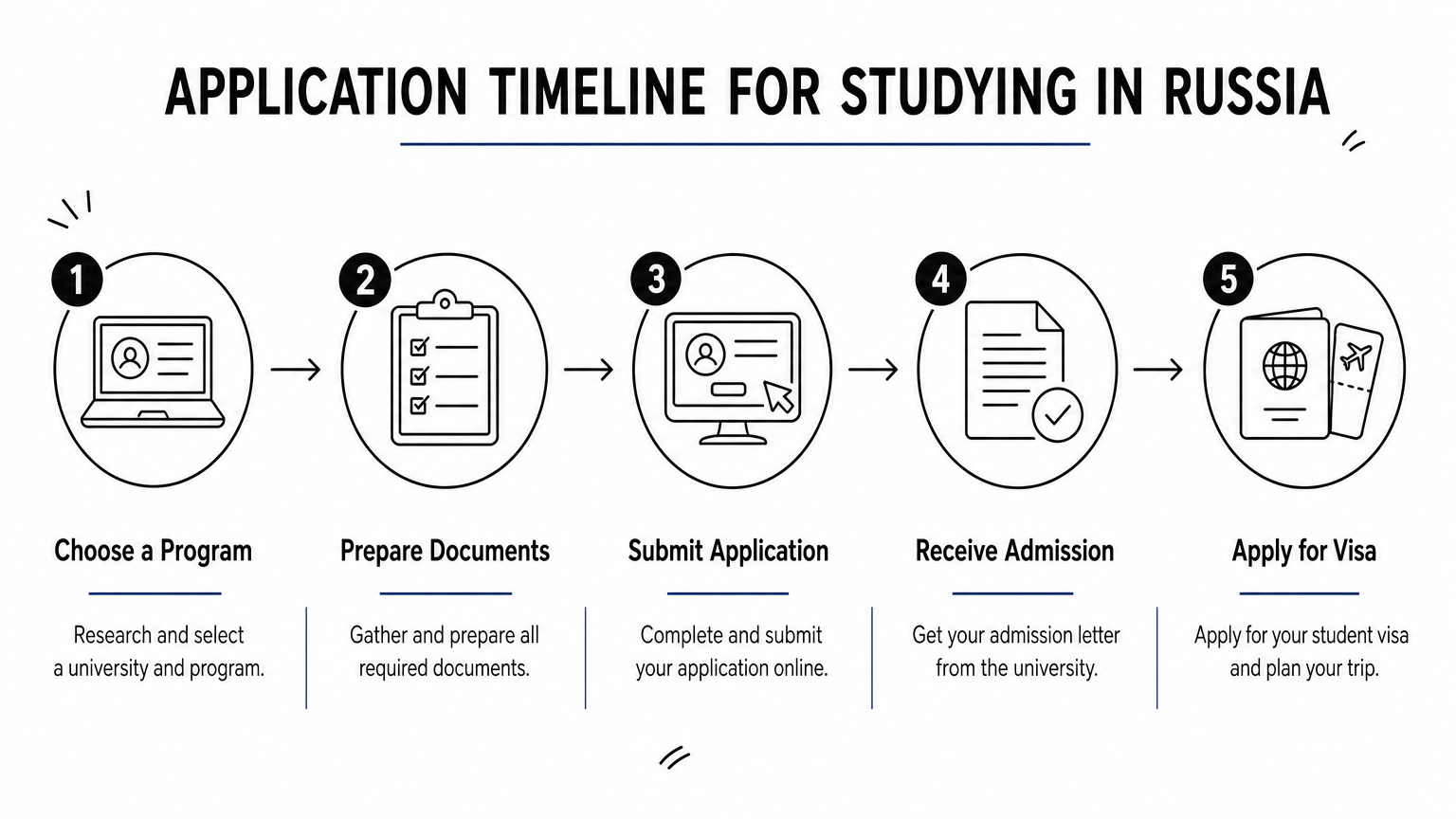
Russian universities generally run two intakes a year, though partner universities working with agencies like RUSBASE often accommodate rolling admissions for the right candidates. Here’s what a typical application calendar looks like for students planning to study in Russia 2025 or the 2026 academic year:
| Stage | Typical window |
|---|---|
| Document collection and pre-screening | 2-4 weeks |
| University acceptance letter | Within 7 working days of a complete file |
| Official invitation from the Ministry of Education | Within 30 working days |
| Visa processing at the embassy | About 1 week |
| Autumn intake start | Late August to early September |
| Spring intake (limited programs) | January to February |
No IELTS or TOEFL required
Most partner universities we work with do not require IELTS or TOEFL scores for admission to English-taught programs, including full medical degrees. Instead, they rely on a short interview or an internal English-proficiency check conducted after enrollment, which is far less stressful than months of test preparation. This single fact is why so many students from non-English-speaking education systems choose Russia over the UK, US, or Canada: you get taught entirely in English without the exam gatekeeping. Keep this in mind as you shortlist programs in the next step, since not every university follows the same policy, and confirming it early saves you from last-minute surprises.
Step 1. Choose your university and program
Choosing where to study is where most students either save themselves months of frustration or set themselves up for a transfer headache two years in. Start by listing your target subject, then filter for English-taught programs that match it, since not every university offers every specialization in English. Once you have a shortlist of three or four options, compare them side by side on tuition, city, and accreditation before you contact admissions.

Match your subject to a recognized program
Medicine, dentistry, and pharmacy draw the largest share of applicants who want to study in Russia in English, and these fields carry the strictest recognition requirements. Confirm the specific program, not just the university, appears on the WHO World Directory of Medical Schools, since some institutions list only certain faculties. Engineering, business, and IT programs have fewer recognition hurdles but still vary in course depth and lab access, so ask for the actual syllabus rather than a marketing brochure.
Pick the program that matches your career plan, not the campus with the best photos.
Compare cities: Moscow, Kazan, Ufa, and beyond
City choice affects your living costs, climate, and daily student life as much as the degree itself. Below is a quick comparison of common destinations among RUSBASE partner universities.
| City | Typical program strength | Living cost feel |
|---|---|---|
| Moscow | Medicine, business, engineering | Higher cost, biggest student community |
| Saint Petersburg | Medicine, arts, engineering | Mid-to-high cost, culturally rich |
| Kazan | Medicine, IT | Moderate cost, strong Muslim community |
| Ufa | Medicine | Lower cost, quieter campus life |
| Novosibirsk | Engineering, sciences | Lower cost, research-focused |
| Sevastopol | Medicine, maritime studies | Lower cost, coastal setting |
Shortlist with guidance, not guesswork
Second-guessing your shortlist alone rarely ends well, since course names and faculty structures don’t always translate cleanly from Russian websites. Book a free consultation with RUSBASE to walk through your budget, subject, and target city with someone who has placed students in these exact programs before. That conversation usually narrows four options down to one clear choice within a day.
Step 2. Budget for tuition and living costs
Money questions land in our inbox more than any other topic, and that makes sense: tuition transparency is the main reason so many students choose Russia over Western options in the first place. Your total cost depends on three variables: the university, the city, and the specialization. Medical degrees generally run higher per year than engineering or business programs, but even the priciest medical option stays far below equivalent tuition in the UK or US. RUSBASE publishes actual tuition figures for every partner university upfront, so you compare real numbers instead of waiting weeks for a quote after you’ve already invested time in an application.
Tuition ranges by field and city
Exact figures shift depending on the city and the specific faculty, but the ranges below reflect what students typically pay at partner universities across Moscow, Kazan, Ufa, and Novosibirsk.
| Program type | Typical annual tuition |
|---|---|
| Medicine (MBBS-equivalent) | $4,000 – $11,000 |
| Engineering | $2,500 – $6,000 |
| Business/IT | $1,600 – $5,000 |
Living costs beyond tuition
Rent, food, and transport add up faster than most first-time applicants expect, so build a monthly budget before you commit to a city. Smaller cities like Ufa and Novosibirsk cost noticeably less than Moscow or Saint Petersburg for the same standard of living.
- Dormitory housing: $50-$150 per month, depending on city
- Private apartment: $150-$400 per month
- Food and groceries: $100-$200 per month
- Local transport: $10-$25 per month
- Health insurance: roughly $150-$300 per year, often mandatory for your visa
Comparing Russia to the UK, US, and Canada
Students from Tunisia and India routinely tell us they save 60-80% on total degree cost by choosing Russia over the UK, US, or Canada, once you add tuition and living expenses together over a full program. Living well as a student in a mid-sized Russian city rarely costs more than $300-$400 a month outside rent, which keeps a six-year medical degree affordable for families who could never stretch to Western prices.
A full medical degree in Russia can cost less overall than one year of tuition alone in the UK or US.
Factor in currency exchange rates before you transfer funds, since rates shift and most universities expect payment in rubles or US dollars depending on the contract.
Step 3. Prepare and submit your application documents
Once you’ve picked a program and worked out your budget, the paperwork stage decides how fast your admission moves. Most delays we see happen because a document was missing a stamp, not because a student was unqualified. Get organized early, since a complete document file is what triggers the 7-working-day acceptance timeline you’re counting on.

The core document checklist
Every partner university asks for a similar base set of documents, though a few add extra requirements for medical programs specifically. Gather these before you contact admissions so you’re not scrambling once a seat opens:
- Passport copy valid for at least 18 months
- High school or bachelor’s diploma and transcripts
- Birth certificate
- Medical certificate confirming fitness to study
- Passport-sized photos (usually 6-8)
- HIV test certificate (required by most Russian universities)
- Application form for the specific university
Notarized translation and legalization
Any document not already in English or Russian needs a notarized translation, and some universities also ask for apostille certification on your diploma depending on your home country’s agreements with Russia. Skipping this step is the second most common cause of delay after missing documents entirely, since universities won’t process an incomplete academic file. RUSBASE checks every document before submission, catching translation gaps or formatting issues that would otherwise bounce back weeks later.
A missing stamp can cost you more time than a missing document.
Submitting your file and tracking your acceptance
Once your file is complete, it goes to the university’s admissions office for review, and you should expect a decision within about 7 working days if nothing is missing. From there, the university issues your official invitation letter through the Ministry of Education, which typically takes up to 30 working days and is the document you’ll need for your visa application. Students who want to study in Russia in English without navigating this back-and-forth themselves usually hand the whole submission process to their agency, since a dedicated contact who has already worked with the admissions office catches problems before they become delays. That’s exactly the role RUSBASE plays for every applicant it represents, from document check to final invitation letter.
Step 4. Secure your visa and travel to Russia
With your official invitation letter in hand, the visa stage moves fast, usually about a week at the embassy once you submit a complete file. Booking your embassy appointment early matters more than it sounds, because embassy slots fill up in the weeks before an autumn intake, and a late appointment can push your arrival past the semester start date.
What the embassy asks for
Embassies process Russian study visas quickly when your paperwork matches what the university already sent them. Bring these items to your appointment:
- Valid passport (18+ months remaining)
- Original invitation letter from the Ministry of Education
- Completed visa application form
- Passport-sized photos
- Proof of the mandatory health insurance policy
- Visa fee payment receipt
Your visa moves at the speed of your invitation letter, not the other way around.
Booking flights and timing your arrival
Arrive a few days before orientation starts, not the night before, since Russian cities can be unfamiliar territory and jet lag hits harder than students expect. Choose direct or one-stop routes into Moscow or Saint Petersburg where possible, since connecting through smaller regional airports adds hours to an already long trip for students traveling from Tunisia or India. Weather also plays a role here: if you’re heading to Ufa, Kazan, or Novosibirsk for an autumn intake, pack for a fast drop into cold temperatures by late October.
Airport pickup and your first week
First-time travelers underestimate how disorienting a new country feels after a 12-hour flight, which is exactly why airport pickup matters more than it seems on paper. RUSBASE arranges physical pickup on arrival and helps with the first-week essentials: registering with local authorities, settling into your dormitory or apartment, and getting oriented around campus before classes begin. Getting this part right removes the single biggest source of anxiety for students who’ve never left home before, and it’s the difference between a rough first week and a smooth one. If you want that support built into your admission from day one, start the process through RUSBASE’s free consultation rather than figuring out logistics alone once you land.
Planning your next steps
Getting into a Russian university in English isn’t complicated once you know the sequence: pick a recognized program, budget honestly, gather clean documents, and lock in your visa early. Every delay we’ve described in this guide traces back to skipping one of those four steps, not to some hidden obstacle unique to Russia. Students who study in Russia in English and finish on schedule are usually the ones who got organized before the intake deadline, not after.
Your next move is simple: stop comparing options in the abstract and get real numbers for your specific subject and budget. Nothing here replaces a direct conversation about your transcripts, your target city, and your timeline for the 2026 intake. Book a free consultation with RUSBASE and walk away with a shortlist, real tuition figures, and a clear application timeline instead of another week of open browser tabs.
Questions About Your Own Case?
Requirements depend on your nationality and subject. Ask us directly — free.
Book a Free Consultation